Webull (BULLZ) — Supplier relationships and commercial signals investors should know
Webull operates a digital brokerage and trading platform that monetizes through transactional and subscription services, market access partnerships, and product integrations that increase engagement and ancillary revenue. The BULLZ instrument tracks an incentive warrant tied to Webull Corporation; for supplier assessment the relevant signal is the company’s use of third‑party exchanges and product partners to extend product breadth (for example, prediction markets and crypto-linked contracts) and drive user activity. These partnerships function as distribution and product-amplification channels rather than core infrastructure providers. For a quick platform-level scan, visit https://nullexposure.com/.
How Webull’s commercial model translates into supplier risk and opportunity
Webull’s operating model is a classic digital brokerage playbook: drive customer acquisition to scale trading volumes, monetize order flow and margin, and layer subscription/market access products to widen monetization per user. Supplier relationships that expand tradable instruments — such as partnerships with regulated exchanges or niche market venues — serve two explicit commercial roles: (1) broaden product inventory to increase customer time-on-platform and trade frequency; and (2) outsource product development and regulatory complexity to specialist venues.
Key monetization channels relevant to suppliers:
- Transaction-driven revenue (trading spreads, flow routing, contract execution).
- Subscription and premium product revenue (access to specialized markets or analytics).
- Partnership revenue or traffic sharing when co-branded products generate incremental trades.
These characteristics create a supplier posture that prioritizes flexibility and distribution over long-term vendor lock-in. Webull sources capability from third parties to move quickly across asset classes, which reduces capex but increases dependency on partner product roadmaps and regulatory postures.
What the record shows about supplier relationships (the full set)
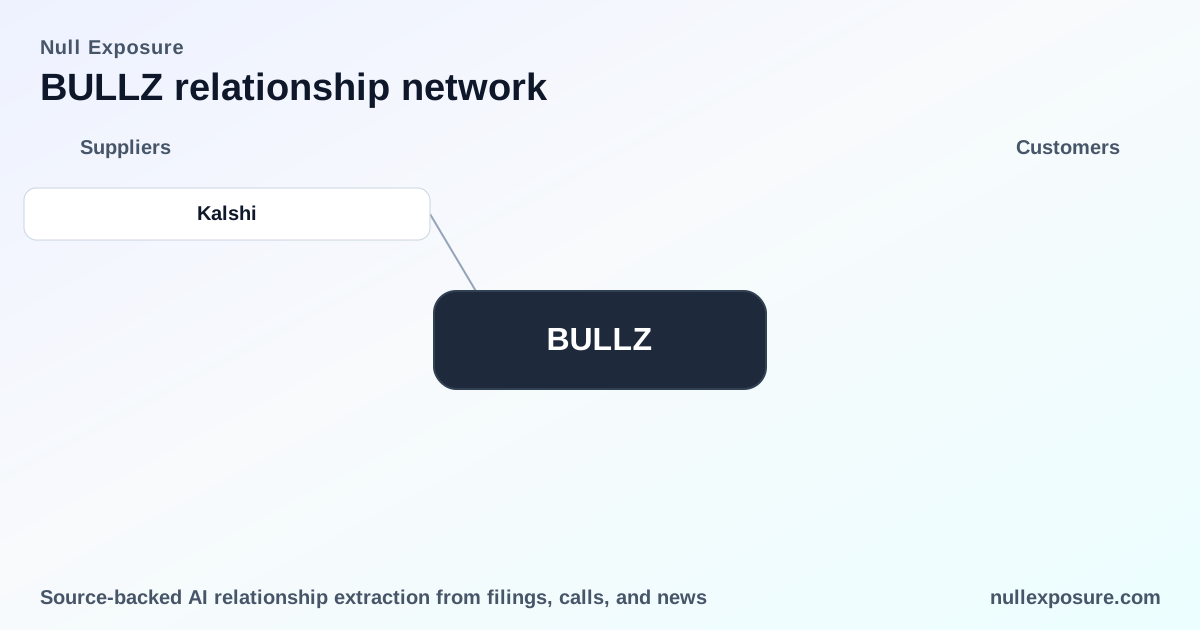
The dataset returned a single supplier relationship entry for BULLZ. Below I cover that relationship in context and cite the public reference used to surface it.
Kalshi — prediction markets and hourly crypto/Fed contracts
Webull expanded an existing partnership with Kalshi to add cryptocurrency hourly contract trading and Federal Reserve event trading to Webull’s prediction markets offering, increasing product breadth for active users. A news item covering Webull’s second-quarter 2025 financial commentary reported that the expansion occurred in June and was positioned to provide users with increased access to rapidly growing U.S. asset classes. This was reported in a StockTitan news summary published March 9, 2026, describing Webull’s Q2 2025 results.
Source: StockTitan news report summarizing Webull’s Q2 2025 financial commentary (published March 9, 2026).
Operational constraints and company-level signals
The records provided did not include supplier-specific contractual constraints. As a company-level signal, that absence is meaningful: no supplier contract cliffs, cure periods, collateral demands, or supply caps were captured in this feed, which indicates either the relationships are commercial and non-proprietary, or that explicit contract metadata was not disclosed in the referenced public materials.
From the data and Webull’s business posture we can derive the following operating model characteristics:
- Contracting posture: transactional and modular. Webull sources niche products from regulated venues (Kalshi) rather than building bespoke internal alternatives, which accelerates go-to-market but leaves pricing and product control partly to partners.
- Concentration: low single‑supplier concentration in product scope, based on the presence of distribution partnerships rather than critical infrastructure suppliers. Prediction-market partners are additive rather than singular gatekeepers for core execution services.
- Criticality: medium to low for core brokerage operations but high for specific product lines. Prediction-market capacity drives engagement among a subset of active traders but does not replace clearing, custody, or core market connectivity.
- Maturity: partnerships are in early/expansion stages. The Kalshi extension in June (as reported) shows an active rollout of adjacent products, consistent with a growth-oriented partnership playbook.
If you want a deeper supplier risk profile and contract-level visibility, start here: https://nullexposure.com/.
What investors and operators should take away
- Product partnerships are a deliberate strategy to increase trade frequency and diversify revenue per user. Integrating third‑party venues like Kalshi lets Webull offer differentiated short-duration products without internal development cycles.
- Supplier risk is concentrated in commercial execution, not in platform core. A partner’s regulatory posture or product delisting would affect particular product lines (e.g., prediction markets, Fed-event contracts) more than overall brokerage operations.
- Financial impact is tactical rather than structural. These partnerships drive engagement and incremental transaction revenue; they do not substitute for payments-for-order-flow or margin interest as primary revenue drivers.
Mid-analysis action: if you’re modeling supplier exposure by revenue buckets or mapping third‑party product risk across trading volumes, start a supplier audit at https://nullexposure.com/.
Closing assessment and next steps
Webull’s move to expand Kalshi-based products is a textbook example of a trading platform outsourcing niche market creation to regulated specialists to accelerate product breadth. For investors, the key metric to track is engagement uplift from these product launches (trades per user and churn) rather than the supplier contract terms themselves. For operators, the immediate priorities are ensuring UX integration, routing reliability, and contingency plans if a partner changes listing status or product cadence.
For a pragmatic supplier due-diligence checklist and to map partner criticality across revenue streams, see https://nullexposure.com/.
Acknowledgement of sources: the supplier relationship was surfaced through a March 9, 2026 StockTitan news item summarizing Webull’s Q2 2025 results, which stated the June expansion of the Kalshi partnership to include cryptocurrency hourly contracts and Fed events trading.