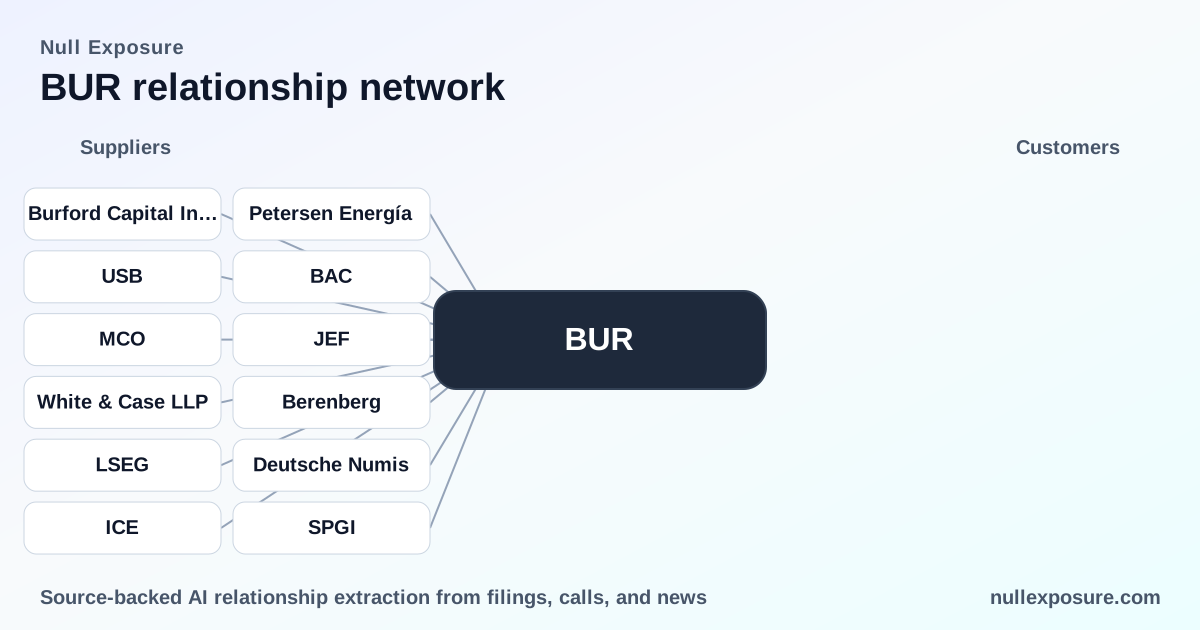
Burford Capital (BUR) — Supplier relationship map and investor takeaways
Burford Capital underwrites and finances commercial litigation outcomes, monetizing through direct investment returns on funded claims, asset-management fees from private funds, and balance-sheet financing (including senior notes) that leverages capital-market access. The company’s economics depend on three axes: the performance of funded legal assets, cost and stability of marketed debt, and the operational capacity of its investment management and legal-advisory partners. For investors evaluating supplier risk, the current feed shows a deliberate mix of large capital markets intermediaries, ratings agencies, a trustee and specialist legal counsel that together support Burford’s funding and distribution model. For a mapped view of Burford’s partner network, visit https://nullexposure.com/.
Why the partner list matters: a quick investment frame
Burford’s supplier set is not incidental — it is structural. Brokers and bookrunners underwrite liquidity and pricing for debt, trustees and counsel govern covenants and enforceability, and ratings agencies influence funding spreads. That configuration determines both cost of capital and operational resilience when individual legal assets are illiquid for extended periods. The relationships disclosed in the most recent media and filings signal that Burford runs a capital-markets-forward contracting posture with broad institutional counterparties rather than ad-hoc boutique funding channels.
For institutional diligence, note three company-level signals in the disclosures: there are no supplier-specific contractual constraints surfaced in the provided feed, Burford consistently uses major global brokers and trustees for debt issuance, and the firm’s asset-management arm is registered in the U.S., which anchors regulatory oversight of its fund operations. Explore a supplier risk scorecard at https://nullexposure.com/.
Each partner and why it matters to an investor
Petersen Energía
Burford purchased distressed claims from bankrupt Petersen Energía for roughly €15 million, positioning the company to capture outsized recoveries on that exposure. This is a direct illustration of Burford’s claims-acquisition strategy. (Finviz report, March 2026: https://finviz.com/news/246155/burford-capital-limited-bur-a-bull-case-theory)
BofA Securities
BofA Securities is disclosed repeatedly as a joint broker on Burford’s capital-market communications and senior-note activity, underpinning distribution and pricing for debt offerings. (Reuters/Stockopedia coverage of Burford annual results and debt activity, Jan–Feb 2026)
Jefferies International Limited
Jefferies acts as a joint broker alongside other houses on Burford transactions, supporting syndication and market outreach for equity and debt placement. (Reuters/Stockopedia coverage of Burford annual results and debt activity, Jan–Feb 2026)
Berenberg
Berenberg is listed as a joint broker on Burford’s senior notes activity and appears on announcement filings, indicating participation in primary-market execution for the company’s bond issuance. (Reuters/TradingView coverage of private offering and pricing, Jan 2026)
Deutsche Numis
Deutsche Numis functions as Burford’s NOMAD and joint broker on London-market matters, reflecting the company’s dual-listing and U.K. regulatory interface. (Reuters/TradingView and Research-Tree reporting on FY2026 results and corporate listings)
S&P Global (S&P)
S&P is cited in Burford’s filings as having upgraded Burford’s credit outlook in 2025, a development that materially improves debt-market access and reduces funding spreads. (SEC 10‑K reporting summarized via TradingView, FY2026)
Moody’s
Moody’s is likewise noted for rating actions in 2025 that supported Burford’s credit profile, reinforcing improved financing flexibility for the group. (SEC 10‑K reporting summarized via TradingView, FY2026)
Burford Capital Investment Management LLC
Burford Capital Investment Management LLC is the fund manager for Burford’s private funds and is registered as an investment adviser with the U.S. SEC, supplying the regulated vehicle through which institutional capital is managed. (Research-Tree summary of Burford FY2026 filings)
U.S. Bank Trust Company
U.S. Bank Trust Company serves as trustee under Burford’s indenture governing senior notes, which is central to covenant enforcement and investor protections on Burford’s bond liabilities. (TradingView coverage of indenture signing, FY2026)
White & Case LLP
White & Case acted as legal adviser to the syndicate on a US$500 million senior notes offering, evidencing reliance on global law firms for transactional and documentation work central to debt issuance. (White & Case press release on counsel role, FY2026)
London Stock Exchange (LSE)
Burford is publicly traded on the London Stock Exchange, supporting AIS/market access and regulatory visibility for U.K.-based investors. (Research-Tree coverage of dual-listing, FY2026)
New York Stock Exchange (NYSE / ICE)
Burford’s listing on the New York Stock Exchange anchors its U.S. public-market profile and liquidity for North American investors. (Research-Tree coverage of dual-listing, FY2026)
(Each relationship above is cited from the corresponding press coverage and filings reported in early 2026.)
What the relationship list implies about Burford’s operating constraints
The disclosures in these sources flag several company-level operating characteristics that investors must treat as constraints on value creation:
- Contracting posture — capital-market dependent. Burford’s funding cadence is explicitly channeled through large brokers, trustee arrangements and rated debt, which makes access to wholesale markets a gating factor for growth and portfolio deployment.
- Concentration — diversification across capital providers but reliance on major banks. Multiple global brokers reduce single-counterparty risk, but the firm remains exposed to the functioning of structured debt markets.
- Criticality — ratings and legal counsel are operationally material. Upgrades from Moody’s and S&P materially alter funding economics; legal counsel and trustees are critical for enforceability and bondholder protections.
- Maturity — institutionalized relationships. The mix of long-standing brokers, a major trustee, and an in-house registered investment manager signals a mature capital markets program rather than an emergent funding model.
No supplier-specific contractual constraints were included in the provided feed, which itself is an operational signal about disclosure scope rather than supplier flexibility.
For a detailed supplier risk profile tied to capital-markets counterparties, see our mapping tools at https://nullexposure.com/.
Bottom line for investors and operators
Burford’s partner set is purpose-built for scale: institutional brokers distribute debt, ratings agencies compress spreads when positive, trustees and top-tier counsel secure documentation, and an SEC‑registered manager governs private fund flows. Those relationships materially lower execution risk on capital raises but concentrate counterparty exposure on the large banks and the functioning of debt markets.
Key investor actions:
- Monitor changes in broker syndicates and trustee arrangements as leading indicators of funding cost and structural covenant shifts.
- Track rating agency actions closely; upgrades and downgrades will translate directly to debt servicing economics.
- Scrutinize material claims acquisitions (such as the Petersen Energía exposure) because underwriting risk drives asset volatility and cash-flow timing.
Bold takeaway: Burford’s operational resilience rests as much on its supplier ecosystem — banks, trustees, ratings agencies and legal counsel — as on the forensic diligence of individual legal claims. For institutional-grade supplier intelligence and to track how these relationships evolve alongside filings and market activity, visit https://nullexposure.com/.