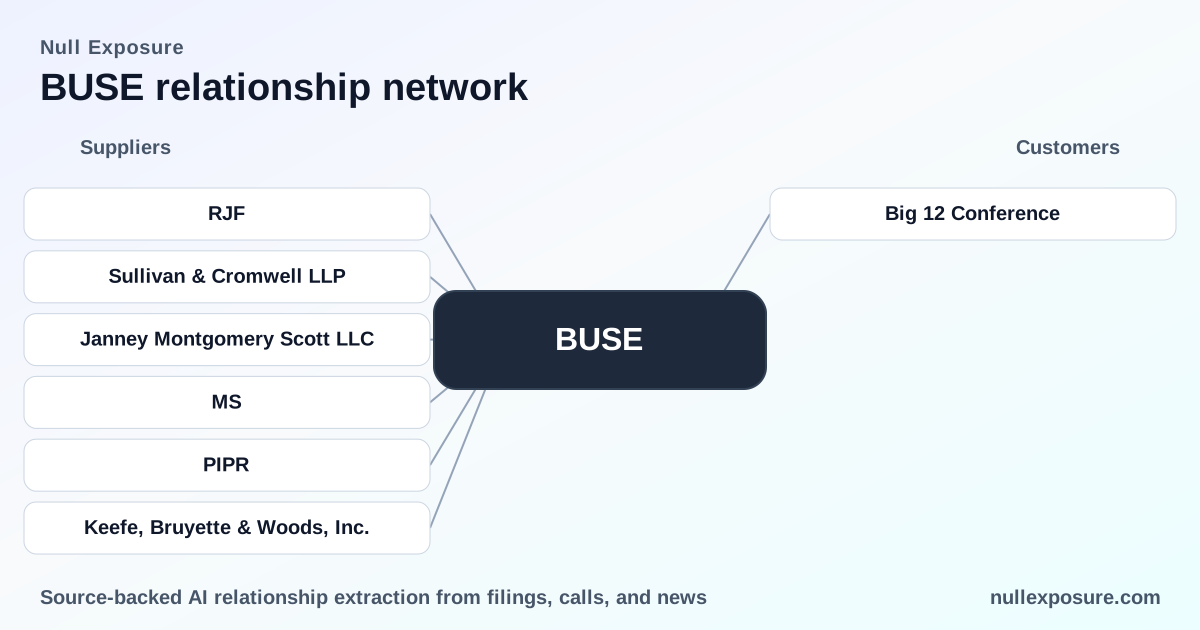
Busey (BUSE) — how its supplier and advisor network underpins execution and capital strategy
First Busey Corporation operates as a regional banking holding company, generating revenue through retail and commercial banking—interest income on loans and deposit spreads, plus fee-based services—and monetizes growth via M&A and capital markets transactions that expand its franchise. For investors evaluating counterparty risk and execution capacity, Busey’s choice of financial advisors, legal counsel and underwriting partners provides a clear signal about deal sophistication and access to capital. Learn more about how these supplier relationships show up in public filings and press releases at https://nullexposure.com/.
The quick investor thesis: structure, scale, and where value is captured
Busey is a regional bank headquartered in Champaign, Illinois with FY running revenue of $666.8 million and a market cap near $2.16 billion. The company’s operating profile combines core banking margins with episodic capital-market-dependent events—M&A and depositary-share issuances—that require external specialists. These specialists translate into two investor-relevant truths: (1) access to top-tier capital markets and advisory talent reduces execution risk on transactions; (2) reliance on third-party service providers creates an operational and cyber‑risk vector that must be monitored.
Company disclosures explicitly state the firm’s approach to third‑party oversight: "Performing due diligence with respect to third‑party service providers, including their cybersecurity practices, and requiring contractual commitments from Busey’s service providers to take certain cybersecurity measures." This is a company-level control signal that Busey contracts for defensive controls and legal protections with suppliers.
What the public record shows about Busey’s supplier relationships
Raymond James & Associates, Inc.
Raymond James served as financial advisor and provided a fairness opinion to Busey’s board in the CrossFirst partnership announcement. According to a GlobeNewswire press release tied to the CrossFirst transaction (published August 27, 2024), Raymond James advised Busey and delivered a fairness opinion to the board. This indicates Busey leverages national advisory boutiques for strategic transactions.
Sullivan & Cromwell LLP
Sullivan & Cromwell acted as legal counsel to Busey in the CrossFirst announcement. The same August 27, 2024 GlobeNewswire release lists Sullivan & Cromwell as Busey’s legal counsel, signaling reliance on established national law firms to manage transactional and regulatory legal risk.
Janney Montgomery Scott LLC
Janney participated as a co‑manager on a depositary share offering in 2025. A GlobeNewswire release dated May 14, 2025 describes Janney Montgomery Scott acting as a co‑manager on Busey’s depositary share offering, reflecting the bank’s use of regional broker‑dealers to broaden distribution for capital raises.
Morgan Stanley & Co. LLC
Morgan Stanley served as a joint bookrunner on Busey’s May 2025 depositary share offering. The May 14, 2025 GlobeNewswire pricing announcement lists Morgan Stanley among the joint bookrunning managers, demonstrating Busey’s ability to secure tier‑one investment bank distribution on capital markets transactions.
Piper Sandler & Co.
Piper Sandler functioned as a joint bookrunner on the 2025 offering, indicating active syndicate leadership. The same May 14, 2025 announcement shows Piper Sandler named as a joint bookrunner alongside Morgan Stanley and Keefe, Bruyette & Woods, which is consistent with using regional and national firms together to place securities.
Keefe, Bruyette & Woods, Inc.
Keefe, Bruyette & Woods participated as a joint bookrunner for the depositary share deal, contributing sector‑specialized underwriting capability. GlobeNewswire’s May 14, 2025 disclosure includes KBW among the joint bookrunners, reinforcing the point that Busey assembles syndicates with banks experienced in financial‑sector offerings.
Why these relationships matter for investors (and what to watch)
Busey’s roster of advisors and underwriters reflects a dual strategy: combine national banks and boutique regional firms to secure both distribution muscle and sector expertise. That strategy has predictable effects:
- Execution: Using Morgan Stanley and Raymond James increases probability of successful deal execution and market access, helping Busey push capital transactions at scale and on favorable terms.
- Legal and regulatory defense: Engaging Sullivan & Cromwell signals conservative legal management for complex transactions, reducing frictions during regulatory review or integration.
- Distribution diversification: A mixed syndicate (Piper Sandler, KBW, Janney) broadens investor reach and reduces single‑counterparty concentration in offerings.
At the same time, the company‑level requirement for third‑party cybersecurity commitments is materially relevant: consistent contractual controls reduce systemic operational risk but create a monitoring burden—investors should treat vendor oversight as a continuous risk factor, not a one‑time checkbox.
Explore relationship mapping and transaction history in more depth at https://nullexposure.com/ to assess counterparties and concentration.
Practical risk checklist for portfolio managers
Consider the following monitoring items when sizing or re‑underwriting a position in Busey:
- Counterparty concentration: track repeat business with the same underwriters and advisors to detect increasing single‑firm exposure.
- Execution dependence: evaluate how frequently Busey requires external fairness opinions or underwriting to complete strategic moves.
- Legal/regulatory posture: review counsel selection and the firm’s track record on regulatory approvals following M&A.
- Third‑party operational risk: verify contractual cybersecurity commitments and evidence of ongoing due diligence; this is a clear company disclosure and should be tested in diligence.
- Market‑sensitivity of capital raises: monitor timing and pricing of depositary share issuances against interest‑rate and deposit trends.
All of these items materially affect downside protection and liquidity strategy for investors.
How to use this supplier map in your investment process
For investors and operators, the disclosed supplier set is actionable: treat advisory and underwriting partners as extensions of management’s execution capacity. If a future offering lists the same joint bookrunners and counsel, infer continuity of execution and similar pricing leverage. Conversely, a sudden shift to less‑established firms would warrant closer scrutiny.
If you want a consolidated view of Busey’s counterparties and press‑release evidence for each transaction, review the sourced records and relationship timelines at https://nullexposure.com/ and incorporate that into your valuation or operational due diligence.
Final call to action
Busey’s choice of advisors and underwriters is a leading indicator of how the company will fund growth and manage regulatory complexity; track these suppliers as part of any position monitoring. For a deeper, transaction‑level view and ongoing supplier signal coverage, visit https://nullexposure.com/ and subscribe for updates.