First Busey Corporation (BUSEP): Capital markets counterparties and what they tell investors
First Busey Corporation operates as a regional bank holding company that earns through net interest margin on loans and securities, plus fee income from retail and commercial banking services. The company supplements core balance-sheet funding with occasional capital markets transactions — for FY2025 that included a depositary share offering — and uses underwriters and co-managers to place that paper. Understanding who Busey hires to execute market financings is a direct signal of its access to capital, pricing flexibility, and market standing. For a concise supplier-risk view of Busey and its counterparties, visit https://nullexposure.com/.
What the recent bookrunners reveal about Busey's capital strategy
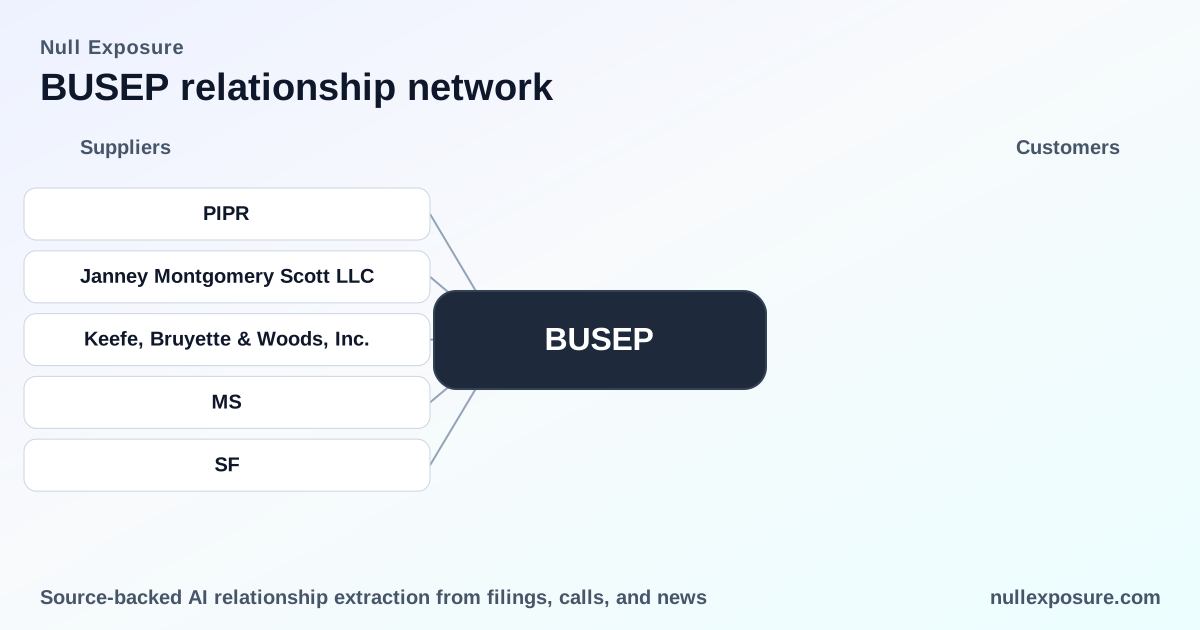
Busey’s FY2025 depositary share offering was underwritten by a mix of national and specialist banks. That mix — bulge‑bracket distribution muscle combined with regional investment-banking relationships — signals a deliberate approach to diversify syndicate roles and avoid over-reliance on any single intermediary.
Using multiple joint bookrunning managers and a co‑manager is consistent with a transactional contracting posture for capital raises (deal-by-deal engagement rather than long-term exclusivity). This reduces counterparty concentration but also distributes execution fees across participants. For investors, the immediate implication is preserved access to institutional capital markets with moderate counterparty complexity, rather than a structural dependency on one large underwriter.
If you want a deeper supplier-risk breakdown and counterparty mapping for Busey, see additional analysis at https://nullexposure.com/.
The counterparties on the FY2025 deal — firm-by-firm
Piper Sandler & Co.
Piper Sandler served as a joint bookrunning manager for Busey’s depositary share offering in FY2025, placing it among the lead underwriters responsible for distribution and pricing. This involvement indicates Piper Sandler’s role as a primary placement agent for regional-bank capital raises (GlobeNewswire, May 14, 2025).
Morgan Stanley & Co. LLC
Morgan Stanley acted as a joint bookrunning manager on the same offering, providing national distribution and institutional placement capability that complements regional underwriters’ retail channels. The engagement confirms Busey’s access to top-tier institutional investors for FY2025 issuance (GlobeNewswire, May 14, 2025).
Keefe, Bruyette & Woods, Inc.
Keefe, Bruyette & Woods participated as a joint bookrunning manager, leveraging its sector-focused coverage of regional banks to support the transaction’s placement and pricing. KBW’s role underscores Busey’s use of bank-focused specialists in constructing the syndicate (GlobeNewswire, May 14, 2025).
Janney Montgomery Scott LLC
Janney acted as a co-manager on the deal, handling secondary distribution and retail intermediary functions that help broaden investor reach beyond primary institutional buyers. Janney’s co-manager position reflects a complementary, execution-focused part of the syndicate rather than lead underwriting responsibility (StockTitan reporting, March 9, 2026; GlobeNewswire, May 14, 2025).
Constraints and what the available data implies
The supplier-relationship feed for Busey contains no explicit constraint excerpts (no recorded contractual constraints, termination clauses, or vendor-specific limitations surfaced in the provided results). That absence is a company-level signal: there is no evidence in this set of material supplier constraints restricting Busey's use of these underwriters. Interpreting that negatively or positively requires care — the lack of constraint data is not the same as a formal statement of flexibility — but on balance it indicates that the FY2025 financing executed under ordinary market terms without publicly disclosed vendor-imposed operational covenants.
From an operating-model perspective:
- Contracting posture: episodic and deal-oriented for capital markets work; Busey engages multiple underwriters per transaction rather than a single preferred bookrunner.
- Concentration: low on underwriting concentration for this deal because several managers and a co‑manager participated.
- Criticality: underwriting relationships are strategically important for capital access but not operationally critical to day-to-day banking services; they become critical at the moment of issuance.
- Maturity: involvement of established firms (Morgan Stanley, Piper Sandler, KBW, Janney) indicates mature capital‑markets access and institutional relationships that support repeat issuance capacity.
Investment implications and a short risk checklist
Busey’s FY2025 financing syndicate composition carries practical signals for investors and operators:
- Access to broad distribution: Inclusion of Morgan Stanley and Piper Sandler gives Busey national institutional reach, which supports favorable pricing and placement for future issuances.
- Sector alignment: KBW’s presence confirms sector expertise during execution — valuable when investor appetite for regional-bank paper is variable.
- Retail/institutional mix: Janney’s co-manager role helps fill retail and regional channels, improving demand diversification at bookbuilding.
- Low supplier concentration risk for financing: multiple managers reduce the operational risk of a single counterparty failure during an offering.
- Event-driven criticality: underwriting relationships are crucial around capital raises but do not create day-to-day vendor lock-in.
Quick financial context from corporate reporting: Busey reported roughly $666.8 million in trailing revenue, a profit margin of about 20.3%, and a dividend of $1 per share (yield ~3.89%) — metrics that support the company’s demonstrated ability to access capital markets when needed. Use these facts to calibrate the cost-of-capital trade-offs when assessing future financing needs.
- Key risks to monitor:
- Market conditions that tighten institutional demand for regional-bank paper.
- Changes in syndicate composition that concentrate execution risk.
- Shifts in regulatory capital requirements that increase issuance frequency or volume.
For an expanded supplier map and ongoing monitoring of Busey's counterparty exposure, explore our platform at https://nullexposure.com/.
Bottom line for investors and operators
The FY2025 depositary share offering shows Busey executes capital raises with a diversified syndicate combining national and bank-focused underwriters, which preserves market access while minimizing single-counterparty exposure. These are characteristics consistent with a regional bank that runs a balanced capital strategy: tap national distribution for scale, use specialists for sector pricing insight, and engage co-managers to broaden retail reach.
For portfolio managers, this structure reduces specific underwriter concentration risk while preserving the company’s ability to raise capital efficiently. For operators, it confirms that Busey’s capital-raising playbook is transaction-driven, leveraging mature market relationships rather than exclusive bilateral dependencies.
If you need a tailored supplier-risk assessment or want alerts when Busey engages new counterparties, start here: https://nullexposure.com/.