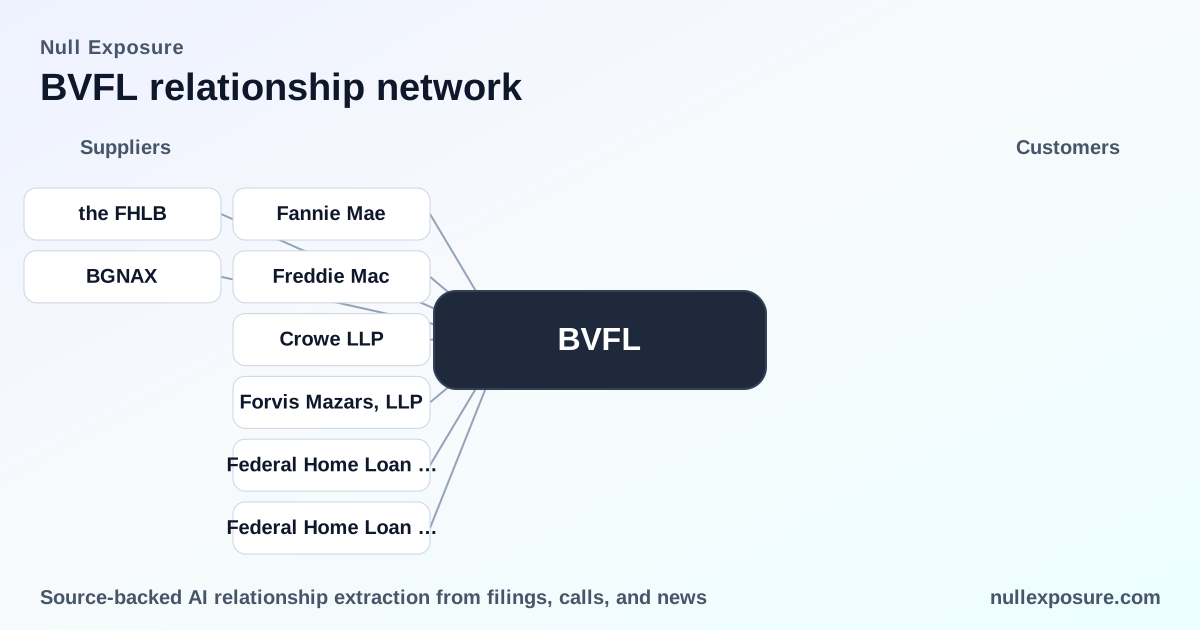
How BV Financial makes money and who supplies the rails
BV Financial, Inc. is the holding company for BayVanguard Bank and generates revenue principally from traditional regional bank activities: interest income on originated and purchased loans, fees, and securities investment returns. The bank uses a mix of on‑balance sheet lending, purchased loan participations, and mortgage‑backed securities to monetize regional mortgage flows, while financing gaps are managed through Federal Home Loan Bank advances and subordinated notes. For investors evaluating supplier and counterparty risk, the relevant picture is one of concentrated regional credit exposure, recurring long‑dated funding, and standard banking relationships with government‑sponsored agencies and accounting firms. For a deeper supplier-risk view, visit https://nullexposure.com/.
Why this matters to investors: counterparties determine funding cost, liquidity flexibility, and audit/governance assurance—each of which drives BV Financial’s operating margins and valuation multiple.
Why the supplier list matters to BV Financial’s risk profile
BV Financial runs a conservative, relationship-based model: mortgage securities are held with explicit agency guarantees, liquidity is supported through Federal Home Loan Bank lines, and financial reporting oversight is transitioning between established audit firms. These relationships are operationally critical — they influence BV Financial’s funding cost, regulatory standing, and investor confidence — and they are largely mature and long‑term in nature.
Visit https://nullexposure.com/ for practical supplier risk benchmarking and independent counterparty analysis tools.
Every relationship cited in the record — one by one
Fannie Mae
BV Financial holds mortgage-backed securities that are guaranteed by Fannie Mae, which transfers credit risk on those securities away from the bank and into the GSE guarantee. This is documented in BV Financial’s 2024 Form 10‑K noting that mortgage securities are guaranteed by Freddie Mac, Fannie Mae or Ginnie Mae (Form 10‑K 2024).
Freddie Mac
Mortgages and mortgage-backed securities on BV Financial’s balance sheet carry guarantees from Freddie Mac, providing credit support and standardizing valuation and liquidity treatment for agency MBS in the bank’s portfolio (BV Financial 2024 Form 10‑K).
Ginnie Mae
BV Financial’s disclosure lists Ginnie Mae as a guarantor for certain mortgage-backed securities, which is important because Ginnie‑guaranteed MBS have full faith and credit backing and different servicing/liquidity dynamics versus GSE‑guaranteed paper (BV Financial 2024 Form 10‑K).
Crowe LLP
BV Financial’s Audit Committee approved Crowe LLP as the new independent registered public accounting firm, effective for the fiscal year ending December 31, 2026; the change was disclosed in an 8‑K reported to markets in March 2026 (8‑K filing reported on StockTitan, March 2026).
Forvis Mazars, LLP
BV Financial’s Audit Committee dismissed Forvis Mazars, LLP as its independent auditor effective upon completion of the audit for fiscal 2025 and the filing of the 2025 Form 10‑K; this transition was described in the same March 2026 8‑K (8‑K filing reported on StockTitan, March 2026).
Federal Home Loan Bank (generic)
BV Financial uses FHLB advances as a primary secured funding source; public filings and press releases note the bank’s use of Federal Home Loan Bank borrowings both to retire higher‑cost debt and to support liquidity (TradingView SEC filings and multiple press reports, FY2025–FY2026).
Federal Home Loan Bank of Atlanta
The company specifically replaced subordinated debt with $35.0 million in lower‑cost advances from the Federal Home Loan Bank of Atlanta, a move disclosed in Q4 earnings commentary and press releases in March 2026 (Yahoo Finance, AccessWire, The Globe and Mail, March 2026).
the FHLB (as referenced)
BV Financial reports a $162.5 million line of credit with the FHLB and a $20.0 million short‑term unsecured facility as part of its liquidity position in recent filings, underscoring a material reliance on these facilities for short‑to‑medium term funding flexibility (SEC 10‑Q commentary reported on TradingView, FY2025).
Sources for the above relationships include BV Financial’s 2024 Form 10‑K, the March 2026 8‑K (reported on StockTitan), and multiple March 2026 press reports and filing summaries on Yahoo Finance, AccessWire, TradingView and The Globe and Mail.
What the supplier and constraint signals mean for BV Financial’s operating model
The documented constraints form a concise profile of how BV Financial contracts and runs its business:
- Long‑term capital in place. The company issued fixed‑to‑floating subordinated notes due 2030, indicating durable subordinated capital on the balance sheet and a long‑dated creditor relationship (company disclosure excerpt).
- Regional lending footprint. BV Financial purchases loan participations secured primarily in Maryland, which concentrates credit exposure geographically and keeps underwriting and servicing localized (Form 10‑K excerpt).
- Outsourced service model. The bank outsources a majority of data processing and relies on unaffiliated brokers for a subset of originations (notably marine loans), indicating a service‑provider posture for certain operational functions and a mixed seller/buyer role in loan participations.
- Material borrowing band. Borrowings and funding relationships fall into a $10M–$100M scale band; public filings reference total borrowings and specific advance programs consistent with that spend and funding profile.
Together these signals indicate a mature, relationship‑driven operating model with concentrated regional credit, third‑party service dependency for non‑core functions, and long‑dated funding instruments that dampen short‑term funding volatility but concentrate refinancing risk into specific maturities.
Investment implications and recommended actions
- Funding flexibility is the key near‑term driver. The replacement of subordinated debt with lower‑cost FHLB advances should lower interest expense and improve operating leverage; monitor FHLB access and advance pricing as liquidity risk indicators (press commentary March 2026).
- Audit transition is governance‑relevant. The switch from Forvis Mazars to Crowe LLP is material for investor due diligence; auditors influence financial disclosure cadence and market confidence—review subsequent 8‑K and Form 10‑K filings for the completed auditor’s report (8‑K, March 2026).
- Concentration risk is real. Heavy Maryland loan participation sourcing and reliance on agency MBS guarantees mean credit performance will be sensitive to regional economic trends and national mortgage policy changes; include regional stress cases in scenario analyses.
For a targeted supplier‑risk scorecard and ongoing counterparty monitoring, check our platform: https://nullexposure.com/.
If you are actively evaluating BV Financial for investment or vendor due diligence, prioritize review of the 2025 Form 10‑K (post‑auditor change) and the bank’s detailed FHLB advance schedules in quarterly filings to quantify funding cost and maturity concentration.
For bespoke counterparty intelligence or to run a supplier concentration assessment for your portfolio, start here: https://nullexposure.com/.