Bioventus (BVS) — supplier exposure, contractual levers, and what investors should watch
Bioventus monetizes by developing and commercializing products that accelerate the body's natural healing—principally hyaluronic acid (HA) and related orthobiologic treatments—sold through a global commercial footprint and produced largely by third‑party manufacturers. Revenue is driven by repeatable product volumes under long-term supply relationships and distributor/reseller channels; margins and continuity hinge on a concentrated set of manufacturing partners and multi‑year purchase commitments. For investors and operators, the immediate question is not whether Bioventus has customers, but whether its supplier structure creates operational dependency and margin vulnerability. For a consolidated view of counterparties and to benchmark supplier concentration across your portfolio, visit https://nullexposure.com/.
Why supplier contracts matter to Bioventus' economics
Bioventus' gross profit and operating margin profile are directly linked to the stability of its supplier base. Company disclosures show that key products and components are produced under multi‑year, single‑source supply agreements that include annual minimum purchase commitments and rolling forecasts. Those contracting terms create two structural features:
- Predictable volume commitments that support scale and unit economics when demand is stable, because suppliers plan capacity around guaranteed minimums.
- Operational leverage that becomes a liability when demand softens or when suppliers face disruptions: minimum purchases force purchases or renegotiation, and single-source arrangements limit tactical switching.
Bioventus discloses long-term supply commitments that include automatic renewal provisions—examples include a 10‑year minimum purchase schedule for a three‑injection OA product with automatic five‑year renewal, and an eight‑year horizon for a five‑injection product amended in December 2020. These contractual features create durable supplier relationships but also raise concentration and renewal risk in the medium term (company filings, 2024). If you underwrite Bioventus, build scenarios that stress minimum‑purchase clauses and model their margin impact.
Geographic and concentration dynamics that shape risk
Bioventus operates a globally distributed manufacturing and supplier network. The company reports suppliers and facilities outside the US, including Israel, and sources components from Japan, Switzerland, Sweden, and the United States. That pattern creates a dual exposure:
- Geographic diversification across EMEA/APAC/NA supports resilience to localized outages and regulatory variation, yet it introduces logistics, foreign regulatory and currency complexity.
- Intense supplier concentration: the top three single‑source third‑party manufacturers accounted for 46%, 43% and 42% of net sales in 2024, 2023 and 2022, respectively (company filings). That level of concentration is material to both production continuity and negotiating leverage.
Because these manufacturers supply finished HA products, the relationship role is manufacturer and the product exposure is critical to revenue generation. Investors should treat supplier continuity as an operational KPI on par with sales growth and gross margin.
For a quick comparative screening of supplier concentration across peers, check https://nullexposure.com/ to see how Bioventus stacks up.
Contracting posture and commercial maturity
Bioventus' supplier relationships are not short‑term transactional buy/sell arrangements. The company’s language describes multi‑year agreements, minimum order volumes, and forecasting obligations, indicating a contracting posture that is intentionally long‑dated and capacity‑anchored. That gives Bioventus planning visibility and cost predictability when demand forecasts are accurate, but it also means renewal cycles and forecasting accuracy are gating items for operations and investment performance.
From an investor perspective, the maturity of these arrangements is a mixed signal: maturity reduces near‑term supplier risk but concentrates negotiation risk at renewal points (for example, once the initial 8–10 year windows end or enter automatic renewals). Monitor contract expiry schedules, historical renewal outcomes, and any capex or inventory build that hedges supplier risk.
The practical risk checklist for investors and operators
- Concentration: Top three manufacturers account for nearly half of sales—this is a primary operational risk.
- Contractual rigidity: Minimum purchase obligations and forecast requirements create downside exposure in demand shocks.
- Geographic complexity: Cross‑border production reduces single‑jurisdiction risk but increases supply‑chain fragility.
- Supplier role criticality: Suppliers are manufacturers of finished goods, not commodity input vendors—switching costs are high.
Operationally, management levers include multi‑sourcing initiatives, strategic inventory, and renegotiation at renewal windows. From a valuation lens, embed a premium for supplier disruption risk into downside scenarios.
All identified counterparty relationships (complete list)
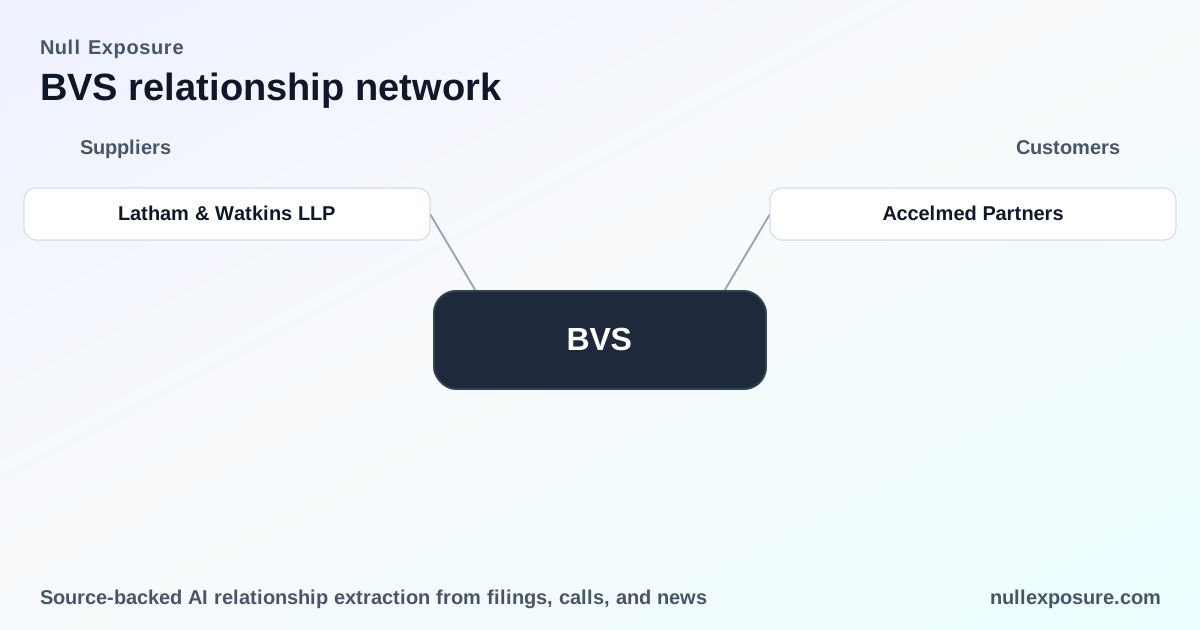
- Latham & Watkins LLP — Latham & Watkins represented Bioventus in its initial public offering; the firm’s announcement on the 2021 offering lists counsel team members involved in the transaction (Latham & Watkins news release, 2021: https://www.lw.com/en/news/2021/02/latham-watkins-advises-bioventus-initial-public-offering). This is a legal advisory relationship tied to capital markets activity rather than product supply.
What this means for valuation and monitoring
The interplay of high supplier concentration, long-term minimum purchase contracts, and global manufacturing footprint creates a distinct risk profile that should be explicitly modeled:
- Base case: assume steady demand and continued supply under current contracts—this supports current margins and the forward PE implied by sell‑side targets.
- Stress case: model partial supplier disruption or demand shortfall that forces inventory write‑downs or suboptimal purchasing to honor minimums—this compresses gross margin and could materially affect free cash flow given the concentration metrics disclosed.
For portfolio managers and operations leads, the immediate actions are: obtain contract expiry calendars, quantify the financial impact of minimum purchase clauses under demand stress, and assess the timeline and cost to qualify alternate manufacturers. If you want a consolidated supplier-risk view across your holdings, visit https://nullexposure.com/ to compare exposures and contract types.
Bottom line and next steps
Bioventus' revenue model is durable so long as its concentrated manufacturing relationships remain intact and forecasting is accurate. The company’s supplier structure is a strategic asset when demand is stable and a material liability when it is not. Investors should treat supplier contracts as forward‑looking balance sheet items—tracking renewal windows, minimums, and supplier concentration is essential for realistic downside scenarios.
For a more detailed benchmarking of supplier concentration across healthcare suppliers and to prioritize due diligence steps, go to https://nullexposure.com/. Assess contract timetables, quantify downside purchase obligations, and require management to disclose contingency plans at the next investor update.