BorgWarner (BWA) — Supplier relationships and what they signal to investors
BorgWarner is a global automotive supplier that monetizes by designing, manufacturing and selling powertrain and electronics components to OEMs and adjacent industrial customers; revenue is generated through component sales, long-term supply agreements and engineering services, with scale reflected in roughly $14.3B of trailing revenue and a market capitalization near $11.1B. The company’s commercial model is driven by long-term contracting, global sourcing and sizeable committed spend on electronics, which together shape both topline durability and procurement risk exposure. For focused supplier intelligence on BorgWarner and comparable suppliers, visit https://nullexposure.com/.
What BorgWarner disclosed on the Q4 call — the headline
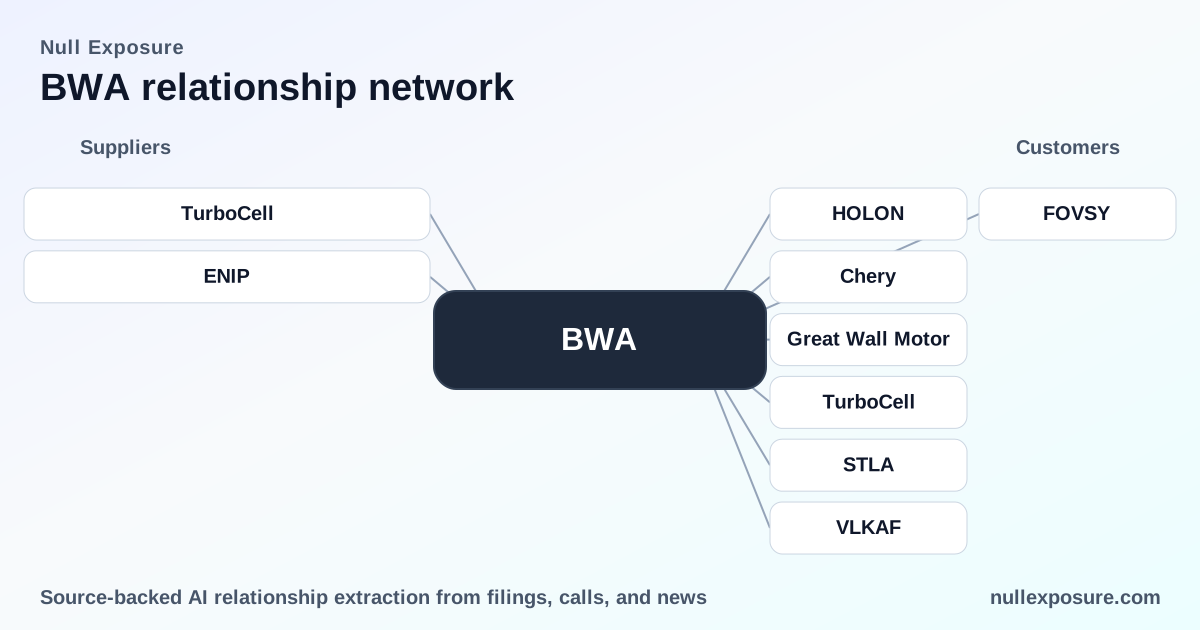
BorgWarner used its 2025 Q4 earnings call to disclose a new strategic supply relationship outside its traditional OEM base. The company announced a master supply agreement with TurboCell, a business unit tied to the data center infrastructure developer Endeavor, signaling BorgWarner’s push into non-automotive applications for its electronics portfolio. The disclosure was made on the quarter-end earnings call (reported 7 March 2026). According to the transcript, BorgWarner “has signed a master supply agreement with TurboCell, which is a subsidiary of data center infrastructure developer Endeavor.” (BorgWarner 2025 Q4 earnings call, 7 March 2026).
The relationships disclosed — straight to the point
TurboCell
BorgWarner signed a master supply agreement directly with TurboCell, establishing a supplier-customer relationship for electronics components or systems under a multi-year framework. This agreement positions BorgWarner to supply data center infrastructure components through TurboCell’s channel. (BorgWarner 2025 Q4 earnings call, 7 March 2026).
Endeavor (inferred ticker ENIP)
TurboCell is identified as a subsidiary of Endeavor, the data center infrastructure developer, which provides a corporate anchor and end-market context for the TurboCell engagement; BorgWarner’s counterparty relationship therefore dovetails with Endeavor’s business model. (BorgWarner 2025 Q4 earnings call, 7 March 2026).
How these disclosures slot into BorgWarner’s operating model
The new agreements and company disclosures map to several clear operating characteristics:
-
Contracting posture — long-term and deliberate. BorgWarner’s published disclosures indicate the firm relies on long-term contracts, cost‑sharing arrangements and design collaboration to control costs and secure supply. These are not transactional one-offs; they are structured arrangements that lock in engineering and purchase relationships. (Company disclosures as of Dec 31, 2025).
-
Spend scale and concentration — material committed outlays. BorgWarner reported approximately $180 million of contractual purchase commitments for certain electronics components through 2027, which places these supplier relationships firmly in a high spend band and implies relatively high vendor importance and exposure on those product lines. (Company disclosures as of Dec 31, 2025).
-
Geographic breadth — global sourcing footprint. The company explicitly states purchases of raw materials and components from many countries, indicating global supply chains and cross-border dependency that amplify geopolitical and logistics risk vectors. (Company disclosures).
-
Procurement posture — centralized and active. BorgWarner’s global procurement organization is oriented around cost reduction, lower‑cost geographies, supply-base optimization and dual sourcing where appropriate, signaling a mature, programmatic procurement discipline rather than ad-hoc buying. (Company disclosures).
Together these characteristics indicate a mature contracting approach with meaningful committed spend, global supplier exposure, and procurement capabilities designed to mitigate—but not eliminate—supply concentration and market risk.
Operational and investor implications
For investors evaluating counterparty and supply risk, the TurboCell/Endeavor engagement creates a few tangible lines of inquiry:
-
New end markets reduce cyclicality but introduce different counterparty risk. Supplying data center infrastructure diversifies demand away from automotive OEM cycles, which improves revenue mix resilience; however, the credit and concentration profile of large data center developers differs from automotive customers and requires separate counterparty diligence (contractual terms, termination rights, performance guarantees).
-
Committed electronics spend raises concentration sensitivity. The disclosed $180M of electronics purchase commitments through 2027 implies a non-trivial portion of BorgWarner’s procurement budget tied to electronics suppliers; any disruption in those supply chains or cost inflation in electronics will compress margins absent contractual pass-throughs. (Company disclosures as of Dec 31, 2025).
-
Global sourcing amplifies geopolitical and logistics channels. With materials and components sourced internationally, BorgWarner’s suppliers are exposed to trade policy, shipping congestion and raw material price cycles. The company’s procurement playbook (dual sourcing, cost sharing, design changes) mitigates but does not eliminate these macro risks.
-
Contract maturity provides visibility but also locked-in obligations. Long-term master agreements with entities like TurboCell give revenue visibility and engineering runway, but they also create fixed obligations and committed procurement that can limit near-term flexibility if market conditions shift.
What operators inside procurement and treasury should act on
-
Prioritize counterparty diligence on TurboCell and Endeavor: confirm contract terms, payment security, volume firming and termination provisions. The engineering and volume commitments embedded in a master supply agreement transfer execution risk to operations. (BorgWarner 2025 Q4 earnings call, 7 March 2026).
-
Reconcile committed spend against supplier diversification plans: the $180M commitment for electronics through 2027 should be mapped to supplier lists and alternate sources to quantify single‑supplier exposure and contingency capacity. (Company disclosures as of Dec 31, 2025).
-
Stress-test margin scenarios against electronics price inflation and logistics shocks given BorgWarner’s global sourcing posture and sizeable electronics commitments.
For ongoing supplier intelligence and comparative supplier profiles, see https://nullexposure.com/. For bespoke supplier risk reports tailored to procurement teams and investors, visit https://nullexposure.com/.
Bottom line — clarity for investors
BorgWarner’s Q4 disclosure of a master supply agreement with TurboCell (an Endeavor subsidiary) is a concrete signal of strategy: leverage electronics expertise into adjacent industrial end markets while relying on long-term contracting and significant committed procurement. That strategy enhances revenue diversification but raises procurement concentration and counterparty considerations tied to electronics supply and global sourcing. Monitor contractual terms, spend allocation, and the performance of TurboCell/Endeavor as early indicators of execution risk and margin impact. For regular updates and deep supplier relationship profiles, visit https://nullexposure.com/.