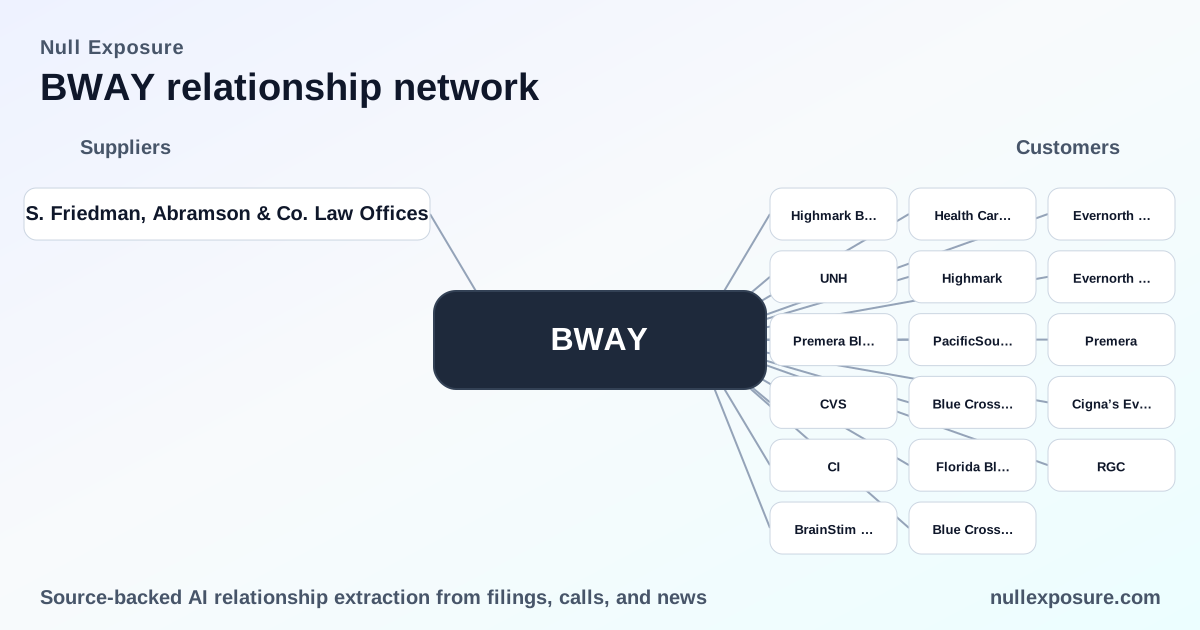
BrainsWay (BWAY) — legal and supplier relationships investors should price into the model
BrainsWay Ltd. commercializes non‑invasive neuromodulation systems and generates revenue from device sales, consumables, and follow‑on services while supplementing growth through strategic minority investments in adjacent care providers. Management monetizes core technology directly through hardware and service contracts and indirectly through targeted equity stakes and M&A activity, actions that require repeatable legal and transactional support and that influence counterparty risk and governance. For a concise investor view of the supplier footprint and transaction partners uncovered publicly, read on — or review broader supplier profiles at NullExposure.
Why supplier and advisor relationships matter for a med‑tech reseller and investor
BrainsWay operates at the intersection of regulated medical devices and clinical services: device sales drive near‑term revenue and gross margin, while international distribution, clinical partnerships, and minority investments expand addressable markets. Supplier and advisor relationships are thus double‑edged — they underpin regulatory compliance, channel rollout, and M&A execution, and they concentrate legal and operational risk when few counterparties cover large parts of a program.
From the company financials, BrainsWay reports modest EBITDA and high gross margins, consistent with a product‑plus‑service model; strategic advisors will therefore influence deal speed, contractual protections, and the cost of scaling in new jurisdictions. Investors should treat evidence of repeat counsel and transactional advisors as signals of an active corporate development program that is already on the company’s balance sheet (see the BrainStim investment referenced below). If you want a broader supplier lens on BWAY, visit NullExposure.
What the public record shows about BrainsWay’s supplier/advisor relationships
The public signals in our collection identify legal counsel involved in BrainsWay’s minority‑stake transactions. Each captured mention is summarized below with the original publisher noted.
-
Advocates Ami Hordes and Sarit Molcho of S. Friedman, Abramson & Co. Law Offices served as lead counsel for BrainsWay on the transaction with BrainStim and for the company’s prior minority‑stake investments, according to a company press release distributed by GlobeNewswire on Feb 19, 2026. Source: GlobeNewswire (Feb 19, 2026).
-
The same counsel role is republished by Bitget in March 2026, confirming the use of S. Friedman, Abramson & Co. as BrainsWay’s transaction counsel for the BrainStim minority investment. Source: Bitget (March 2026 republication).
-
A German edition of the GlobeNewswire release repeats that S. Friedman, Abramson & Co. acted as lead counsel on the BrainStim transaction, reinforcing that the company used specialized Israeli legal advisers for cross‑border investment work. Source: GlobeNewswire — German edition (Feb 19, 2026).
-
An additional GlobeNewswire distribution of the same press release (English) again attributes lead counsel responsibilities to S. Friedman, Abramson & Co., aligning multiple distributions around the single adviser engagement. Source: GlobeNewswire (Feb 19, 2026).
Takeaway: all publicly captured items point to a single, repeat legal adviser supporting BrainsWay’s minority equity transactions — an operational design choice that concentrates legal execution with a boutique firm experienced in the company’s deals.
What that pattern signals about operating posture and constraints
No explicit supplier constraints were reported in the collected material, so the following are company‑level signals inferred from the relationship pattern and financial profile rather than constraint excerpts.
-
Contracting posture: BrainsWay uses dedicated external counsel for transactional work, indicating a centralized contracting posture for M&A and minority investments that prioritizes legal continuity over multiple small‑firm engagements. This supports faster deal execution and consistent terms across investments.
-
Concentration: The recorded supplier profile is narrow — public coverage identifies a single law firm handling significant transactions — which creates concentration risk in legal execution and institutional knowledge. If the relationship is essential for cross‑border investments, any disruption could slow rollout or increase legal costs.
-
Criticality: Legal counsel is critical for cross‑border minority stakes and regulatory contracts in medical devices; having repeat counsel reduces execution friction but increases vendor dependence, a factor investors should price into scenario analyses for expansion and M&A cadence.
-
Maturity: The presence of repeated counsel on multiple minority investments is consistent with an active, maturing corporate development program rather than ad hoc partnerships; BrainsWay is executing repeatable investment plays alongside its commercial business.
These signals sit alongside BrainsWay’s financial profile — positive gross margins, modest EBITDA, and a high valuation multiple — suggesting that investors are pricing both growth optionality and execution risk into the stock.
If you want an expanded supplier risk assessment tailored to different scenarios (rapid M&A versus product‑led growth), get a deeper read at NullExposure.
How investors and operators should act on this information
-
For investors: price in execution concentration risk. The public record shows a single external counsel handling multiple deals; assume legal execution is a single line of failure when modeling time to close and legal fee volatility for future investments.
-
For operators: formalize backup counsel and process documentation. If legal advice and negotiating templates live with one firm, codify playbooks and negotiate SLAs or onboarding terms with alternative advisers to preserve deal cadence.
-
For governance teams: insist on board‑level reporting of advisor appointment policies for material transactions. Repeat engagements are efficient but require transparency on conflicts, fee structures, and independence.
Final read and next steps
BrainsWay’s publicly visible supplier footprint is concentrated and transactional — specialized legal counsel is central to the company’s minority‑investment strategy, and investors should treat that as both a strategic enabler and a vendor concentration risk. For a consolidated supplier and counterparty view across BrainsWay’s operations and to benchmark legal/advisor concentration against peers, visit NullExposure for a deeper supplier intelligence package.
If you want a short, actionable supplier risk brief for BWAY or comparable med‑tech names, NullExposure offers tailored reports and supplier mapping to support investment diligence: explore https://nullexposure.com/.