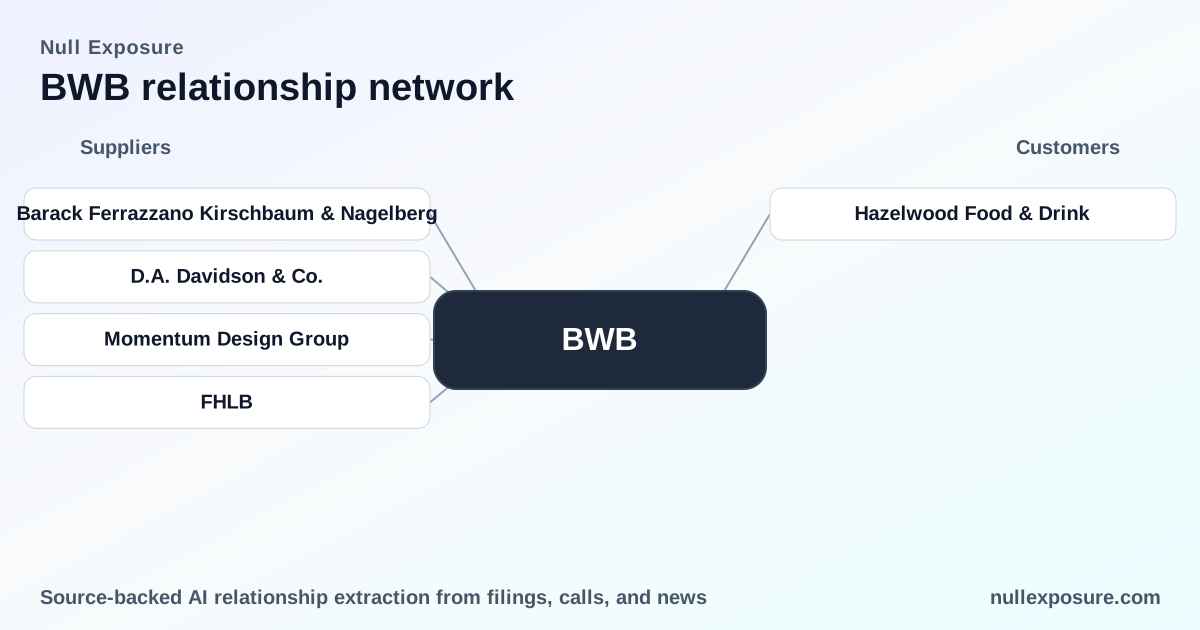
Bridgewater Bancshares (BWB): Supplier and Counterparty Map for Investors
Bridgewater Bancshares operates as the bank holding company for Bridgewater Bank, monetizing through traditional commercial banking channels: lending to commercial real estate investors, small businesses and high‑net‑worth clients, generating net interest income from deposit and loan spreads, and collecting fee income tied to servicing and deposit products. Critical to that cash flow are a small set of external suppliers and counterparties that support funding, legal/transaction execution, and physical branch operations. For investors evaluating counterparty concentration and operational risk, the supplier relationships below explain where Bridgewater outsources capability and where balance sheet dependency concentrates. Learn more at https://nullexposure.com/.
Quick read: the supplier posture that matters to returns
Bridgewater runs a lean vendor footprint for core functions while relying on large financial counterparties for liquidity and letters of credit and on third parties for legal, design and transaction advisory. This structure keeps operating leverage tight but creates concentrated counterparty exposure that can influence funding cost and operational resilience.
Explore deeper supplier mappings at https://nullexposure.com/.
Relationship briefings: every counterparty in the record
Below are concise, plain-English descriptions of each supplier or counterparty found in public coverage and filings.
Barack Ferrazzano Kirschbaum & Nagelberg
Barack Ferrazzano provided legal advice related to Bridgewater’s transaction activity reported around the Minnetonka branch finalization. According to a Yahoo Finance article covering the transaction (March 2026), the firm acted as legal counsel on the deal. https://finance.yahoo.com/news/bridgewater-bank-finalises-first-minnetonka-153840406.html
D.A. Davidson & Co.
D.A. Davidson served as financial advisor during Bridgewater’s acquisition execution, supporting deal structuring and financial due diligence. A March 2026 Yahoo Finance report lists D.A. Davidson as the financial advisor on the acquisition. https://finance.yahoo.com/news/bridgewater-bank-finalises-first-minnetonka-153840406.html
Momentum Design Group
Momentum Design Group acted as the designer for Bridgewater’s office or branch space referenced in prior company coverage; their role reflects outsourcing of tenant‑fit and workplace design rather than a strategic operating dependency. TCB Magazine profiled Bridgewater’s office design work and cited Momentum Design Group in 2021. https://tcbmag.com/office-envy-bridgewater-bank/
Federal Home Loan Bank (FHLB)
Bridgewater uses the FHLB as a material funding source through advances and subordinated debentures, and the bank held over $100 million in outstanding letters of credit with the FHLB as of year‑end 2024. Bridgewater’s third‑quarter 2025 results commentary and filings reference higher balances and rates paid on FHLB advances and subordinated debentures, underscoring the FHLB’s role in liquidity and contingent funding. (See Bridgewater Bancshares Q3 2025 report summary). https://aijourn.com/bridgewater-bancshares-inc-announces-third-quarter-2025-financial-results/
What these relationships reveal about Bridgewater’s operating model
These supplier links expose a focused operating pattern with a handful of implications investors should weight:
-
Concentrated liquidity dependence. Bridgewater’s use of FHLB advances and large letters of credit (>$100m) indicates funding concentration with large, regulated counterparties—this reduces market execution risk but creates single‑point funding exposure that will move margins if cost of advances rises. The FHLB relationship is explicitly material in company filings and results commentary.
-
Long‑dated property commitments. The bank’s branch and office leases are real estate leases running through 2029, which indicates a stable, long‑term occupancy cost base that restricts short‑term footprint flexibility but protects against sudden rent spikes.
-
Strategic outsourcing of non‑core platforms. Bridgewater outsources major systems such as data processing and mobile/online banking and uses external advisers for legal and transaction execution; this reduces fixed overhead and speeds capability access but places emphasis on vendor governance and cybersecurity control.
-
Counterparty quality over price. The company’s use of large financial institutions to offset client exposures and the employment of prominent law and advisory firms suggests a contracting posture that prioritizes counterparty strength and regulatory comfort over lowest‑cost alternatives.
Constraint signals that shape operational risk and capital allocation
Below are the strongest constraint signals surfaced from Bridgewater’s disclosures and public reporting, presented as company-level implications unless a relationship is explicitly named.
- Contracting posture: long-term real estate leases running to 2029 indicate fixed occupancy commitments that stabilize branch cost but limit near‑term reconfiguration flexibility.
- Counterparty type: reliance on large enterprise financial counterparties for offsetting positions and liquidity management reduces counterparty credit risk but centralizes exposure.
- Materiality: third‑party cybersecurity risk is identified as a material enterprise risk in filings; vendor governance must be treated as a driver of loss probability and operational continuity.
- Relationship role: multiple third parties function as service providers for core systems, and the company holds secured and unsecured borrowing capacity across established channels.
- Relationship stage: supplier links are active, including related‑party leases and active borrowing lines.
- Spend band: the company had > $100 million in outstanding letters of credit with the FHLB at year‑end 2024, flagging large contingent liabilities tied to that counterparty.
For a visual map and deeper constraint scoring, visit https://nullexposure.com/.
Investment implications: what investors should do with this map
-
Valuation and credit reviews should incorporate funding‑cost sensitivity to FHLB advances; stress tests should model higher advance rates and reduced unsecured liquidity margins. Bridgewater reported higher rates and balances on FHLB advances in its 2025 commentary, which directly compresses net interest margin. https://aijourn.com/bridgewater-bancshares-inc-announces-third-quarter-2025-financial-results/
-
Operational diligence must prioritize vendor risk and cybersecurity posture given the outsourcing of major systems and explicit company disclosure of third‑party cyber risk as material. Vendor continuity plans and SLAs are value‑relevant.
-
Transaction and legal expenses reflect selective use of premium advisers (e.g., D.A. Davidson, Barack Ferrazzano); for acquisition-driven growth scenarios, budget and deal execution risk should be adjusted upward.
-
Fixed occupancy costs through 2029 reduce short‑term branch rationalization flexibility; investors valuing a rapid contraction of the physical footprint should discount potential savings.
Final takeaways and next actions
Bridgewater’s supplier landscape is compact but consequential: the FHLB is a large, explicit counterparty with >$100m contingent exposure; legal and advisory relationships support deal execution; and outsourced core systems create a vendor governance imperative. These elements combine to make funding and operational resilience the primary near-term investor focus.
For a full supplier risk dashboard and tailored exposure scoring for BWB, visit https://nullexposure.com/ and request a briefing. If you need a concise counterparty risk memo for board or credit committee review, order a custom report at https://nullexposure.com/.