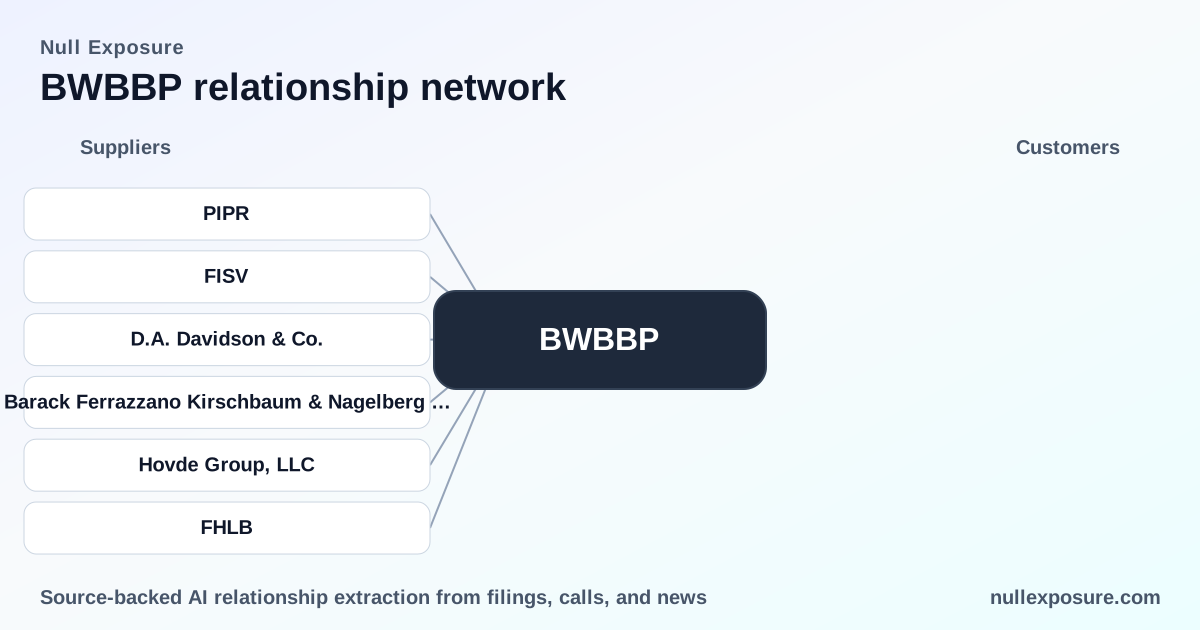
Bridgewater Bancshares (BWBBP): who supplies the bank and what that means for investors
Bridgewater Bancshares funds its community-banking franchise through a mix of deposit gathering, secured advance facilities, and occasional capital markets transactions, while the BWBBP preferred instrument gives investors fixed-ish income exposure to the bank’s equity economics. Bridgewater monetizes by earning net interest margin on commercial and consumer loans, collecting fee income, and tapping capital markets or secured borrowing lines when liquidity or growth requires incremental funding. For suppliers and relationship managers, the company’s playbook emphasizes short-term liquidity access combined with selective long-term obligations, creating a supplier profile that is simultaneously transactional and strategically important.
If you track counterparty relationships for credit, operational or commercial exposure, start with this quick view at NullExposure for contextual intelligence: https://nullexposure.com/
What Bridgewater’s operating model means for suppliers and partners
Bridgewater runs a hybrid funding model: core deposits supplemented by non‑core funding such as brokered deposits, Federal Home Loan Bank (FHLB) advances, and overnight correspondent lines. That posture creates high frequency, short-term counterparty interaction while also locking the firm into some longer-duration commitments (real estate leases through 2029). The company maintains a vendor risk program and uses large financial institutions to offset certain risks, which signals both operational discipline and dependency on major counterparties.
Key operational constraints that matter to suppliers and investors:
- Short-term borrowing reliance increases sensitivity to funding markets and counterparties.
- Longer-term lease obligations (through 2029) impose fixed cost commitments for branch and office footprint.
- Government and large-enterprise counterparties (FHLB, Federal Reserve Bank, and major financial institutions) are embedded in the funding stack.
- The firm declares material secured borrowing capacity with central institutions, a company-level signal of sizable liquidity backstops.
If you want a consolidated supplier view with actionable connections and risk flags, see NullExposure’s homepage: https://nullexposure.com/
The supplier roster — partner-by-partner implications
Piper Sandler & Co. — equity distribution agreement (FY2026)
Bridgewater entered into an Equity Distribution Agreement with Piper Sandler that allows the company to sell up to $50 million of common stock through at‑the‑market offerings and other permitted sale methods, giving Bridgewater a flexible capital access channel to the public markets. This arrangement increases the bank’s ability to top up capital quickly at market prices and positions Piper Sandler as a strategic capital markets partner (reported March 2026 via StockTitan/TradingView coverage of the company’s 8‑K).
Piper Sandler & Co. — lead placement agent for private notes (FY2025)
Piper Sandler also acted as lead placement agent on a FY2025 private notes offering, coordinating distribution and pricing for the issuance; that role underscores a deeper investment‑banking relationship beyond ATM execution. The placement agent role was reported in company release summaries republished on StockTitan in March 2026.
D.A. Davidson & Co. — co-placement agent on the FY2025 notes
D.A. Davidson served as a co‑placement agent alongside Piper Sandler on the FY2025 notes offering, providing distribution support and adding retail/institutional placement capacity to the transaction. This participation was disclosed in the same March 2026 coverage of the private placement (StockTitan).
Hovde Group, LLC — co-placement agent on the FY2025 notes
Hovde Group acted as another co‑placement agent for the FY2025 notes, diversifying the placement network for Bridgewater’s private issuance and helping reach middle‑market investors; the engagement is documented in the March 2026 reporting on the deal (StockTitan).
Barack Ferrazzano Kirschbaum & Nagelberg LLP — legal counsel for the company (FY2025)
Barack Ferrazzano provided legal counsel to Bridgewater on the FY2025 placement, a standard external counsel engagement that supports deal documentation, regulatory filings, and transaction compliance, as reported in March 2026 summaries of the offering (StockTitan).
Fiserv — core processing provider (FY2026)
Bridgewater runs its core banking platform through Fiserv, meaning transaction processing, deposit systems and day‑to‑day account operations route through a major third‑party software and processing vendor. The bank’s management commentary in Q4 2025 earnings material, republished in March 2026, explicitly identifies Fiserv as the bank’s core provider (InsiderMonkey transcript).
Federal Home Loan Bank (FHLB) — secured borrowing counterparty (FY2026)
Bridgewater discloses available borrowing capacity with the FHLB, and the company explicitly cites FHLB advances as part of its secondary liquidity sources; that relationship functions as a government‑sponsored backstop to the bank’s liquidity position (TradingView summary of company filings, March 2026). This connection structurally reduces near‑term liquidity risk but also implies dependence on secured borrowing at market rates.
What these relationships mean in aggregate
Bridgewater balances transactional suppliers (placement agents, legal counsel) with strategic vendors and government counterparties (Fiserv, FHLB, Federal Reserve Bank relationships). That mix produces predictable service demands—regular processing throughput for Fiserv and intermittent, but potentially large, capital or borrowing transactions with placement agents and central credit lines.
- Concentration: The use of Fiserv as the core provider and a small set of investment banks for capital transactions creates concentration points that are operationally and commercially material.
- Contracting posture: The bank relies on short‑term funding relationships (overnight lines, brokered deposits) combined with multi-year vendor agreements and leases, requiring suppliers to support both high-frequency operations and scheduled strategic initiatives.
- Criticality: Some suppliers are mission‑critical (core processing, secured lenders) and others episodic but strategically sensitive (placement agents, legal counsel).
- Maturity: Lease commitments through 2029 and recurring borrowing capacity indicate mixed maturity profiles—short funding cycles versus medium-term real estate obligations.
Practical takeaways for investors and vendors
- For investors: prioritize counterparties that can absorb short-term funding shocks and monitor brokered deposit and FHLB usage as leading indicators of funding stress or growth acceleration.
- For suppliers and service providers: ensure SLAs and contingency planning are aligned to a bank that blends high‑frequency operational needs with periodic capital markets activity; contract terms should reflect both liquidity sensitivity and branch footprint commitments.
- For relationship managers: use the bank’s recurrent tapping of placement agents and secured lines as negotiation levers—Bridgewater values flexible capital access and reliability.
For a consolidated mapping of Bridgewater’s supplier relationships and actionable exposure scores, visit our home page: https://nullexposure.com/
Final verdict and next steps
Bridgewater Bancshares runs a practical, market‑savvy funding model that combines community bank franchise economics with active capital markets engagement. The supplier ecosystem is small but consequential: Fiserv, FHLB, Piper Sandler and a handful of co‑agents and legal advisors together enable liquidity, operations and capital execution. That structure favors suppliers who offer reliability, rapid execution and flexible commercial terms.
If you manage counterparty exposure or sell services to regional banks, this profile demands a blend of operational readiness and capital markets fluency—prepare contracts accordingly and track Bridgewater’s ATM and placement activity closely.
Explore supplier intelligence and get relationship briefings on comparable regional banks here: https://nullexposure.com/