Bankwell Financial Group (BWFG) — supplier relationships, operational constraints, and what investors should know
Bankwell Financial Group operates as a regional bank holding company centered on Connecticut commercial and consumer banking. The company monetizes principally through net interest income on lending and investment portfolios, supplemented by fee income, while active use of interest-rate hedges indicates a deliberate program to stabilize funding and lending margins. For investors and operators assessing supplier risk, the record shows a concentrated, infrastructure-dependent vendor posture combined with material derivatives exposures that shape vendor selection, contracting terms, and continuity planning.
Discover more supplier intelligence and corporate exposure profiles at https://nullexposure.com/.
One broker, one disclosure — what the relationship data records
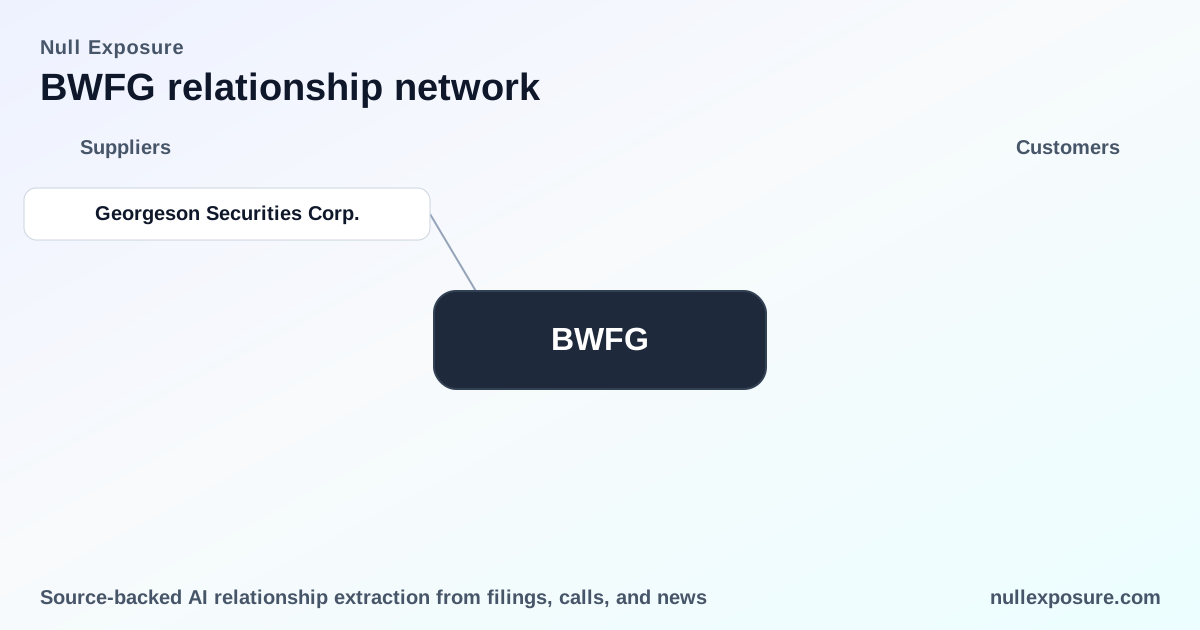
The supplier relationship dataset identifies a single external broker: Georgeson Securities Corp. The disclosure notes Georgeson was identified in a filing as the broker for the intended sale of 245 shares (aggregate market value $10,177.30) on NASDAQ with a transaction date around 09/02/2025. This is recorded in an FY2026 filing aggregated on StockTitan’s SEC filings page. (Source: StockTitan SEC filings summary, FY2026 — https://www.stocktitan.net/sec-filings/BWFG/page-5.html)
How that broker relationship fits into the operational picture
The Georgeson mention is transactional and limited in scale; it reflects executive or insider share placement activity handled by a broker rather than an ongoing critical service contract. For operational due diligence, this is a low-criticality vendor interaction in dollar terms, but it is useful evidence of standard capital markets activity and third-party brokerage use. (Source: StockTitan SEC filings summary, FY2026)
Company-level constraints and what they signal about vendor strategy
Company disclosures include explicit statements and financial instrument detail that inform supplier risk and contracting posture. These are company-level signals — not tied to the Georgeson broker mention — and they define the structure and priorities of Bankwell’s vendor program:
-
The company states: “Our business depends on the successful and uninterrupted functioning of our information technology and telecommunications systems and third-party servicers.” This is a direct confirmation that IT and telco vendors are mission-critical and that vendor continuity is a priority for operational resilience. (Company disclosure excerpt)
-
The filing adds: “We rely on third parties to provide key components of our business infrastructure, and failure of these parties to perform for any reason could disrupt our operations.” This emphasizes a contracting posture that accepts third-party specialization but requires robust oversight and contingency clauses. (Company disclosure excerpt)
-
On financial sizing of vendor-grade exposures, the company discloses a pay-fixed portfolio layer swap with a total notional amount of $150 million, and separately that it was a counterparty to three cash flow swaps with $25 million notional each to stabilize interest expense. Those contract sizes place derivatives counterparties and custodial/operations partners squarely into a higher spend and exposure band for procurement and risk management. (Company disclosure excerpts)
Taken together, these company-level constraints produce a clear operational framework: vendor relationships are both strategically critical (infrastructure and IT) and financially material (counterparty exposure for swaps). Procurement and legal teams must therefore prioritize service-level agreements, continuity planning, and counterparty credit assessment at a higher standard than for routine suppliers.
What the constraints imply for contracting posture, concentration, criticality, and maturity
-
Contracting posture: Bankwell operates with tight, risk-conscious contracting for infrastructure and financial counterparties. The language in filings signals that contracts will contain specific performance metrics and fallback provisions given the explicit risk of operational disruption.
-
Concentration: The presence of notional derivatives ($150M and multiple $25M swaps) indicates concentrated exposure to a small set of financial counterparties and custodial/operations vendors. Even though the Georgeson broker mention is immaterial in size, the derivatives positions create economic concentration that elevates key vendors’ strategic importance.
-
Criticality: IT, telecommunications, and derivative counterparties are mission-critical. Disruption in those services would have direct effects on deposit-taking, payment processing, and interest-expense management.
-
Maturity: Use of portfolio-layer swaps and multi-leg cash flow hedges reflects a mature balance-sheet risk-management program that integrates vendor relationships (e.g., custodians, swap counterparties, treasury platforms) into enterprise risk policy and oversight.
Practical implications for investors and operators
For investors evaluating BWFG supplier relationships and operational resilience, the checklist below translates disclosure signals into due-diligence action items:
-
Validate vendor continuity plans and SLAs for IT and telecommunications. Given explicit company reliance, these vendors are single points of failure for customer-facing operations.
-
Assess counterparty risk for swaps and hedging instruments. The notional sizes ($150M total in a pay-fixed instrument and three $25M swaps) require counterparties with strong credit and operational controls.
-
Request evidence of vendor concentration management. Contract language, escrow arrangements for critical software, and backup processing arrangements are essential.
-
Monitor small transactional broker use separately from strategic vendor partnerships. The Georgeson broker engagement is a routine capital-markets activity and not an indicator of broader operational dependency. (Source: StockTitan SEC filings summary, FY2026)
If you want a consolidated supplier risk profile and continuous monitoring for BWFG and peers, visit https://nullexposure.com/ for a guided view of vendor-criticality and exposure mapping.
Relationship-by-relationship recap (complete)
- Georgeson Securities Corp. — Georgeson is identified in an FY2026 filing as the broker handling the intended sale of 245 common shares (aggregate market value $10,177.30) scheduled around 09/02/2025 on NASDAQ; this is a small, transactional capital-markets engagement rather than a strategic vendor contract. (Source: StockTitan SEC filings summary, FY2026 — https://www.stocktitan.net/sec-filings/BWFG/page-5.html)
Bottom line for investors
Bankwell operates with mature hedging and an explicit dependence on third-party infrastructure, which raises the bar for vendor governance even as many supplier interactions are routine and limited in dollar size. The single broker disclosure is immaterial operationally, but the company’s own admissions about IT reliance and sizable hedging notional demonstrate where vendor risk concentrates: counterparties to interest-rate hedges and providers of core banking infrastructure. These are the relationships that require continuous oversight, contractual rigor, and scenario-tested continuity plans.
For a deeper supplier exposure assessment and automated monitoring of counterparty risk across the financial sector, review the coverage available at https://nullexposure.com/.