Baldwin Insurance Group (BWIN) — Supplier and Partner Landscape Investors Should Track
Thesis: Baldwin Insurance Group operates as an acquisition-led independent insurance distributor that monetizes primarily through brokerage commissions, fee income from managing general agency (MGA) activities, and ancillary services sold to commercial and personal lines customers. Revenue is driven by organic brokerage margins plus targeted acquisitions and embedded distribution partnerships that scale fee and commission flows while leveraging centralized back-office services. For investors evaluating Baldwin as a supplier counterparty or platform operator, the recent deal activity and disclosed vendor posture reveal both growth levers and operational dependencies. Learn more about supplier risk and partner strategy at https://nullexposure.com/.
Transactions and strategy — an acquisitions-first playbook
Baldwin’s recent announcements confirm a deliberate strategy: acquire distribution networks and embed insurance capabilities into adjacent customer flows, while funding that expansion with incremental bank financing. The company scales by folding acquired retail and distribution channels into its MGA and agency stack, capturing both up-front acquisition synergies and longer-term fee streams. The capital structure has adjusted accordingly—Baldwin signed a material credit amendment to add capacity for deal execution. Investors should view the combination of M&A and committed bank liquidity as a clear growth vector that increases revenue visibility but also amplifies integration and vendor risk.
- Key corporate signal: Baldwin runs a footprint of roughly 110 operating locations across 24 U.S. states and holds long-dated real estate leases, reflecting a mature, geographically diversified retail distribution model with steady occupancy cost commitments.
Interested in how these supplier and financing relationships affect counterparties? Visit https://nullexposure.com/ for deeper supplier intelligence.
What the partner list tells you about exposure and priorities
Baldwin’s relationships fall into three strategic buckets: distribution/embedded-insurance partners, acquisition targets that expand product or channel reach, and lenders that enable scale. This mix increases revenue optionality while concentrating operational reliance on a limited set of critical vendors and financing counterparties. The company’s own disclosures emphasize dependence on third-party service providers for agency management systems, billing, and cybersecurity — a structural operational constraint that matters when integrating acquisitions.
Key company-level constraints investors must weigh:
- Long-term obligations: Baldwin maintains leased headquarters and multiple branch leases with expirations extending into 2030, locking in occupancy cost and limiting short-term flexibility.
- Geography: Operations are concentrated in the U.S., with distribution across 24 states—domestic concentration increases regulatory and market-cycle correlation.
- Vendor dependence: Baldwin relies on a small number of third-party IT and service providers for agency management, billing, and cybersecurity, making these vendors critical single points of failure for operating continuity.
- Segment focus: The business is service-led (insurance brokerage and MGA activities), meaning people, platforms, and distribution relationships drive margins more than capital-intensive underwriting.
Key supplier and partner relationships investors should track
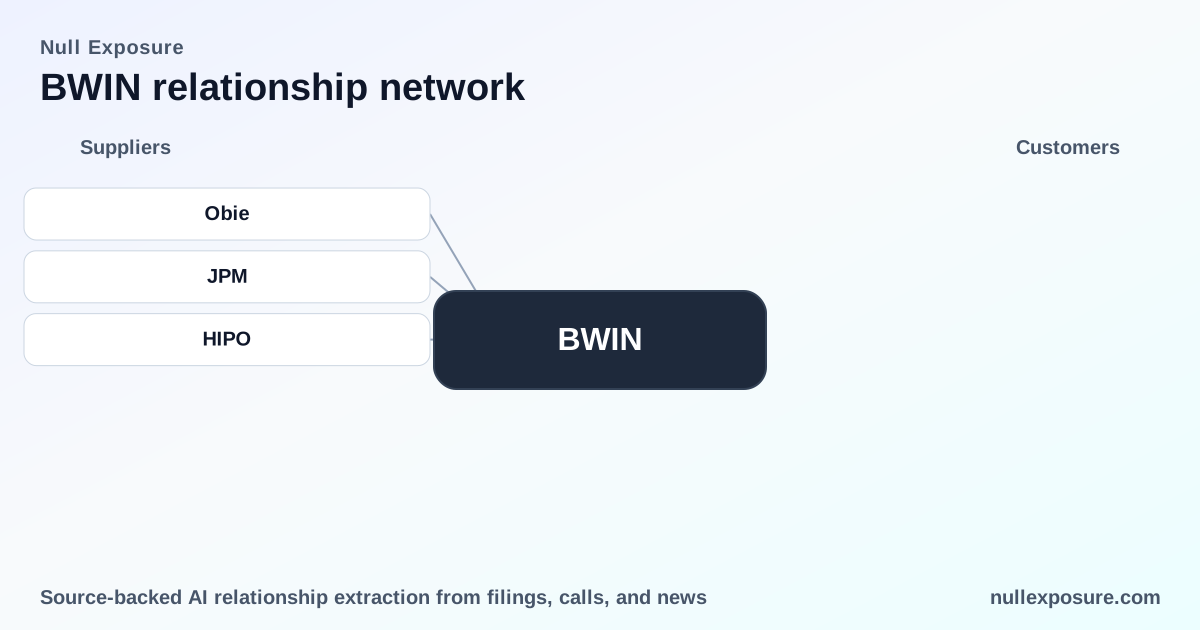
Obie — embedding distribution into real estate investor flows
Baldwin’s acquisition/partnership with Obie expands embedded insurance distribution capabilities for Baldwin’s MGA, MSI, and strengthens Baldwin’s offerings to real estate investors. According to a StockTitan news report on March 9, 2026, the move broadens access to insurance distribution inside property investment workflows and supports Baldwin’s strategy of embedding products where customers transact.
JPMorgan Chase Bank — incremental committed financing for acquisitions
Baldwin amended its credit agreement to add $600 million of incremental term B loans, with JPMorgan Chase Bank acting as administrative agent, to finance acquisitions and enhance liquidity for growth. TradingView reported the credit agreement amendment effective January 2, 2026, showing that Baldwin is using syndicated bank financing to underwrite its acquisition cadence and working capital needs.
Hippo Holdings, Inc. — acquisition of a homebuilder distribution network
Baldwin’s indirect subsidiary, Westwood Insurance Agency, completed the acquisition of the homebuilder distribution network previously owned by Hippo Holdings, expanding Baldwin’s reach into builder and contractor channels. A StockTitan report referencing FY2025 activity noted the completion of this strategic purchase and its role in consolidating Baldwin’s homebuilder distribution capabilities.
Operational and financial implications for counterparties
Acquisitions such as Obie and Hippo accelerate fee income and cross-sell potential, but they also require integration of third-party platforms and consistent IT operations. The company’s disclosed reliance on outside service providers for agency management, billing, and cybersecurity elevates the importance of vendor stability and contractual clarity. Lenders like JPMorgan provide committed capital but also introduce covenant and repayment dynamics that can affect operational freedom during cyclical stress.
- Contracting posture: Long-term leases and material bank financing indicate firm contractual commitments that reduce short-run flexibility but support predictable market presence.
- Concentration and criticality: Dependence on a limited number of IT/service vendors makes vendor continuity a material operational risk during M&A-driven scale episodes.
- Maturity: With 110 locations across 24 states, Baldwin’s operating model is established and regionally diversified, supporting stable distribution economics but still exposed to U.S. insurance market cycles.
If you are modeling supplier concentration or counterparty exposure for portfolios, Baldwin’s combination of strategic acquisitions and vendor dependence is a core input—get detailed supplier dossiers at https://nullexposure.com/.
Risk vs. reward — what investors need to price in
- Upside: Acquisition-driven revenue lift, expanded embedded distribution (higher lifetime customer value), and committed bank financing that supports continued inorganic growth.
- Downside: Integration execution risk, single-vendor operational dependencies, and fixed occupancy and debt load that constrain flexibility if revenue trends weaken.
Baldwin’s FY metrics show healthy top-line scale (roughly $1.5 billion TTM revenue) but negative trailing EPS and modest operating margins, which heightens the importance of execution on purchased growth and cost synergies.
Final takeaways and investor action points
Baldwin is executing a classic roll-up and embed strategy: acquire distribution, connect it to an MGA and agency stack, and fund the play with bank financing. For counterparties and investors, the salient signals are the reliance on a limited set of third-party service providers and the firm’s long-term occupancy and financing commitments—each is a lever for both value creation and concentration risk.
- Monitor integration milestones for Obie and Hippo to judge revenue realization and cost synergies.
- Track covenant language and utilization under the JPMorgan-led credit facility for liquidity stress indicators.
- Evaluate vendor continuity plans and cyber resilience given the company’s reliance on external agency management and billing systems.
For a deeper supplier-level risk assessment and monitoring setup, visit https://nullexposure.com/ to commission a tailored report.