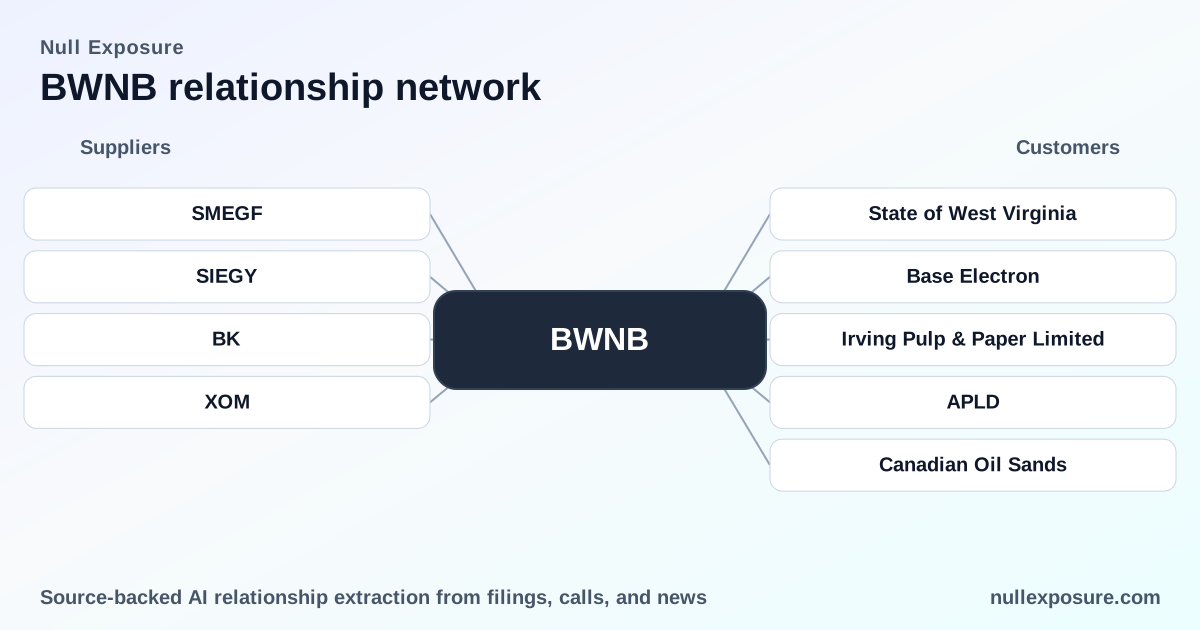
Babcock & Wilcox Enterprises (BWNB): supplier relationships that drive project wins and capital sensitivity
Babcock & Wilcox Enterprises builds, sells and services industrial boilers and advanced energy systems and monetizes through large equipment contracts, long-term service and licensing agreements, and project-based engineering deliveries that generate upfront equipment revenue plus follow-on aftermarket and warranty income. The company’s commercial model is project-centric: winning large plant or data‑center power contracts converts engineering and manufacturing capacity into cash, while letters of credit, surety bonds and debt facilities underwrite those contracts. Learn more about supplier risk signals and relationship mapping at https://nullexposure.com/.
How suppliers fit into BWNB’s revenue engine
BWNB structures revenue around capital-intensive projects and ancillary services. Equipment deliveries and engineered power systems are high-dollar, low-frequency events that require strong supplier and capital-provider relationships to execute. That creates two simultaneous dependency vectors: strategic suppliers for core turbine, emissions and licensing technologies; and financial counterparties to provide contract security (letters of credit, bonds) and trustee services for capital markets instruments.
- Contracting posture: BWNB operates as a prime contractor on turnkey plant scopes, which pushes counterparty credit and performance risk onto a network of component suppliers and trustees.
- Concentration and criticality: Individual supplier relationships are high‑leverage — a single supplier for a turbine set or a licensed emissions technology can be mission-critical to project delivery.
- Maturity and staging: Recent activity shows active project wins alongside capital restructuring that closed prior credit facilities and migrated letter‑of‑credit obligations into a new Credit Agreement, signaling a mid-transformation maturity profile.
Explore BWNB supplier relationship data and tracking at https://nullexposure.com/.
Supplier map: the counterparties named in recent reporting
Siemens Energy — turbine supplier for a one‑gigawatt Applied Digital project
B&W selected Siemens Energy to provide steam turbine generator sets for a project designed to supply one gigawatt of power to an Applied Digital AI Factory, a transaction reported in March 2026. This is a classic supplier-prime configuration where Siemens supplies a critical, high-value rotating‑equipment scope that BWNB integrates into its larger plant delivery. (See Yahoo Finance, March 9, 2026: https://finance.yahoo.com/news/babcock-wilcox-selects-siemens-energy-111100762.html and coverage at https://www.sahmcapital.com/news/content/babcock-wilcox-rockets-on-24-billion-ai-data-center-project-reports-q4-results-2026-03-04.)
The Bank of New York Mellon Trust Company, N.A. — indenture trustee on redeemed notes
B&W disclosed a full redemption of notes issued under an indenture for which The Bank of New York Mellon Trust Company, N.A. served as trustee; the company’s notice describes the redemption mechanics under the indenture framework. The trustee relationship is typical for corporate debt transactions and reflects BWNB’s engagement with established capital‑markets servicers for note administration. (See company press release on the redemption, FY2025: https://www.babcock.com/home/about/corporate/news/babcock-and-wilcox-announces-full-redemption-of-notes.)
ExxonMobil — licensor of wet gas scrubbing technology used by B&W
B&W licenses wet gas scrubbing technology originally developed by ExxonMobil, which B&W now deploys and supports in industrial and refining installations to remove particulates and SO2 from flue gases. This is a technology‑licensing relationship that underpins a portion of B&W’s environmental-emissions offerings and supports aftermarket service revenue. (See B&W industrial facilities product page noting ExxonMobil licensing heritage, FY2025: https://www.babcock.com/home/utilitiesindustries/industrial-facilities/petrochemical-and-refining.)
What the company-level constraints reveal for investors
Two company-level constraints reported alongside supplier relationships are material to execution and capital structure.
- Critical dependence on debt capacity for contract security. Management states that maintaining sufficient capacity under its debt facilities is essential to supporting letters of credit, bank guarantees and surety bonds that back contract execution; loss of capacity would materially diminish BWNB’s ability to meet contract security requirements. This is a direct signal that execution risk is tightly coupled with liquidity and borrowing capacity (evidence excerpted from company disclosures, FY2025–FY2026).
- Active credit-agreement transition and terminated facility posture. The company disclosed that a prior Revolving Credit Agreement and associated Letter of Credit/Reimbursement Agreements were terminated and that outstanding letters of credit were transitioned to a new Credit Agreement by September 30, 2024. This is a company-level signal of refinancing activity and a changed contracting posture toward consolidated credit support rather than multiple legacy facilities.
Together these constraints indicate that supplier performance and project delivery are necessary but not sufficient — BWNB also requires robust, available credit lines to convert supplier capacity into deliverable projects.
Investment implications: risks and levers to watch
- Execution risk is supplier- and capital-driven. Siemens Energy’s role on the Applied Digital project exemplifies how single-supplier scopes can accelerate revenue when delivered, but also how supplier delays or financial friction in BWNB’s credit lines could push cost exposure back onto BWNB.
- Licensing and aftermarket are valuable stabilizers. The ExxonMobil‑licensed wet gas scrubbing tech provides recurring service and retrofit opportunity that improves revenue visibility versus one-off equipment sales.
- Capital structure sensitivity. The terminated revolving facility and the need to migrate letters of credit into a new Credit Agreement make covenant compliance, bank relationships and liquidity metrics primary monitorables for bondholders and counterparties.
Key items for model updates and due diligence:
- Monitor project milestones on the Applied Digital contract and Siemens Energy delivery schedule.
- Track covenant metrics and usage under the new Credit Agreement to assess whether contract security capacity is intact.
- Quantify revenue mix shift toward aftermarket and licensing for stability.
For a deeper supplier-risk checklist and ongoing monitoring solutions visit https://nullexposure.com/.
Bottom line and recommended actions
Babcock & Wilcox operates a project-heavy, supplier-dependent business that converts engineering and equipment sales into follow-on service revenue, but execution is tightly bound to available credit capacity and selective supplier performance. Investors and operators should treat supplier wins (like Siemens Energy) as material upside only if paired with demonstrable liquidity under the company’s credit facilities; conversely, the termination and migration of legacy credit agreements is a red flag that requires active surveillance.
Actionable next steps:
- Confirm Siemens Energy delivery timelines against BWNB project milestones.
- Request covenant and letter‑of‑credit capacity disclosures from management or bond trustees.
- Reassess revenue durability assumptions by weighting licensed technologies and aftermarket service revenue more heavily.
To subscribe for ongoing supplier relationship intelligence and structured counterparty monitoring, go to https://nullexposure.com/.