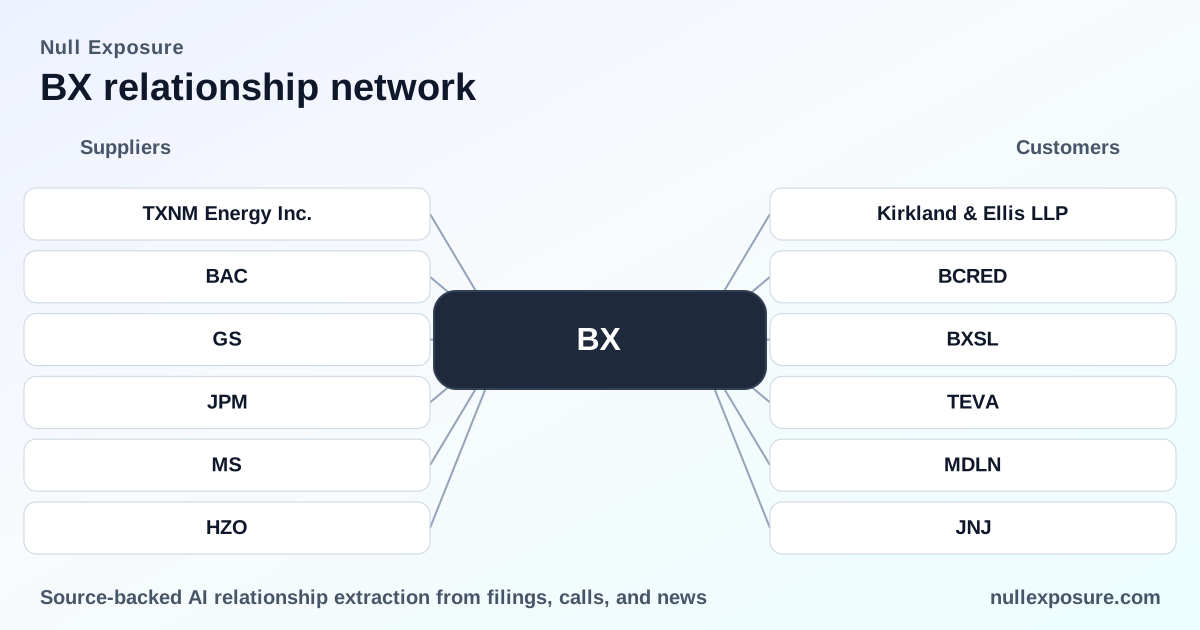
Blackstone (BX) — supplier relationships that shape capital allocation and operational risk
Blackstone operates as a global alternative asset manager that monetizes through management fees, performance fees (carry), and balance-sheet investments across private equity, real assets, credit, and hedge funds. Its operating model relies on deep third‑party relationships for distribution, fund administration, legal and technology services while simultaneously using large-scale M&A and capital markets transactions to deploy and realize capital. Investors should treat Blackstone’s supplier footprint as both a cost center and a strategic enabler of deal flow and scale.
Explore full supplier intelligence for a deeper view.
What to watch: how Blackstone contracts and where concentration matters
Blackstone’s supplier posture combines heavy reliance on a handful of large counterparties with significant recurring operational vendors. The company’s public disclosures and recent reporting signal three structural characteristics:
- Contracting posture: Blackstone contracts with investment‑grade financial institutions for custody, distribution and capital‑markets activities while outsourcing non‑core infrastructure (fund administration, cloud services) to third parties. This creates a split contracting approach: strategic, long‑term financial counterparties plus third‑party operational vendors.
- Concentration and criticality: The firm shows examples of very large single‑vendor spend (e.g., >$100m legal fees) alongside mid‑sized recurring payments (aircraft and service providers in the $1–10m range). That pattern creates single‑vendor importance for critical legal, audit and tech functions while leaving distribution and product placement exposed to competitor products sold by the same intermediaries.
- Maturity and stage: Vendor relationships are operationally mature and active — Blackstone documents ongoing reliance on cloud platforms and fund administrators to support 2024–2026 operations, reflecting a steady, embedded supplier set rather than one‑off engagements.
These company‑level signals indicate high operational leverage to a small set of service providers and major financial partners, which is a structural consideration for investors focused on continuity of fee generation and execution risk.
See supplier posture and implications at NullExposure.
What the public reporting shows about spending behavior
Public excerpts illustrate that Blackstone executes both very large professional services contracts and a patchwork of smaller operational payments. For 2024 the company disclosed legal fees to Kirkland of approximately $101.3 million, a separately summarized set of fees to Deloitte entities, and multiple aircraft‑use payments in the $1–5 million range. Those entries demonstrate both scale and a willingness to centralize critical legal and audit services while keeping other operational relationships distributed across smaller providers.
How each reported relationship matters for investors
TXNM Energy Inc. — utility acquisition driving asset mix
Blackstone completed an $11.5 billion acquisition of TXNM Energy Inc. in May 2025, reflecting the firm’s continued use of balance‑sheet and fund capital to acquire large regulated assets that generate stable cash flows. This transaction expands Blackstone’s real‑asset footprint and contributes to fee‑related and carried‑interest upside from large infrastructure deals (source: AI‑CIO, March 2026; https://www.ai-cio.com/news/consortium-including-calpers-eqt-blackrocks-gip-to-acquire-utility-company-aes/).
Bank of America (BAC) — capital markets and syndicate involvement
Benzinga reported that Bank of America was one of the banks involved in a $3.4 billion Medline share offering that included Blackstone as a selling stockholder; this places Bank of America as a transactional partner for equity placement and block sales, useful for liquidity execution when Blackstone needs to monetize stakes (source: Benzinga, March 2026; https://www.benzinga.com/markets/private-markets/26/03/51009308/blackstone-carlyle-hellman-friedman-offer-75m-shares-for-medline).
Goldman Sachs (GS) — strategic underwriting and distribution
Goldman Sachs participated alongside other bulge‑bracket banks in the Medline offering cited above, reinforcing Goldman’s role as a distribution and underwriting counterparty for Blackstone’s secondary share sales and large capital markets transactions (source: Benzinga, March 2026; https://www.benzinga.com/markets/private-markets/26/03/51009308/blackstone-carlyle-hellman-friedman-offer-75m-shares-for-medline).
JPMorgan Chase (JPM) — execution and financing partner
JPMorgan Chase was identified among the banks handling the Medline share placement; its involvement underscores JPM’s function as a financing and execution counterparty that supports Blackstone’s large exits and capital markets solutions (source: Benzinga, March 2026; https://www.benzinga.com/markets/private-markets/26/03/51009308/blackstone-carlyle-hellman-friedman-offer-75m-shares-for-medline).
Morgan Stanley (MS) — sell‑side collaboration for liquidity events
Morgan Stanley is named as an active participant in the Medline offering, indicating its place in Blackstone’s network of bulge‑bracket partners used to place large blocks of stock into the market efficiently (source: Benzinga, March 2026; https://www.benzinga.com/markets/private-markets/26/03/51009308/blackstone-carlyle-hellman-friedman-offer-75m-shares-for-medline).
MarineMax (HZO) — potential buyout interest and deal origination
A March 2026 report captured interest from Blackstone among other private equity firms in a potential buyout of MarineMax, demonstrating Blackstone’s continued pursuit of platform acquisitions in cyclical consumer sectors and its ability to compete in auction processes (source: BusinessObserverFL citing Reuters, March 4, 2026; https://www.businessobserverfl.com/news/2026/mar/04/marinemax-keeps-ceo-bids-company/).
Risk and opportunity takeaways for operators and investors
- Opportunity: Blackstone’s relationships with major banks and consistent use of large professional services firms support efficient execution of large exits and M&A, which drives carry and fee realization. The firm’s scale and partner network are competitive advantages for deal origination and distribution.
- Risk: Concentration in critical vendors (large legal/audit spends and reliance on third‑party fund administrators and cloud infrastructure) creates operational tail risk if a key provider fails or commercial terms shift. Distribution risk also exists because intermediaries that sell Blackstone products often also offer competing proprietary funds.
- Commercial posture: Expect long‑standing contractual arrangements with investment‑grade counterparties combined with active procurement for operational services; spend evidence ranges from >$100m in one‑off professional fees to repeated $1–10m operational payments.
Dig deeper into supplier signals and vendor concentration at NullExposure.
Final read: what investors should act on now
Blackstone’s supplier map is an asset in capital markets execution and a point of vulnerability in operations. Monitor large‑vendor contracts (legal, audit, fund administration) for renewal risk and fee inflation, and track which banks are consistently used for distribution — these relationships directly influence Blackstone’s ability to monetize positions and sustain fee flows. For investors and operators evaluating partner exposure, prioritize counterparty stability and contractual tenure when modeling downside scenarios.
For a comprehensive view of supplier concentration and relationship detail, visit NullExposure.