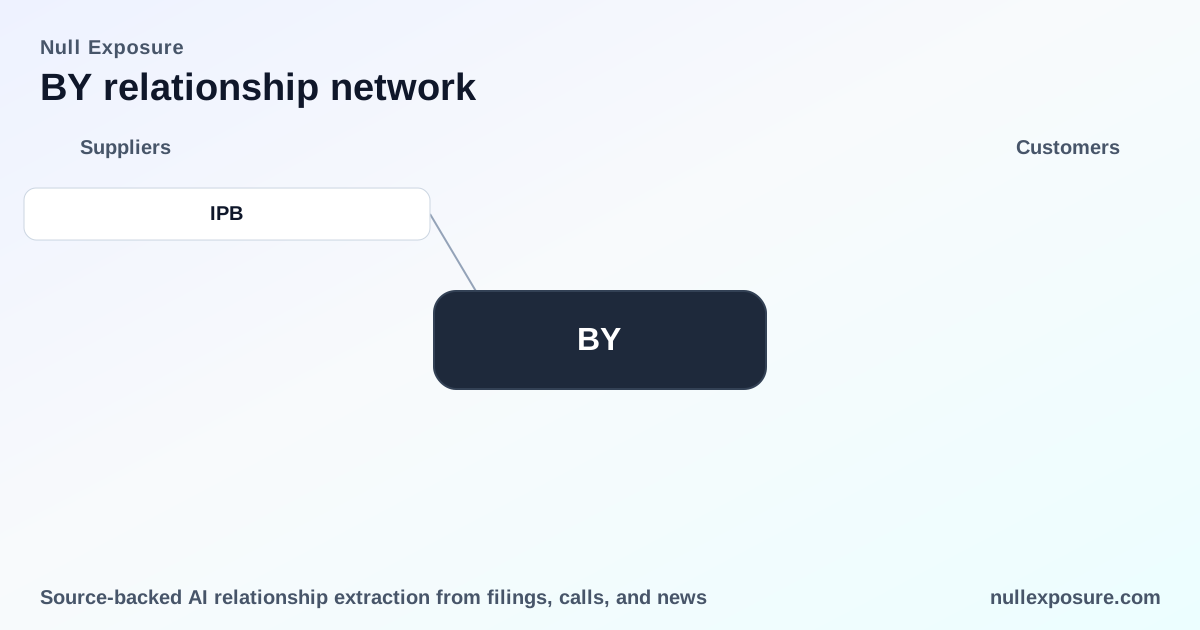
Byline Bancorp (BY) — Supplier relationships and what they mean for investors
Byline Bancorp operates as a regional bank focused on small and medium-sized businesses, commercial and financial real estate sponsors, and consumer customers, monetizing through net interest income, fee-based services, and lending-related revenue across its Chicago-centered footprint. For investors evaluating supplier exposure, the company combines a traditional banking revenue model with outsourced operational dependencies that can amplify both cost and operational risk if vendors fail or pricing shifts. If you want a consolidated view of counterparties and operational signals, start here: https://nullexposure.com/.
How Byline runs the business and where the money comes from
Byline is the holding company for Byline Bank and generates revenue primarily from lending and deposit-taking activities. The latest company figures show TTM revenue of $410 million, a profit margin of 31.7%, ROE of 11%, and a market capitalization near $1.40 billion, indicating a profitable regional franchise with scale in its markets. The bank’s price-to-book of ~1.10 and forward P/E around 9.6 position it as a value-oriented regional bank relative to growth peers.
Operating characteristics that matter to supplier analysis:
- Contracting posture — long-term commitments. Public disclosures indicate material notional amounts with maturities stretching to 2033, which signals multi-year commitments to funding, hedging, or service arrangements and constrains short-term flexibility.
- Outsourced delivery — external service providers for core operations. The company outsources major systems such as data processing, loan servicing, deposit processing, and internal audit systems, which increases operational reliance on third parties.
- Criticality and replacement difficulty. Byline states that some vendors supply core banking, debit card services, and information services that would be difficult to replace quickly and could raise costs or cause customer loss if disrupted.
Treat these points as company-level signals: long maturities, meaningful outsourcing, and vendor concentration around core banking functions materially influence execution risk and vendor negotiation leverage.
Supplier relationships investors should review
Below I cover every supplier relationship located in the supplier-scope results and explain the investor-relevant facts and sources.
Merrill Lynch (Brokerage counterparty)
Merrill Lynch is listed in an SEC filing as a broker associated with the sale of securities, including details such as address and number of shares to be sold, indicating one-off capital markets or distribution activity connected to Byline’s securities program. According to the filing posted March 9, 2026, Merrill Lynch is identified as a named broker of record with transaction-level detail. (Source: SEC filing reproduced on StockTitan, March 2026.)
Why that relationship matters for a capital markets and operations view
Merrill Lynch’s appearance as a named broker is transactional and capital-markets focused, not an operational vendor providing core systems. This reduces the counterparty’s operational criticality relative to outsourced providers — however, broker execution and underwriting relationships are important for liquidity, equity issuance, and secondary-market support, particularly if Byline pursues capital raises or block sales.
For operational risk and supplier concentration, focus on the company-level constraints described above: long contract maturities through 2025–2033, the outsourcing of core processing, and the stated difficulty of replacing key third-party vendors. These are the levers that most directly affect day-to-day resilience and cost structure.
If you want the full mapping of named counterparties and supplier signals, see our index at https://nullexposure.com/.
Investment implications and a short risk checklist
Investors should weigh Byline’s attractive profitability against these supplier-driven exposures:
- Concentration of critical services. Outsourcing of core systems (loan servicing, deposit processing, debit card services, internal audit) creates single points of failure and potential vendor pricing power.
- Long-term contractual commitments. The company discloses notional amounts with maturities into 2033; those long maturities reduce near-term flexibility to reprice or restructure relationships.
- Capital markets reliance is limited but tactical. Broker relationships like Merrill Lynch are important for discrete equity transactions or distribution events but are not the primary operational dependency.
- Replacement cost and customer churn risk. Byline explicitly notes that replacing certain vendors could be more costly and could result in customer loss, which is a measurable execution risk during vendor transitions.
Key takeaways for portfolio positioning: treat Byline as a profitable regional bank with operational vendor dependencies that can amplify downside in a stressed or high-cost vendor environment. Balance the current valuation (~1.10 P/B and double-digit forward earnings yield) against the non-trivial vendor and maturity risks embedded in the disclosures.
Mid-read note: for investors evaluating counterparty networks and supplier concentration across banks, consult our supplier-mapping portal for merchant-level and contract-level signals: https://nullexposure.com/.
What to watch in the next 12 months
- Monitor filings and company disclosures for any new vendor terminations or vendor consolidation efforts; these will materially affect cost and operational risk.
- Watch capital transactions that name brokers — repeated use of investment banks can signal funding needs or shareholder activity.
- Track maturity rollovers on long-term commitments as they approach 2025–2028; these windows represent potential inflection points for cost or contract renegotiation.
Final read and next steps
Byline offers a clear, profitable regional-bank model with outsourced operational execution and long-term contractual commitments that investors must price into downside scenarios. The broker relationship identified is transaction-oriented, while the more consequential exposures lie in the outsourced core systems and long maturities. For a systematic look across counterparties and supplier signals, review the platform at https://nullexposure.com/ — it provides focused views for investment and operational diligence.
If you want a tailored supplier-risk brief for Byline or a peer comparison of vendor concentration across regional banks, visit https://nullexposure.com/ and request a bespoke analysis.