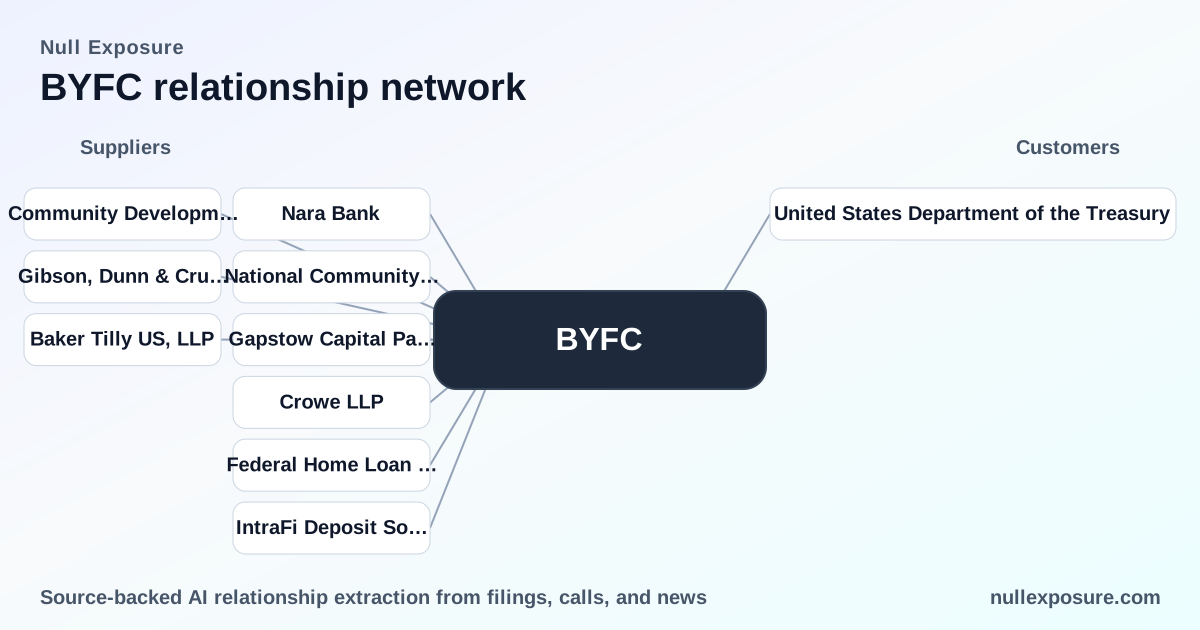
Broadway Financial (BYFC): Supplier Map, Funding Partners and What Investors Should Price In
Broadway Financial Corporation operates as the holding company for Broadway Federal Bank (City First Bank in filings) and monetizes through traditional community-bank channels: deposit gathering, interest margin on lending and investments, and fee income from banking services. The company supplements core deposits with secured borrowings and selective capital transactions, and its supplier set — auditors, legal counsel, liquidity providers, deposit-insurance partners and community investors — directly shapes funding cost, regulatory posture and strategic optionality for growth. For investors evaluating counterparty exposures, the supplier roster signals both funding access and governance execution that affect downside protection and upside deployment.
Explore a concise supplier intelligence view at https://nullexposure.com/.
Why the supplier network matters for valuation and risk
Broadway’s suppliers are not peripheral vendors; they are functional partners that determine liquidity, regulatory capital flexibility and depositor confidence. Funding relationships with the Federal Home Loan Bank (FHLB) and secured-repurchase arrangements are the primary levers for short-term balance-sheet management, while partners such as IntraFi extend depositor insurance beyond FDIC limits and reduce flight risk for large accounts. Professional services — independent auditors and law firms — shape disclosure timing and legal capacity for capital transactions, and community finance partners unlock mission-aligned capital such as New Markets Tax Credits.
Two company-level constraints frame the operating model and should be priced into any thesis: the firm previously used a Federal Reserve Bank Term Funding program (BTFP) borrowing that was paid off in December 2024, indicating episodic use of government liquidity facilities; and deposits are the primary source of funds for lending and investments, making deposit stability a critical operational dependency. These constraints translate to a contracting posture that is creditor- and deposit-centric, high criticality of funding relationships, and moderate maturity of financing sources given repeated recourse to wholesale advances. For deeper background see the firm’s FY2025 statements and regulatory filings.
Learn more about supplier exposure monitoring at https://nullexposure.com/.
Supplier-by-supplier: what each relationship means for investors
-
Nara Bank
Broadway received a loan from Nara Bank (then part of BBCN Bancorp) to bolster its finances during stress periods, reflecting the role of regional banking peers in ad hoc liquidity support. This loan was reported in a Los Angeles Times piece covering historical recapitalization activity (FY2015). -
National Community Investment Fund (NCIF)
NCIF participated in Broadway’s recapitalization structure and later accepted a conversion of preferred shares to common equity with a haircut on amounts owed, signaling mission-oriented capital that trades return for long-term viability. The conversion and terms were described in coverage of the firm’s capital events (FY2015). -
Gapstow Capital Partners
Gapstow, a private equity investor, holds a significant equity stake (~30% at the time of reporting) and was noted alongside Treasury holdings as a major shareholder following recapitalization actions, indicating private-equity influence on corporate governance and strategic choices (FY2015 reporting). -
Crowe LLP
Crowe has been engaged as an independent registered public accounting firm for Broadway’s quarterly reporting and required additional time to complete review procedures for Form 10-Q disclosures in FY2025, a signal of elevated audit scrutiny and disclosure diligence (FY2025 filings). -
Baker Tilly US, LLP (formerly Moss Adams LLP)
Baker Tilly served as the independent auditor for Broadway’s FY2024 annual report, and management discussed matters with both Baker Tilly and Crowe in connection with audit committee reviews, highlighting auditor transitions and oversight intensity (FY2025 8‑K filing). -
Federal Home Loan Bank (FHLB)
FHLB advances were a material source of borrowings; total FHLB advances decreased substantially between December 2024 and mid‑2025, reducing total borrowings by hundreds of millions of dollars and illustrating active balance-sheet de‑risking from wholesale advance funding (Q1–Q2 2025 press releases). -
IntraFi Deposit Solutions
Broadway uses IntraFi to provide deposit insurance coverage above the FDIC $250,000 limit, which serves as a retention tool for large deposits and improves liquidity resilience by protecting institutional and high‑balance retail accounts (FY2025 press releases). -
Community Development Financial Institutions Fund (CDFI Fund)
Broadway was selected to receive a $75 million New Markets Tax Credit allocation from the CDFI Fund (announced Feb 26, 2026), which represents programmatic subsidy that can lower the effective cost of capital for community lending initiatives and support growth in targeted markets (FY2026 8‑K). -
Gibson, Dunn & Crutcher LLP
Gibson Dunn acted as legal counsel during capital transactions, including issuance of preferred stock to the U.S. Department of the Treasury in FY2022, underscoring the role of external legal advisors in structuring complex government‑linked financings (FY2022 disclosure).
What this supplier map implies for portfolio decisions
-
Funding mix and concentration: The company’s reliance on deposits as the primary funding source makes deposit retention programs (IntraFi) and balance-sheet hedging via FHLB advances central to liquidity risk management. The sizable reduction in FHLB usage in 2025 reflects deliberate balance-sheet adjustment and reduced wholesale dependency documented in company releases (Q1–Q2 2025).
-
Governance and disclosure risk: Auditor rotations and extended audit review timelines (Crowe, Baker Tilly) create episodic disclosure timing risk that investors must monitor; audit firm interactions in FY2025 were explicitly discussed in regulatory filings.
-
Capital flexibility and mission capital: Conversions of preferred to common stock and stakes held by Gapstow and the Treasury indicate a capital structure containing mission‑oriented and government investments that compress near‑term returns but enhance survivability and community lending capacity. The NMTC allocation from the CDFI Fund is a material programmatic tool that will influence deployment strategies in targeted geographies (FY2015, FY2026 filings).
Actionable next steps for investors and operators
- Monitor quarterly filings for further commentary on FHLB advance levels and the timing of NMTC deployment; these items will move both liquidity and prospective earnings leverage.
- Track auditor communications and any auditor changes for signals on disclosure controls and financial reporting quality.
- Assess deposit composition and the scope of IntraFi coverage for concentration and flight‑risk modelling.
For continuous supplier intelligence and to see this profile in context, visit https://nullexposure.com/.
Broadway’s supplier set is a mixture of traditional wholesale funding counterparts, mission capital providers and professional services that together determine liquidity flexibility and governance execution; price the stock with attention to funding concentration, disclosure cadence, and the pace of NMTC-driven lending.