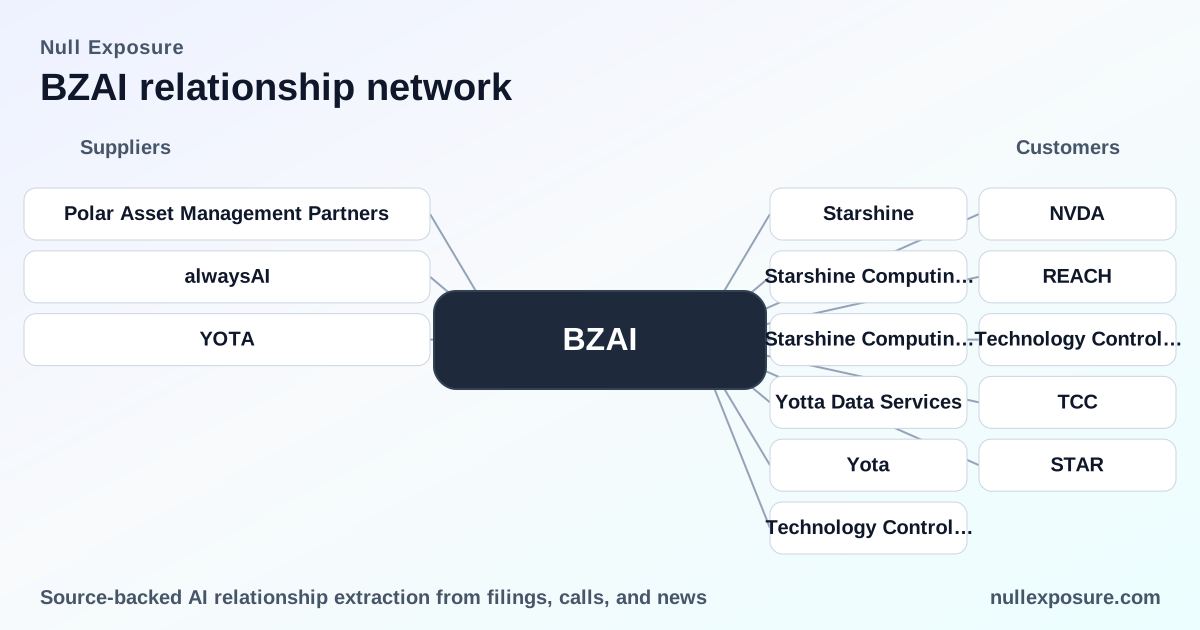
Blaize Holdings (BZAI) — supplier relationships that shape commercial scale-up
Blaize is a fabless AI-edge computing company that monetizes by selling AI-enabled SoCs, edge devices and accompanying software/services, and by monetizing R&D and commercialization partnerships. Its operating model centers on outsourced manufacturing and an internalized services architecture that shifts meaningful spend to related entities and external foundries; strategic investments and partner integrations accelerate go-to-market adoption while moderating capital intensity. For investors, the critical questions are whether partners convert to repeatable revenue, whether manufacturing capacity scales without margin erosion, and whether recent capital injections extend the company’s runway. Explore more supplier and counterparty intelligence at https://nullexposure.com/.
How Blaize runs the business and where value comes from
Blaize designs AI chips and edge systems but outsources wafer fabrication and physical product assembly, positioning itself as a fabless semiconductor and edge-systems vendor. Revenue is generated from product sales (chips and edge devices), software integrations with partners, and intercompany or contractor services tied to R&D and deployment. The company discloses a small but growing top line (roughly $14.9 million trailing twelve months) against negative operating margins, which makes commercial partnerships and outside funding critical to funding scale.
- Outsourced manufacturing is central: the company relies on third-party foundries and contract manufacturers to produce its SoCs and products, a relationship that is operationally critical and capital-efficient but creates supplier concentration risk.
- Internalized service spend is material: Blaize uses subsidiary and related-party service providers for software development and R&D, shifting tens of millions of dollars of operating expense to those entities and implying tight control over IP and development cadence.
- Partner integrations drive distribution: software and systems partners accelerate enterprise deployments; the success of those partners converting trials to volume shipments materially impacts revenue growth.
Dig deeper into supplier footprints and partner exposure at https://nullexposure.com/.
Key supplier and partner relationships investors should track
Polar Asset Management Partners — growth capital to extend commercialization
Blaize secured a $30 million investment from Polar Asset Management Partners to support commercialization acceleration and next-generation chip development as it scales into 2026; the company disclosed this during its Q3 2025 earnings call. This infusion both strengthens the balance sheet and signals investor confidence in execution, but investors should track whether the capital is directed to revenue-driving activities or primarily to product R&D (Q3 2025 earnings call).
alwaysAI — commercial computer-vision integration for edge deployments
Blaize announced a partnership with alwaysAI to combine alwaysAI’s computer vision and remote deployment capabilities with Blaize’s chipsets and edge devices, positioning Blaize for faster enterprise rollouts of real-time AI at the edge; the collaboration was detailed in a PR Newswire release in FY2025. This integration increases the addressable use cases for Blaize hardware and helps lower friction for customer adoption (PR Newswire, FY2025).
Yota — customer purchase order and near-term revenue recognition
Management reported on the Q3 2025 earnings call that Blaize is fulfilling a purchase order from Yota and expects initial deliveries to be completed within the year, representing near-term product revenue and a proof point for customer deployment. Investors should monitor shipment confirmations and subsequent orders to assess repeatability and gross margin contribution (Q3 2025 earnings call).
Manufacturing and internal service partners that underpin production and R&D
Blaize states it is a fabless company and relies on Samsung Foundry and Plexus to manufacture its semiconductor and SoC products, creating operational dependence on external capacity and quality control procedures (company filing text). Separately, Blaize disclosed substantial payments to related service entities: approximately $13.7 million expensed to Blaize India in 2024 for software development services and about $4.0 million to Blaize UK under an R&D services agreement for the same year. Those amounts make internal service providers a material component of operating costs and R&D throughput (2024 company disclosures).
What the constraints tell investors about Blaize’s operating posture
The company-level signals and constraint excerpts reveal a few decisive characteristics investors must weigh:
- Contracting posture — outsourced and intercompany hybrid: Blaize delegates manufacturing to third parties and relies heavily on related-party service contracts for software and R&D, indicating a lean headcount on manufacturing but concentrated operational dependencies.
- Concentration risk — single-source foundry exposure: explicit naming of Samsung Foundry and Plexus suggests supplier concentration that could constrain volume ramps or influence cost of goods if capacity tightness or yield issues arise.
- Spend criticality and scale — material internal spend: documented intercompany spend of ~$13.7M to Blaize India and ~$4.0M to Blaize UK in 2024 places these relationships in meaningful spend bands and ties product development velocity to those providers.
- Maturity and control — active vendor governance: the company describes routine vendor risk assessments and conformance checks to standards like ISO 27001 and supply-chain security practices, indicating an institutional approach to third-party risk management that is appropriate for scaling hardware/software vendors.
- Active relationship stage: excerpts show these are ongoing operational relationships rather than one-off pilots; manufacturing, R&D and partner integrations are active contributors to near-term execution.
Investment implications and concrete signals to watch
Blaize’s model requires simultaneous execution on manufacturing scale, partner-led deployments, and capital management. The Polar investment reduces near-term liquidity risk and funds next-gen chip development, but commercial success is contingent on partner-driven adoption and repeat orders that translate into sustainable margins.
Monitor the following catalysts and red flags:
- Shipment confirmations, invoicing and revenue recognition for the Yota order.
- Follow-on capital events or milestone-based draws tied to the Polar facility.
- Early margin data from partner-integrated deployments (alwaysAI integrations).
- Manufacturing yield and lead times from Samsung Foundry and Plexus.
- Trends in intercompany service spend and whether those costs compress as product scales.
If you want ongoing tracking of Blaize’s supplier exposures and how they impact credit and operational risk, see the full supplier analytics at https://nullexposure.com/.
Actionable monitoring checklist for operators and investors
- Confirm recognition of Yota revenue and any backlog tied to that customer.
- Watch product gross margins as volumes ramp and contract manufacturer costs normalize.
- Track any supply disruptions or capacity statements from Samsung Foundry or Plexus.
- Review subsequent capital inflows or financings following the Polar investment.
- Evaluate partner pipeline conversions (alwaysAI integrations to paying customers) and any disclosed contract terms affecting recurring revenue.
For a deeper supplier-by-supplier briefing and alerts on material relationship changes, visit https://nullexposure.com/ and request a tailored exposure report.
Conclusion — Blaize is executing a capital- and partner-driven scale strategy: outsourced manufacturing and material intercompany service spend lower fixed capital requirements but create supplier concentration and execution risk, while strategic investments and software partnerships accelerate commercialization. Investors should prioritize verifiable revenue ramps from named customers and observe manufacturing throughput and partner conversions as the primary determinants of valuation re-rating.