Beazer Homes (BZH) — Supplier relationships and what they mean for investors
Beazer Homes builds and sells single‑family residential homes across the United States and monetizes through home closings, land development and lot sales. The company’s supplier posture is execution‑centric: construction is outsourced to subcontractors while Beazer retains land inventory risk and the margin on completed homes and developed lots. For investors assessing counterparty and operational risk, the supplier picture is a mix of high spend on land development and a standard subcontractor model that transfers construction execution risk off the balance sheet. Learn more at https://nullexposure.com/.
The investment thesis in plain terms
Beazer’s operating model collects margins at two points: (1) profit on completed home sales and (2) value capture from land acquisition and development. The firm’s scale—roughly $2.27bn in trailing twelve‑month revenue and a market cap near $621m—means supplier relationships for land and trade contractors materially affect earnings volatility and delivery cadence. Beazer’s subcontractor strategy reduces fixed labor exposure but creates execution and insurance dependencies that are important for both credit and operational diligence.
If you want a structured supplier risk view tied to Beazer’s commercial model, visit https://nullexposure.com/.
How Beazer contracts work in practice
Beazer follows a common homebuilder contracting posture: it sources land centrally, carries development costs, and then engages subcontractors for the trade work. Company disclosures state that subcontractors must indemnify Beazer and carry insurance naming Beazer as an additional insured, which shifts legal and insurance obligations onto third parties while protecting Beazer’s balance sheet from certain construction defects and liability claims. This structure implies:
- Concentration of financial exposure in land: the company reports very large capital outlays for land acquisition and development, which are balance‑sheet heavy and have slower liquidity than completed inventory.
- Operational criticality of subcontractors: trades deliver the finished product and affect delivery schedules and warranty exposures, but legal protections reduce direct payroll and benefit liabilities for Beazer.
- Maturity and scalability: the subcontractor model scales with volume but requires active supplier management to preserve quality and margins.
Every reported supplier relationship (full coverage)
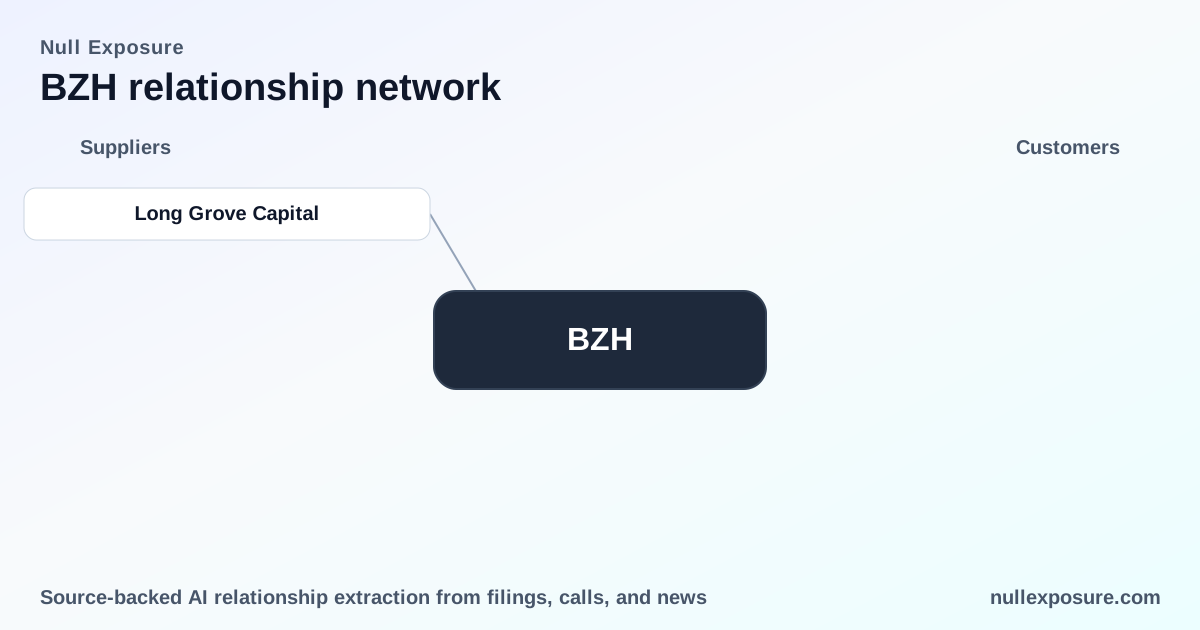
Long Grove Capital — an M&A adviser and consultant role
Long Grove Capital was cited as a consulting counterparty involved in an M&A transaction connected to Imagine Homes’ San Antonio operations; media coverage framed the firm’s role as advisory to both buyer and seller in the deal. This relationship is transactional and advisory rather than a recurring construction supplier agreement. Source: HousingWire coverage of the Imagine Homes transaction, March 2026.
(That is the complete set of supplier relationships surfaced in the provided results.)
Company‑level constraints and what they mean for relationship risk
Beazer’s public excerpts include two constraints that illuminate sourcing and financial posture at the company level:
-
Subcontractor indemnity and insurance requirement — Company filings explicitly require subcontractors to indemnify Beazer and to provide certificates of insurance naming Beazer as an additional insured. This is a governance and risk transfer signal: Beazer minimizes direct liability for trade execution while preserving contractual recourse and insurance coverage in the event of defects or claims. This reduces Beazer’s direct payroll and benefits exposure but increases reliance on the adequacy of subcontractor insurance programs and the enforceability of indemnity terms.
-
High land and development spend (>$100m band) — Beazer disclosed spending $491.9m and $507.8m on land acquisition in fiscal 2025 and 2024, respectively, and $192.0m and $268.7m on land development for the same periods. This level of land capital intensity places balance‑sheet and counterparty focus on title, entitlement, and development vendors (surveyors, civil contractors, utility partners, permitting consultants). Heavy land spend creates concentration in a relatively illiquid asset class and elevates the importance of supplier relationships that control entitlement and lot delivery timelines.
Those constraints are company‑level signals and are not specific to any one external adviser or supplier unless the excerpt names them.
Where supplier risk shows up in the numbers
Beazer’s reported financial and market metrics reinforce the operational story: low operating margin on a TTM basis and significant capital tied up in land increase the economic consequences of supplier disruption. A higher beta and sizeable institutional ownership indicate the stock is sensitive to cycle swings and execution headlines, so supplier failures or material warranty exposures would be magnified in the share price.
Practical implications for investors and operators
Investors and operational partners should treat Beazer’s supplier structure with targeted diligence:
- Evaluate the insurance and indemnity strength of major trade partners and whether certificates naming Beazer as additional insured are current and comprehensive.
- Monitor the timing and counterparty mix of land development spend; civil and entitlement contractors are single points of delay that can compress margins and push closings.
- Distinguish between advisory relationships (like Long Grove in M&A) and recurring operational suppliers; advisory firms affect strategic transactions, not construction delivery risk.
For a deeper, actionable supplier risk profile customized to Beazer, see our platform: https://nullexposure.com/.
Bottom line and next steps
Beazer’s supplier model balances off‑balance‑sheet labor risk against concentrated land investment. The company protects itself contractually from many operational liabilities, but that protection depends on subcontractor insurance and financial strength, while land spend drives capital exposure. For investors, the primary supplier risks are timetable slips and warranty claims that flow through to margins; for operators, the focus is on robust subcontractor vetting and insurance verification.
If you want a concise supplier health check and counterparty map for Beazer or comparable builders, start here: https://nullexposure.com/.
By combining the contractual signals in filings with transaction reporting such as the Long Grove advisory reference, investors can prioritize diligence on insurance programs, indemnity enforceability and the specific civil/entitlement vendors that support Beazer’s land conversion pipeline.