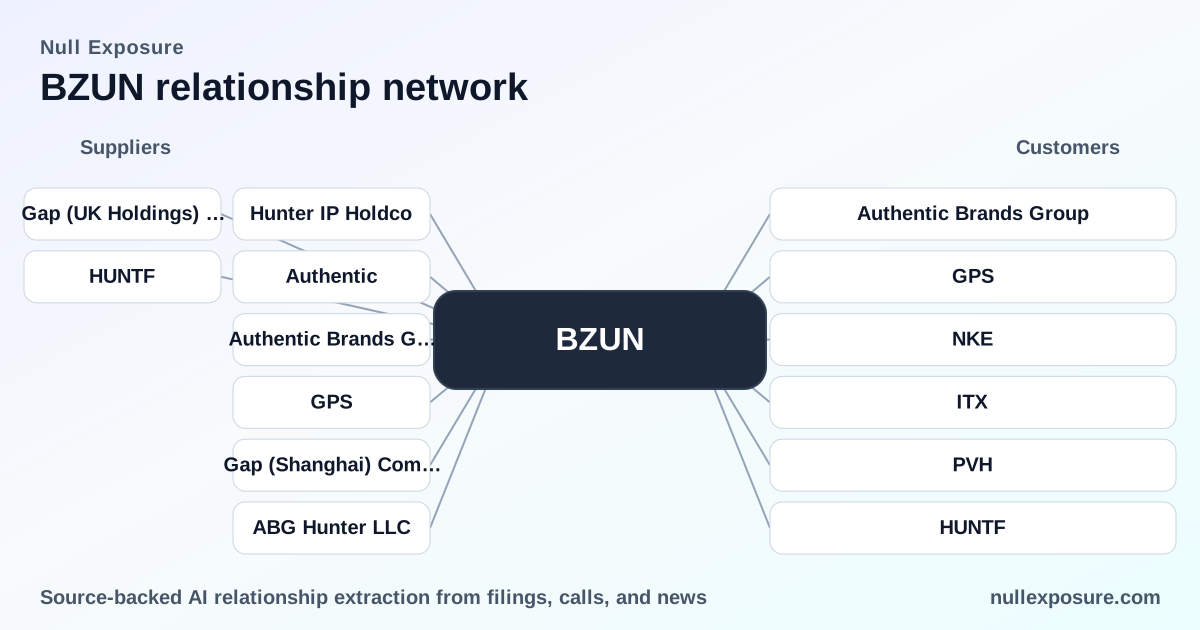
Baozun Inc. (BZUN) — supplier relationships that reshape its e‑commerce moat
Baozun operates as a full‑service e‑commerce enabler for global brands in China, monetizing through a mix of long‑term licensing and service contracts: digital storefront operations, logistics and fulfillment, marketing and creative services, and increasingly, ownership of local IP and operating assets. These arrangements convert brand revenue into platform fees, manufacturing/distribution margins and recurring services revenue, driving scale across a large Chinese revenue base (Revenue TTM: ~$9.77 billion) while leaving the company exposed to brand concentration and margin pressure. For a practical contractor and partner risk view, see more at https://nullexposure.com/.
How Baozun makes money and what that implies for suppliers and partners
Baozun’s commercial model blends agency and wholesale economics with licensing and M&A. When Baozun operates as a licensee or exclusive distributor it captures margin from manufacturing, distribution and local brand development; when it remains a service provider it captures recurring digital commerce fees and platform economics. The firm’s scale in China gives it leverage with marketplaces and suppliers, but its negative net margin and negative EPS (Diluted EPS TTM: -0.48) indicate that revenue scale is not yet translating into consistent bottom‑line profitability. That structural profile implies suppliers and partners face a counterparty that is powerful on distribution but sensitive to margin compression and capital allocation choices.
- Contracting posture: evidence from recent deals shows Baozun signs exclusive, long‑term licensing and acquisition agreements—suggesting a posture that pursues control over local operations and IP to secure revenue capture.
- Concentration: the business model depends on a set of large brand relationships; that concentration increases counterparty importance for both Baozun and its brand suppliers.
- Criticality: for Western brands targeting Greater China, Baozun functions as a strategic, sometimes sole, market entry and scale partner, which increases the supplier relationship’s strategic value.
- Maturity: public company metrics (Market Cap: $139m, EV/Revenue ~0.09, EBITDA positive) show a company with significant top‑line scale but transitional profitability — a growth‑at‑scale profile rather than a mature cash generator.
Explore supplier risk and partner scoring at https://nullexposure.com/ to see how these commercial signals affect contract and credit assumptions.
Relationships uncovered (each entry from available reporting)
Hunter IP Holdco
Baozun is set to receive assignment of a license through Hunter IP Holdco as the licensor across Greater China and Southeast Asia, reflecting Baozun’s expanding role on licensed brand IP management. (WWD, Mar 9, 2026) — https://wwd.com/business-news/mergers-acquisitions/authentic-brands-group-hunter-greater-china-southeast-asia-baozun-1235779133/
Authentic
Authentic reached an agreement for Baozun to acquire intellectual property rights to Hunter Boots for distribution in China and Southeast Asia, signaling a move from pure services into IP‑driven product distribution. (SGB Online, Mar 9, 2026) — https://sgbonline.com/authentic-reaches-deal-for-hunter-boots-intellectual-property-in-china/
Authentic Brands Group
Authentic Brands Group and Baozun entered an exclusive, long‑term licensing agreement under which Baozun will design, manufacture, market and distribute Hunter products in Greater China, indicating vertical integration and local product control. (WWD, Mar 9, 2026) — https://wwd.com/business-news/mergers-acquisitions/authentic-brands-group-hunter-greater-china-southeast-asia-baozun-1235779133/
Gap Inc.
Affiliates of Baozun and Gap entered arrangements granting Baozun rights to manufacture, market, distribute and sell Gap products in Greater China on an exclusive basis, a transaction that converts brand revenue into Baozun’s controlled revenues. (Yahoo Finance, Mar 9, 2026) — https://finance.yahoo.com/news/baozun-completes-acquisition-gap-shanghai-000000919.html
Gap (Shanghai) Commercial Co., Ltd.
Baozun announced completion of the acquisition of Gap (Shanghai) Commercial Co., Ltd., acquiring the operating entity that ran Gap’s Greater China business — a step that transfers local retail operations and revenue streams onto Baozun’s balance sheet. (Yahoo Finance, Mar 9, 2026) — https://finance.yahoo.com/news/baozun-completes-acquisition-gap-shanghai-000000919.html
ABG Hunter LLC
The license agreement originally with ABG Hunter LLC will be assigned to Hunter IP Holdco as the licensor across the region, a corporate step that clarifies licensor structure while preserving Baozun’s regional license rights. (SGB Online, Mar 9, 2026) — https://sgbonline.com/authentic-reaches-deal-for-hunter-boots-intellectual-property-in-china/
Gap (UK Holdings) Limited
Baozun’s White Horse Hongkong Holding Limited signed a share purchase agreement with Gap Inc. and Gap (UK Holdings) Limited to acquire equity interests of Gap Greater China operating entities, formalizing the ownership transfer. (Yahoo Finance, Mar 9, 2026) — https://finance.yahoo.com/news/baozun-completes-acquisition-gap-shanghai-000000919.html
Hunter
Baozun acquired rights to Hunter’s intellectual property across Greater China and Southeast Asia, positioning Baozun as the regional operator and licensor for product development, distribution and marketing. (WWD, Mar 9, 2026) — https://wwd.com/business-news/mergers-acquisitions/authentic-brands-group-hunter-greater-china-southeast-asia-baozun-1235779133/
What these relationships imply for investors and suppliers
The relationships reported come in two distinct flavors: exclusive licensing/IP acquisition (Hunter/Hunter IP Holdco/ABG/Authentic) and operational acquisition of brand operations (Gap and its local entities). Together they show Baozun is moving from service provider into operator‑owner, capturing more downstream margin while assuming inventory, manufacturing and working capital risk.
Key takeaways:
- Higher revenue capture from owned IP and acquired operating companies will increase top‑line visibility but will also raise capital intensity and working‑capital volatility.
- Supplier counterparty risk increases for brand partners that cede control: Baozun’s exclusive position creates lock‑in benefits for Baozun and strategic dependence for the brand.
- Margin profile remains a watch item: Baozun’s scale (Gross Profit TTM: ~$4.81bn) is strong, but negative net margin and EPS indicate operating leverage needs to be realized to justify the shift into ownership.
For an actionable supplier risk framework and partner exposure scoring, visit https://nullexposure.com/ and see how these strategic shifts alter counterparty profiles.
Bottom line — an operational partner shifting into owner
Baozun’s recent deals show a deliberate shift toward vertical integration and IP ownership, converting service relationships into controlled distribution and manufacturing businesses. That strategy increases revenue capture and strategic defensibility in China, but also concentrates execution risk on Baozun’s ability to convert scale into sustainable profits. Investors and counterparties should price in higher working capital and operational risk, alongside the upside from bonded brand revenues and exclusive regional rights.
If you evaluate supplier relationships or need partner scoring for credit or contracting decisions, start with a supplier‑first analysis at https://nullexposure.com/ — detailed partner intelligence changes negotiation and risk assumptions.