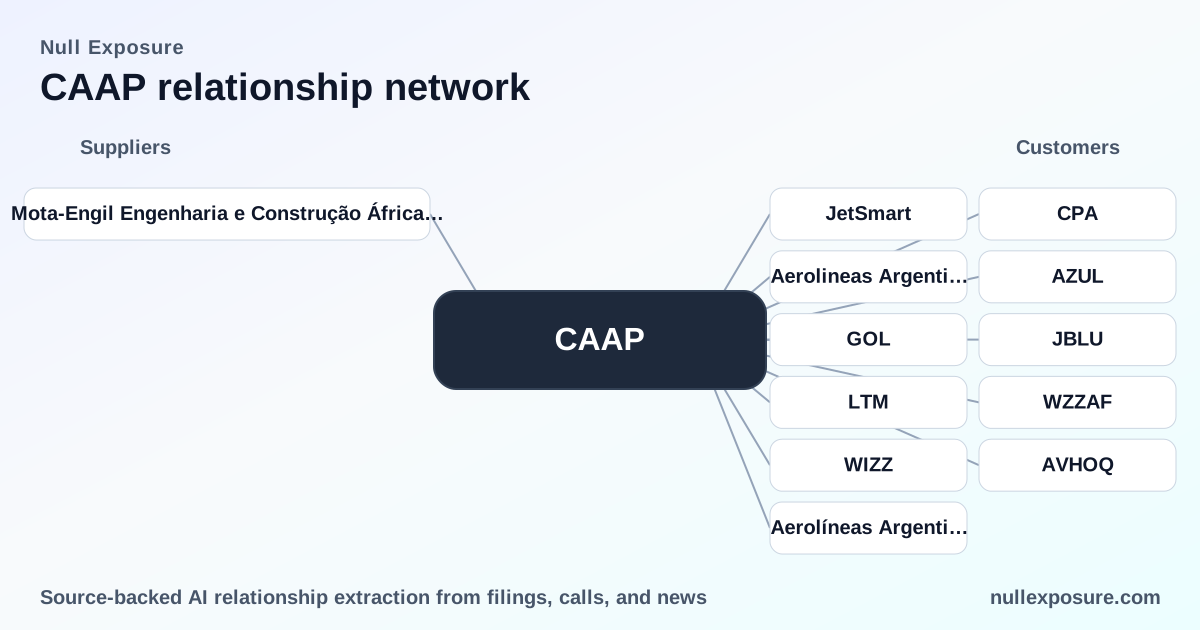
Corporacion America Airports (CAAP): Supplier relationships, the Angola concession, and what investors should price in
Corporacion America Airports operates, acquires and manages airport concessions globally and monetizes through long-term concession fees, aeronautical charges, and higher-margin non-aeronautical revenue (retail, parking, ground services). The business model is concession-driven: CAAP secures long-duration operational rights, invests in terminal and airside improvements—often with construction partners—and extracts cash flow over the life of the contract. For investors, the value proposition is stable, contract-backed cash flow with upside from traffic recovery and retail mix optimization. Learn more on the firm and supplier landscape at https://nullexposure.com/.
The headline: CAAP wins AIAAN concession with a construction consortium partner
CAAP announced a consortium arrangement to operate Guinea-Bissau’s Antonio Agostinho Neto International Airport (AIAAN) under an initial 25‑year concession. The operating mandate is held by CAAP in partnership with Mota‑Engil Engenharia e Construção África S.A., a construction and engineering firm, which signals an integrated operator‑plus‑builder approach to deploying capacity and capturing early-stage value. According to a March 9, 2026 news article on mercado.co.ao, the concession award gives CAAP management responsibility for AIAAN with a potential renewal option for the contract.
Every reported supplier relationship and what it means
- Mota‑Engil Engenharia e Construção África S.A.: CAAP will operate the AIAAN airport in consortium with Mota‑Engil under an initial 25‑year concession, combining CAAP’s airport operating capability with Mota‑Engil’s construction engineering capacity to deliver terminal and infrastructure works required by the concession (news report, mercado.co.ao, March 9, 2026).
How this supplier relationship fits CAAP’s operating model
CAAP’s concession strategy routinely pairs operational know‑how with local or regional construction partners to accelerate ramp-up and meet capital expenditure schedules. This consortium model converts a timing and execution risk into a structured partnership: CAAP captures operating upside while the construction partner absorbs a large portion of capex execution. The Angola/Guinea‑Bissau award illustrates three corporate-level operating signals:
- Contracting posture — concession-centric and long-tenured: CAAP constructs value through multi‑decade contracts that convert traffic growth into durable cash flows.
- Concentration and geographic reach — diversified by concession but sensitive to regional politics: CAAP’s revenues are spread across jurisdictions, which reduces single-market revenue concentration but increases exposure to country-specific execution and regulatory risk.
- Criticality and maturity — supplier relationships are operationally critical and strategically integrated: construction and engineering partners are essential to meeting concession milestones; CAAP’s typical approach is collaborative consortiums rather than pure outsourcing.
- Financial standing — cash-flow positive, mid-cap scale with attractive valuation metrics: company figures through the quarter ended 2025‑09‑30 show Revenue TTM of $1.87B and EBITDA of $667.8M, with EV/EBITDA of 7.6 and trailing P/E of ~22.5, reflecting a mature operator profile and room for multiple compression/expansion based on contract wins and traffic recovery.
Financial and governance signals investors should weigh
Financial and shareholder data reveal additional firm-level signals that affect supplier risk and negotiating posture. CAAP’s insider ownership is pronounced (insiders hold ~80.7% of shares) while institutions represent ~15.1%. This ownership structure produces strong founder control and predictable strategic direction, but also limits the degree of activist pressure that could reshape supplier contracting tactics. The company’s operating margin (27.9% operating margin TTM) and return on equity (~12.6%) show healthy profitability for an airport operator, supporting the ability to fund concession investments and honor partner commitments.
What the Mota‑Engil partnership implies for execution and risk
Pairing CAAP with an experienced regional builder addresses execution risk at the point of handover and early operations. Key implications for investors:
- Faster project delivery and potentially lower cost overruns because the construction partner internalizes build risk.
- Higher alignment between capex scheduling and operational ramp, improving near-term cash conversion.
- Concentration of political and regulatory risk in the awarded jurisdiction: concession performance will depend on bilateral agreements, local permitting, and macro stability.
Risk / Opportunity checklist
- Opportunity: Long-duration concession provides steady annuity-style cash flow and optionality on renewals and ancillary commercial revenue growth.
- Risk: Country-specific political and operational risk (licensing, currency, macro) is material for new concessions and can compress returns if traffic lags.
- Counterparty risk: Performance depends on partner reliability; the consortium construct reduces pure-execution risk but introduces dependency on the partner’s financial/operational health.
- Valuation play: CAAP trades at an EV/EBITDA that supports upside if traffic and retail monetization exceed plan; downside exists if concessions underperform or geopolitical shocks occur.
How investors should read supplier announcements going forward
Treat supplier relationships as both execution tools and risk mitigants. Consortiums that include local engineering firms are a deliberate way for CAAP to accelerate obligations without taking the full construction execution risk on its balance sheet. Monitor three signals in future announcements:
- Contract tenure and renewal clauses (length and renewal mechanics drive valuation duration).
- Partner financial capacity and track record on similar projects (addresses execution risk).
- Payment and capex allocation (who funds early capex versus who shares in concession upside).
For ongoing tracking of CAAP’s counterparty landscape and concession awards visit https://nullexposure.com/ to see consolidated supplier profiles and deal timelines.
Bottom line and investor action
The AIAAN concession and the partnership with Mota‑Engil Engenharia e Construção África S.A. reflect CAAP’s playbook: win long-duration concessions, pair with a construction partner to manage capex execution, and extract operating margins through aeronautical plus non-aeronautical revenue. For risk-adjusted investors, CAAP offers a concession-backed, cash‑flow oriented exposure to airport demand recovery, tempered by country-level execution and political risk. Track pipeline awards and partner credit quality closely; these are the variables that convert a concession win into durable shareholder value.
If you want a consolidated view of CAAP’s supplier relationships and concession timelines, visit https://nullexposure.com/ for deeper supplier analysis and deal history.
For investors allocating to airport operators, CAAP’s concession wins and consortium partners are a primary lever of value creation—monitor contract terms and partner execution as the next catalyst. Discover an up-to-date supplier map at https://nullexposure.com/.