Cabaletta Bio (CABA): what investors need to know about manufacturing and license partners
Cabaletta Bio develops autologous T‑cell therapies for B‑cell autoimmune diseases and monetizes through asset advancement toward commercialization: value is created by progressing lead programs through clinical proof-of-concept and securing licensing, milestone and eventual product revenue streams. The company outsources critical research and manufacturing functions to academic and contract partners while retaining exclusive IP licenses on core binders — a capital‑light R&D model that depends on third‑party scale and regulatory approvals to unlock commercial value. Explore a supplier-centered view at https://nullexposure.com/.
Why suppliers drive valuation here — and the operating rhythm behind it
Cabaletta is a clinical‑stage biotech with no material product revenue and negative EBITDA, so the board’s strategic choice is to concentrate capital on development and rely on external providers for lab work and GMP manufacture. This creates an operating posture where supplier selection and contract terms directly influence timelines, regulatory risk and margin upside on any approved product.
Company disclosures and public commentary surface three structural themes:
- High supplier criticality and concentrated reliance. Cabaletta explicitly depends on university labs and a small set of CMOs for current manufacturing and research, which makes these relationships operationally critical to program timelines (company filings and management commentary, FY2024–FY2026).
- Mixture of licensing and short‑term manufacturing arrangements. The firm holds exclusive license rights on key binders and uses a blend of multi‑year license payments and shorter manufacturing work orders for clinical supply — a mix that shifts fixed cost off the balance sheet but creates execution dependence on partners.
- Geographic and supply‑chain exposure. The company sources specialty materials that can come from APAC suppliers and small vendors, introducing single‑source and regional concentration risks.
These are not abstract points: the 10‑K and subsequent press coverage name specific counterparties and contract features that operationalize the above. If you evaluate CABA as a supplier risk case, calibrate both the probability of partner disruption and the financial impact on development timetables. See the supplier overview at https://nullexposure.com/ for mapping and exposure metrics.
The counterparties you must track (one‑line investor summaries)
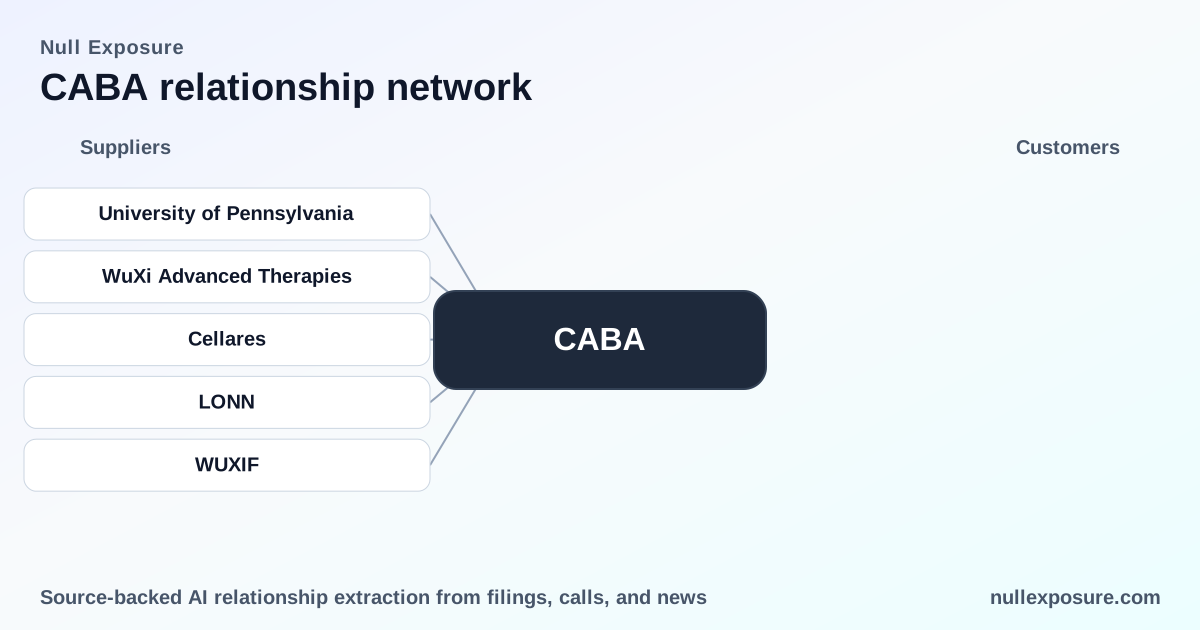
Below are the relationships extracted from public reports and news items; each entry is followed by a concise source reference.
University of Pennsylvania
Cabaletta maintains services agreements with Penn for research, development and manufacturing support that underpin its preclinical and early clinical activities; these agreements give Penn a central role in the company’s technical progress. Source: QZ earnings coverage citing company statements (FY2025) — https://qz.com/cabaletta-bio-inc-caba-reports-earnings-1851773428.
WuXi Advanced Therapies
WuXi Advanced Therapies is a named manufacturing and research services provider under work orders that convert non‑dedicated to dedicated GMP suites; the relationship includes defined terms and potential termination provisions, making it a material operational counterparty. Source: QZ earnings coverage (FY2025) and Cabaletta 2024 Form 10‑K (contract excerpts referencing WuXi, FY2024).
WuXi (WUXIF)
The company’s 10‑K discloses that WuXi can terminate the agreement or any work order for convenience on 18 months’ notice (not effective prior to Feb 2028), a contractual feature that creates a defined but finite stability window for dedicated clinical manufacturing capacity. Source: Cabaletta 2024 Form 10‑K (FY2024).
Cellares
Cellares received FDA clearance of an IND amendment to allow Cabaletta to use its automated Cell Shuttle™ and Cell Q™ platforms for manufacturing and QC release testing of rese‑cel, positioning Cellares as a potential scalable, higher‑margin manufacturing source if commercial agreements follow. Source: Cellares announcement and related press coverage (Nov 2025–Jan 2026) — e.g., Cellares press releases and market reports (FY2025–FY2026).
Lonza
Management has stated that Lonza is a current manufacturing partner and that Cellares could join Lonza as one of two manufacturing sources if clinical results and commercial terms support the move, indicating a dual‑source commercial strategy under consideration. Source: Yahoo Finance coverage of company commentary (FY2026) — https://finance.yahoo.com/news/cabaletta-bio-kicks-off-pivotal-050759072.html.
(Each relationship above is drawn from company filings and contemporaneous news reporting; follow the links for primary context.)
Contracting posture, concentration and spend signals investors should internalize
Cabaletta’s public filings generate a set of actionable company‑level signals:
- Contract types: The company operates a blend of exclusive licensing arrangements (multi‑year, royalty‑bearing) for core IP and shorter, work‑order manufacturing contracts for clinical supply, which creates a two‑tier cost profile — predictable long‑term royalty commitments versus operationally sensitive CMO services.
- Role mapping: The firm functions as licensee for IP from Penn/CHOP/IASO and as a customer of manufacturers/service providers (Penn, WuXi, Lonza, Cellares). This split limits capital intensity but transfers execution risk to partners.
- Concentration and materiality: Public language classifies certain partners as material — Penn and WuXi are explicitly cited as having potential material impact if they fail to perform — while broader supplier spend signals show a range from modest upfront license payments (single millions) to higher potential milestone exposure (tens to low hundreds of millions).
- Supply risk profile: Cabaletta highlights reliance on small specialty suppliers and APAC sources for raw materials, marking single‑source and regional vulnerability that operators must monitor across scaling phases.
- Spend bands: License upfronts and work orders display a spectrum: sub‑$10M operational commitments and a larger $100M+ contingent milestone universe tied to licensing outcomes.
These signals collectively imply that operational continuity and partner contracting are as value‑important as clinical data for CABA.
What this means for investors and operators
- Short term: Watch milestones tied to the IND amendment and manufacturing pathway through Cellares and Lonza — regulatory clearance for manufacturing platforms materially reduces execution risk for scaling autologous CAR‑T.
- Medium term: If Cabaletta moves to commercial supply, converting relationships from work orders into robust commercial agreements with multiple CMOs will be essential to defend margins and ensure capacity.
- Risk triggers to monitor: contract termination windows (WuXi’s 18‑month notice clause), reliance on small APAC suppliers for inputs, and unmet milestone payments that could stress cash flow.
For a full, investor‑grade supplier exposure map and ongoing monitoring of counterparties and contract clauses, visit https://nullexposure.com/ and review the supplier profiles.
Bottom line and next steps
Cabaletta’s value depends on progressing rese‑cel and related programs while converting academic and CMO relationships into scalable, multi‑site manufacturing pathways. The company’s licensing strategy reduces upfront capital needs but concentrates operational risk in a handful of partners; successful commercial economics require diversifying manufacturing sources and securing favorable long‑term supply agreements. To track these developments in real time and tie them to market exposure, review Cabaletta’s supplier intelligence at https://nullexposure.com/.
For investors building a diligence checklist, prioritize: contractual termination windows, exclusivity/right‑to‑sublicense language on IP, validation status of automated manufacturing platforms, and the geographic diversity of critical raw material suppliers. For operators, begin negotiating commercial‑scale terms with alternate CMOs now to de‑risk a potential approval pathway.