Cable One (CABO) — Supplier relationships that shape margins and strategic optionality
Cable One, operating under the Sparklight brand, is a U.S. regional broadband and video operator that monetizes through subscription services (residential and business broadband, video and voice), device and managed-service sales, and increasingly through adjacent services such as in‑home Wi‑Fi and a nascent mobile offering. Revenue is driven by recurring subscriber fees and higher‑margin managed services; supplier commitments for programming, device partnerships and network access materially determine both cost structure and customer experience. For a focused supplier-risk read on CABO, visit https://nullexposure.com/.
Why supplier relationships matter to an investor in CABO
Cable operators are commodity sellers of connectivity but differentiators for customers come from in‑home experience and content. CABO’s supplier posture combines long‑term licensing obligations and significant programming spend that compress residential video margins, while device and platform partnerships influence churn and ARPU. The company’s public disclosures and press coverage show three operating dynamics that matter:
- Long‑term contractual commitments for programming and retransmission create predictable but sizable fixed costs. Company disclosures describe multi‑year programming agreements that establish payment rates based on subscribers and extend multi-year obligations.
- High programmatic spend concentration: programming costs and retransmission fees are a dominant line item for the video product, historically representing between 59% and 64% of residential video revenues, which makes video a structurally lower‑margin product versus broadband.
- Scale of committed spend is large: the company’s reported outstanding contractual obligations table includes totals in the excerpt that sum to $3,836,359 (in thousands) as of December 31, 2024, indicating multi‑year cash commitments on the balance sheet. These are company‑level signals that inform cash‑flow risk and bargaining room with suppliers.
Taken together, CABO operates with mature, material supplier obligations that are predictable but costly, while strategic device and mobile partners provide avenues to lift ARPU and retain customers. Learn more about supplier analytics at https://nullexposure.com/.
What the market coverage shows — the supplier roster and how each relationship functions
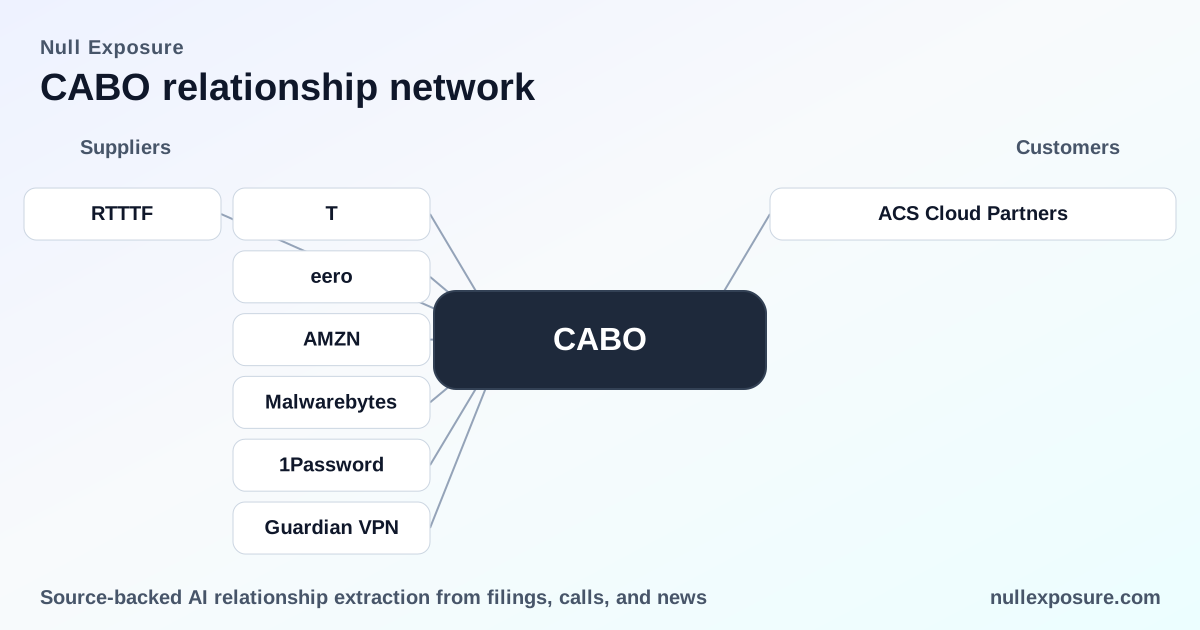
Below I cover every supplier relationship surfaced in the results, with concise plain‑English takeaways and source context.
-
AT&T — Cable One used AT&T’s network for market trials of its new MVNO offering while piloting the service with an MVNE partner. According to a DataCenterDynamics report (Mar 2026), Sparklight ran market trials on AT&T’s network as it tested Sparklight Mobile.
Source: DataCenterDynamics, March 2026. -
Reach — Reach acted as the mobile virtual network enabler (MVNE) partner for initial pilot activity; the company partnered with Reach for a summer pilot while using AT&T’s radio network for trials. DataCenterDynamics (citing Light Reading) reports Reach supported Sparklight’s MVNO pilot in FY2025.
Source: DataCenterDynamics (Light Reading reference), FY2025. -
eero (Amazon’s eero Wi‑Fi) — CABO has rolled out the eero Wi‑Fi 7 portfolio across its residential footprint and leverages eero for both consumer and managed business Wi‑Fi offerings (Business Wi‑Fi Plus). Management said over one‑third of residential broadband customers were using the advanced in‑home capabilities provided by the eero partnership at year‑end, reflecting rapid adoption. Multiple press releases and an 8‑K in early 2026 document the product rollout and business program.
Sources: Company 8‑K and press coverage including StockTitan, Finviz and MarketScreener; earnings call transcript referenced by InsiderMonkey, FY2026. -
Malwarebytes — Malwarebytes is included as a trusted security service option in eero’s premium subscription bundle offered through Sparklight devices, delivering antivirus and identity protection features to customers who choose the upgrade. This was described in product press materials announcing eero Wi‑Fi 7 availability.
Source: StockTitan product announcement, FY2026. -
1Password — 1Password is listed as a trusted service available via the optional eero Plus upgrade sold through Sparklight’s device bundle, extending password and identity management to end users as an upsell. Product marketing for the eero integration names 1Password alongside other security partners.
Source: StockTitan product announcement, FY2026. -
Guardian VPN — Guardian VPN is one of the security/trusted services available through the eero ecosystem that Sparklight now offers with its Wi‑Fi devices as part of premium subscriptions. The inclusion is noted in the product release materials tied to the eero rollout.
Source: StockTitan product announcement, FY2026.
How these relationships move the needle — strategic and financial implications
The supplier list splits into two clear functional buckets: (1) content and network access (programming vendors, retransmission, AT&T, MVNE partners) that represent large, contractual, low‑flex cost commitments; and (2) device and security platform partners (eero, Malwarebytes, 1Password, Guardian VPN) that are levers to increase ARPU, reduce churn and differentiate the consumer experience.
- Contracting posture and maturity: Programming obligations are structured as long‑term, multi‑year agreements and recorded as license fees; this provides expense predictability but limits near‑term margin flexibility. The company’s contractual obligations table (Dec 31, 2024) shows multi‑year commitments in the billions (reported in thousands), confirming the maturity and scale of supplier exposure.
- Concentration and criticality: Programming and retrans fees are material to CABO’s residential video product (59–64% of video revenues historically), making these suppliers critical to product economics even as video becomes a smaller share of total revenue over time.
- Optionality and upside: Partnerships with eero and bundled security services are high‑impact, market‑facing relationships that accelerate adoption of higher‑margin managed services and device revenue, and support a shift toward subscription add‑ons that improve lifetime value.
- Emerging risk vector — mobile: The MVNO experiment with Reach and trials on AT&T’s network enlarge the company’s supplier surface area; while this can create new ARPU streams, it also introduces new network dependence and commercial complexity.
If you’re analyzing CABO supplier risk, track quarterly commentary on programming renewals, retransmission rulings, and the commercial rollout metrics for Sparklight Mobile and eero upsells. More detailed supplier risk models and monitoring tools are available at https://nullexposure.com/.
Bottom line and investment action points
- Cost structure is anchored by long‑term licensing and retransmission commitments that are material to video margins. That structural cost base constrains short‑term margin upside from core video services but is predictable.
- Device and security partnerships are the primary lever for ARPU expansion and differentiation. Eero and bundled security services represent tangible pathways to monetize the in‑home experience.
- Mobile is a strategic optionality with supplier complexity; pilots used Reach as an MVNE and AT&T for radio trials, indicating a measured approach to market entry that will require scaled agreements to materialize revenue.
For investors and operators focused on supplier risk and monetization strategy, prioritize contract renewal terms for programming, adoption metrics for eero‑powered managed services, and public disclosures on the commercialization plan for Sparklight Mobile. For continued supplier intelligence and tracking, visit https://nullexposure.com/.
For direct supplier risk briefings or to model contract exposure into valuation scenarios, see the homepage at https://nullexposure.com/ — the best starting point for sourcing ongoing updates and vendor signal analysis.