Caring Brands (CABR): supplier relationships and what they signal for investors and operators
Caring Brands operates as a small-cap wellness consumer products company that manufactures and licenses over-the-counter and cosmetic products and monetizes through product sales, licensing arrangements and capital markets activity—most recently a public offering tied to a Nasdaq uplisting that injected liquidity and underwriting support. The business model blends B2B licensing/manufacturing arrangements with direct-to-market product sales, and corporate finance actions are an essential revenue and survival lever given minimal operating scale. For an investor or operator assessing supplier exposure, the immediate priorities are execution on licensed products, counterparty terms on manufacturing and distribution, and capital runway. Learn more about the research framing at https://nullexposure.com/.
How CABR actually runs (and why suppliers care)
Caring Brands reports extremely low revenue and negative operating income on a TTM basis—Revenue TTM of $4,493 with negative EBITDA and an operating profile consistent with an early-stage consumer healthcare company that relies on partner agreements and capital raises to fund commercialization. Market capitalization and retail float are small; insiders control a high share of equity (about 72% insider ownership), which concentrates decision authority and affects bargaining dynamics with suppliers and licensors.
- Contracting posture: Expect short-term or highly conditional contracts tied to product launches and licensing milestones rather than long-term fixed supply agreements. Capital markets transactions are used to finance go-to-market activity.
- Concentration and criticality: A single successful licensing partner or product lift can materially affect revenue; conversely, a supplier that provides manufacturing or distribution services to an exclusive licensed product becomes strategically critical.
- Maturity: Uplisting to Nasdaq in November 2025 is a milestone, but financials show the company remains operationally nascent and execution-risk intensive.
If you want a ready overview of CABR’s market activity and partner footprint, visit https://nullexposure.com/ for consolidated signals and filings.
Supplier and partner ledger: what the filings and press releases show
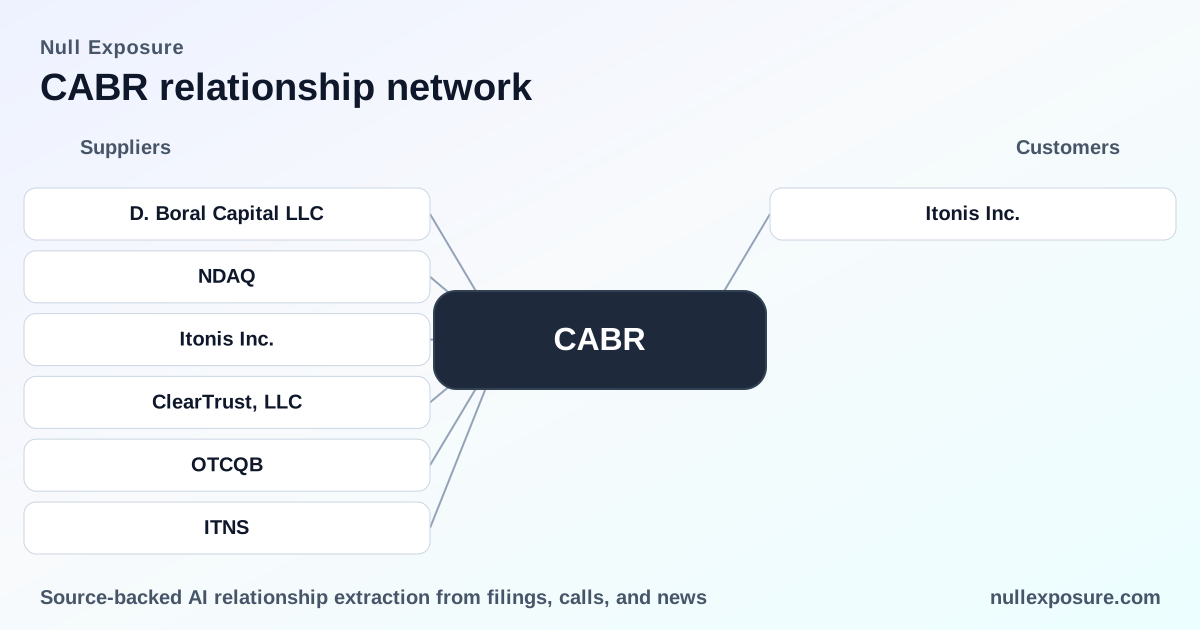
Below are every counterparty relationship surfaced in public releases and news reports. Each entry contains a concise plain-English summary and a source citation.
-
D. Boral Capital LLC — D. Boral acted as the sole underwriter for Caring Brands’ $4.0 million public offering that supported the company’s uplisting and recapitalization; the firm led the distribution and closing activities reported around the November 2025 transaction. According to a GlobeNewswire press release covering the November 13–14, 2025 offering, D. Boral served as sole underwriter. (GlobeNewswire, November 2025)
-
Nasdaq Capital Markets — Caring Brands received approval to list its common shares on the Nasdaq Capital Market, with trading commencing under the symbol CABR on November 13, 2025; the listing supplanted OTCQB trading. The company announced the Nasdaq approval and expected trading start in its November 2025 offering disclosure. (GlobeNewswire / press release, November 13, 2025)
-
Nasdaq (NDAQ) — Separate reporting reiterates that CABR’s shares commenced trading on Nasdaq on November 13, 2025 and that certain offering mechanics were contingent on listing approval and SEC effectiveness. This underscores Nasdaq listing as a corporate-finance event tied to the offering. (GlobeNewswire press release summarizing the closing on November 14, 2025)
-
Itonis Inc. — Caring Brands entered an exclusive worldwide license agreement to manufacture, market and distribute Emesyl, an over-the-counter nausea relief product developed by Itonis, positioning CABR as the commercial manufacturing partner for that SKU. The company announced the exclusive license in public releases in late 2025 and early 2026. (Yahoo Finance distribution and StockTitan/GlobeNewswire summaries, November 2025 / March 2026)
-
ClearTrust, LLC — ClearTrust is referenced as a distribution agent that will round down fractional shares of CABR common stock into whole shares in connection with a distribution tied to corporate actions; this highlights operational mechanics for shareholder distributions. The arrangement was noted in a Yahoo Finance press synopsis tied to a related distribution announcement. (Yahoo Finance investor release, 2025–2026)
-
OTCQB — As part of the corporate transition, CABR’s common stock ceased trading on the OTCQB upon commencement of Nasdaq trading; the OTCQB listing was explicitly replaced by the Nasdaq Capital Market listing announced in November 2025. (StockTitan/GlobeNewswire reporting in November 2025)
What these relationships imply for suppliers and operators
The relationship set reveals a company that is building commercial capacity through licensing (Itonis) while depending on capital markets and third-party underwriters (D. Boral) to fund commercialization and give suppliers payment certainty.
- Licensing-driven go-to-market: The Itonis license turns CABR into a manufacturer/distributor for a branded OTC SKU; that elevates suppliers who provide contract manufacturing, packaging, and logistics to strategic status because product success will drive near-term revenue.
- Financing dependency: The D. Boral underwritten offering and the Nasdaq uplisting are structural financing events that improved liquidity but did not change the fact that operating cash flow is near-zero. Suppliers should insist on tighter payment terms or milestone-based arrangements until sales scale.
- Operational execution risk: Small revenue base and negative operating metrics mean launch performance is the key risk. A single failed product launch or delayed manufacturing run will have outsized impact.
- Governance and concentration: High insider ownership implies consolidated decision-making and faster contract approvals, but also potential for strategic decisions that favor owner-control objectives over broad investor or supplier protections.
If you are negotiating manufacturing or distribution contracts with CABR, prioritize milestone-aligned payments, roll-forward capacity clauses, and clear intellectual property and quality control terms tied to the Itonis license.
For a deeper signals-driven view of how these partner moves affect supplier credit and contract posture, explore our research hub at https://nullexposure.com/.
Practical next steps for investors and operational partners
- For investors: Monitor revenue recognition on the Itonis Emesyl launch and cash-burn monthly cadence. The public offering provided runway but not proof of sustainable sales.
- For suppliers: Structure contracts around deliverables and escrowed payment mechanics where possible; secure supplier termination rights for prolonged non-payment.
- For both: insist on transparent monthly reporting tied to the licensed product’s sales and any use of proceeds from capital raises.
Bottom line
Caring Brands is a small, capital-market-backed operator transitioning from OTC to Nasdaq and expanding via an exclusive license that could scale sales if the company executes manufacturing and commercialization effectively. The core investment and operational risk is execution: financing and uplisting reduce immediate liquidity risk but do not mitigate the need for robust supplier protections and disciplined launch metrics. For ongoing monitoring and deal-level diligence, see the company’s filings and aggregated partner signals at https://nullexposure.com/.