Camden National Corporation (CAC): Supplier relationships and third‑party risk that matter to investors
Thesis — Camden National Corporation is a regional bank holding company that monetizes a mix of net interest income from loans and securities plus fee and noninterest income (payments income, loan fees and transaction services), while pursuing growth via targeted acquisitions and client product expansion. For investors evaluating supplier exposure, the company’s vendor footprint is concentrated around capital markets advisors, payment networks and outside legal counsel—relationships that drive deal execution, fee income and operational continuity. For deeper supplier-risk intelligence and counterparty mapping, visit https://nullexposure.com/.
How Camden National earns its keep (and why suppliers matter)
Camden National is the banking holding company for Camden National Bank, serving consumer, commercial, institutional and municipal customers primarily in New England. Revenue of $233.5 million (TTM) with a 27.9% profit margin and a 10.6% ROE signals a profitable regional banking franchise with a mix of interest and noninterest revenue streams. The company reported meaningful noninterest items tied to its payment network relationships: an annual Visa incentive bonus of $979,000 recognized in Q4 2025 that directly contributes to reported noninterest income, and higher customer loan swap fees on a linked‑quarter basis. According to PR Newswire’s Q4 2025 release, those items influenced the quarter’s headline results.
Camden’s strategic playbook includes bolt‑on acquisitions and deal activity that lean on external advisors and counsel for valuation, fairness opinions and regulatory work—supplier relationships that can be simultaneously strategic and mission‑critical. For a supplier‑centric view of counterparties and deal advisors, see https://nullexposure.com/.
Supplier relationships to monitor (what each does and why it matters)
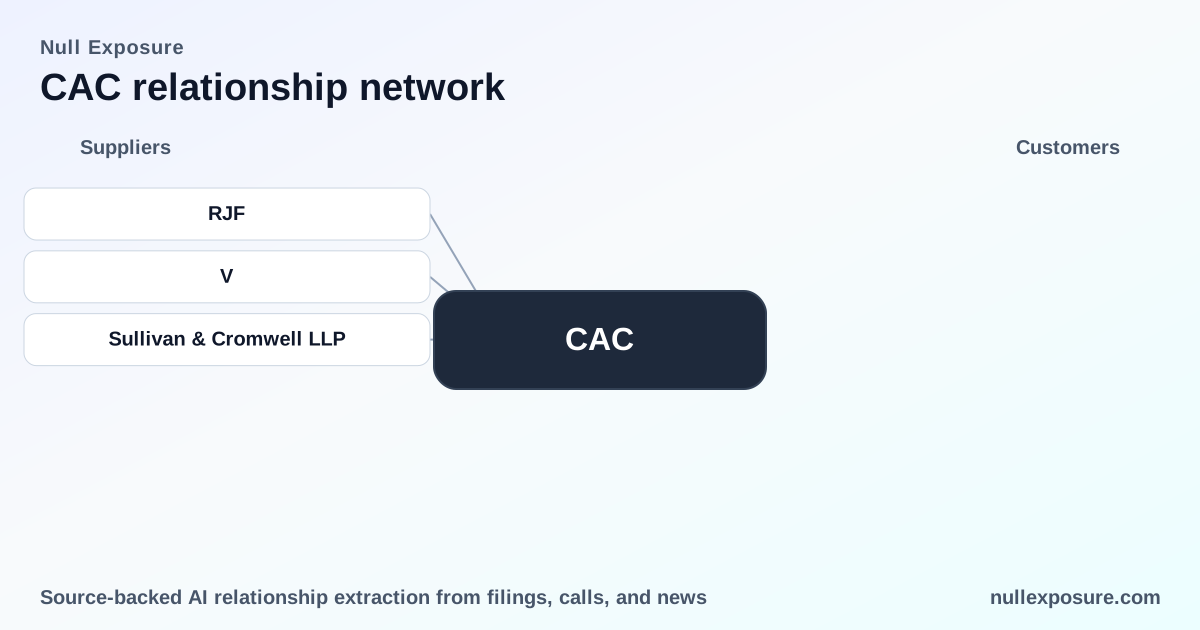
Raymond James & Associates, Inc.
Raymond James served as exclusive financial advisor and provided a fairness opinion to Camden National’s Board in connection with the Northway Financial acquisition. That engagement signals reliance on a full‑service investment bank for valuation, deal structuring and transaction execution. (PenBay Pilot, reporting on the acquisition, March 2026.)
Visa
Visa is a core payments network partner whose incentive program and payment processing flows feed Camden’s noninterest income. Camden recognized an annual Visa incentive bonus of $979,000 in Q4 2025, a recurring line item that links payments partnership economics directly to quarterly results. (Camden National press release via PR Newswire and transcript coverage, Q4 2025.)
Sullivan & Cromwell LLP
Sullivan & Cromwell provided legal counsel to Camden National on the noted acquisition transaction, underscoring use of elite outside law firms for regulatory, disclosure and transactional risk management associated with M&A. (PenBay Pilot coverage of the transaction, March 2026.)
What the constraints say about Camden National’s operating model
Camden’s vendor constraints read as two clear, company‑level signals: (1) third‑party relationships are material to operations and financial condition because external failures or cyber incidents can cause operational disruption, customer impacts and regulatory consequences; (2) third‑party vendors act as service providers of key business infrastructure, so vendor performance directly affects the delivery of products to customers.
From an investor lens this implies:
- Contracting posture: Camden operates with standard vendor relationships that include advisors, payment networks and outside counsel; contracts are likely structured around discrete advisory and service engagements rather than captive vertical integration.
- Concentration and criticality: Certain suppliers are critical (payment networks like Visa and financial advisors for M&A) and their failures are material to the business; concentration risk exists where single providers serve strategic functions.
- Maturity and governance: The company acknowledges third‑party risk, which implies formal vendor management and oversight exist but that residual risk remains material to operations and financial results.
These constraints should be treated as company‑level governance signals rather than tied to any single named supplier unless the company explicitly states otherwise.
Investment implications and risk factors
Camden’s supplier map produces a set of clear investor takeaways:
- M&A dependency elevates advisor risk: Use of Raymond James for fairness opinions and deal execution means transaction outcomes and valuation support come from an external advisor; investor assessment of M&A‑driven growth must include counterparty diligence on advisor incentives and fees. (PenBay Pilot, FY2024/FY2025 reporting.)
- Payment network economics are meaningful to revenue volatility: The Visa incentive bonus is a recurring noninterest income component; changes in payments volumes or incentive structures will flow through quarterly results. (PR Newswire and earnings transcript coverage, Q4 2025.)
- Legal counsel reduces regulatory execution risk but increases legal expense exposure: Reliance on top‑tier firms like Sullivan & Cromwell for significant transactions improves regulatory navigation at the cost of outsized legal fees for complex deals. (PenBay Pilot, March 2026.)
- Third‑party operational and cyber risk is explicitly material: Camden’s own disclosures flag third parties as possible sources of information security and operational failures that could produce financial loss, reputational damage or regulatory action—an explicit risk factor investors should price into downside scenarios.
For a concise counterparty risk briefing or to map Camden National’s full supplier footprint for investment due diligence, explore https://nullexposure.com/.
Practical next steps for investors and operators
- Request targeted diligence on payment economics (Visa rebates/incentives, interchange trends) and advisor agreements (fee structure and termination rights) before underwriting M&A or growth projections.
- Stress‑test loss scenarios tied to a vendor outage or cyber incident given Camden’s explicit statement that third‑party failures are material.
- Monitor quarterly disclosures where noninterest income and incentive credits are broken out; these are high‑signal line items for supplier economics.
For tailored supplier intelligence, counterparty scoring and continuous monitoring on Camden National and similar regional banks, visit https://nullexposure.com/.
Bottom line
Camden National’s supplier relationships are concentrated around transaction advisors, payment networks and elite outside counsel—relationships that directly affect earnings, deal execution and operational resilience. Investors should treat these suppliers as strategic counterparties: they are enablers of growth and potential vectors of material operational and financial risk. For ongoing supplier analysis and to integrate supplier risk into valuation models, consult the supplier intelligence at https://nullexposure.com/.