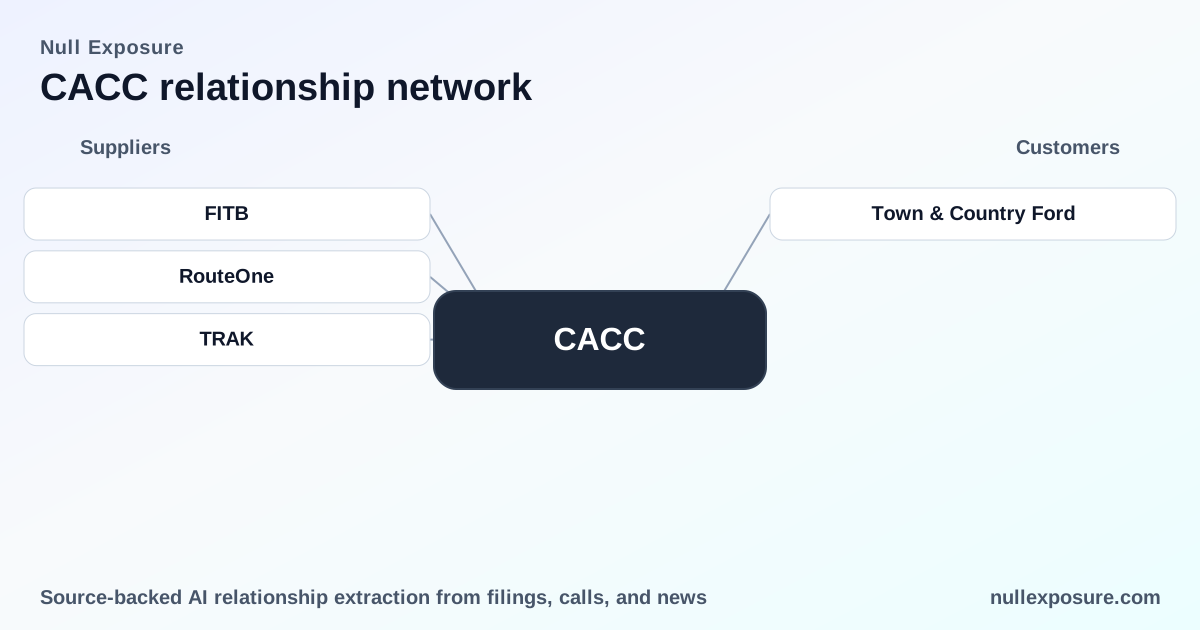
Credit Acceptance (CACC): Supplier Relationships and Contract Profile
Credit Acceptance is a specialized auto-finance originator that monetizes by underwriting and either purchasing or servicing subprime and near-prime consumer auto loans originated through independent and franchised dealerships. The company earns interest and fees on retained credit portfolios, monetizes cash flows through securitizations and bank partnerships, and collects servicing revenue and recoveries on purchased loans — a blended model that combines lending economics with dealer-distribution scale. With a market capitalization near $4.9 billion and a trailing profit margin north of 34%, Credit Acceptance runs a capital-intensive, distribution-driven lending franchise anchored to dealer origination channels and third‑party funding partners.
Explore deeper supplier intelligence at https://nullexposure.com/ to map counterparties and contract exposure.
Why supplier relationships matter for valuation and operations
Credit Acceptance’s economics are driven by three structural levers: origination throughput through dealers and aggregators, capital and securitization capacity provided by bank counterparties, and operational integration that locks in dealer behavior (e-contracting tools, F&I product support, servicing). Supplier and counterparty relationships therefore translate directly into originations, funding capacity, and operational risk. Investors evaluating CACC should focus on the integration depth with aggregator platforms, the continuity of bank funding lines and ABS counterparties, and the company-level contracting posture reflected in lease and service commitments.
The counterparties identified in public filings and news
Below are the relationships surfaced in recent disclosures and press coverage. Each entry has a short plain-English description and a concise source reference.
Fifth Third Bank — bank funding / ABS counterparty
Credit Acceptance reported amendments to its term ABS 2021-1 facility involving Fifth Third Bank, indicating an active funding or counterparty relationship that supports the company’s securitization program. According to TradingView’s coverage of the amendment announcement on March 9, 2026, Fifth Third Bank is listed as a counterparty in the transaction documentation. (TradingView, March 9, 2026)
RouteOne — origination and e-contracting integration
RouteOne is an origination aggregator where Credit Acceptance has implemented deeper e-contracting integration and expanded deal-structuring and F&I product support, strengthening the company’s electronic flow from dealer desks into underwriting and funding pipelines. This integration was described in Credit Acceptance’s fourth-quarter 2025 results and accompanying commentary. (GlobeNewswire press release, January 29, 2026)
Insider commentary from Credit Acceptance’s Q4 2025 earnings transcript also highlights that dealers use aggregators such as RouteOne to access the company’s origination channels alongside its proprietary systems, reinforcing RouteOne’s role as a preferred dealer-facing conduit. (Earnings transcript summarized by InsiderMonkey, March 2026)
Dealertrack — aggregator channel access
Dealertrack is cited by management as another aggregator through which dealers access Credit Acceptance’s origination capabilities, complementing the proprietary system and RouteOne integrations. The company referenced Dealertrack during its Q4 2025 earnings discussion as a preferred channel for dealer demand fulfillment. (Earnings transcript summarized by InsiderMonkey, March 2026)
What the constraints tell investors about CACC’s operating model
The explicit constraints extracted from filings and disclosures provide company-level signals about contracting posture, cost scale, and relationship maturity:
-
Contracting posture: long-term but modest lease commitments. Credit Acceptance discloses future operating lease commitments totaling approximately $1.7 million across 2025–2027, which signals long-term but limited fixed-asset lease exposure relative to revenue. The company expects standard renewals or replacements of leases in the normal course. (Company lease disclosures for year-end 2024)
-
Relationship role: buyer of consumer loans and lender under portfolio arrangements. Corporate program descriptions confirm two distinct operating models: a Purchase Program in which Credit Acceptance buys consumer loans from dealers and retains collections, and a Portfolio Program in which it functions as a lender to dealers for assigned loans. This dual role drives both credit risk and operational servicing responsibilities. (Company program descriptions, FY2025–FY2026 filings)
-
Service-provider posture: vendor and lessee for office services and equipment. The company leases office equipment and historically leased office space, signaling standard service-provider interactions for corporate operations rather than material vendor dependencies. (Lease expense and equipment lease disclosures)
-
Relationship stage and spend scale: active, renewing, and operationally modest. Rental expense history (approximately $2.0 million in 2024, $1.2 million in 2023) places lease spend in the $1M–$10M band, indicating predictable, operational-level vendor spend that is not a major line-item relative to financing and servicing cash flows. (Operating lease expense disclosures)
Taken together, these constraints describe a company that operates a mature, repeatable dealer-funding franchise with moderate fixed-cost commitments and active, renewing operational relationships rather than large, lumpy vendor contracts.
Investment implications and risk vectors for operators and counterparties
-
Funding concentration risk: The presence of bank counterparties such as Fifth Third Bank in ABS and term facility documents means securitization and bank agreements are critical to CACC’s funding stack. Disruptions or covenant pressure at the bank level would compress originations and raise funding costs.
-
Integration lock-in with aggregators: Deeper e-contracting with RouteOne and Dealertrack increases origination efficiency and dealer retention, creating positive switching costs. That integration also centralizes a third-party operational risk: outages, contractual repricing, or data-feed changes with aggregators would have immediate throughput implications.
-
Credit and operational alignment: The company’s dual role as purchaser and lender to dealers concentrates credit risk and aligns incentives between underwriting, purchase economics, and servicing performance — a feature investors should treat as both an efficiency and a potential concentration of credit volatility.
-
Manageable fixed-cost base: Lease commitments are small relative to top-line credit economics; the operating model therefore remains highly variable and scalable with origination flow rather than weighted by fixed overhead expansion. This keeps operating leverage tied to originations and funding rather than property or equipment obligations.
Explore supplier mappings and counterparty risk tools at https://nullexposure.com/ to quantify funding links, integration depth, and contract exposure.
Bottom line for investors and operators
Credit Acceptance runs a distribution-centric finance model that relies on two structural things: stable funding corridors (bank/ABS partners) and deep operational integration with dealer aggregators. The relationships with Fifth Third Bank, RouteOne, and Dealertrack are complementary components of that model — funding, e-contracting, and dealer access respectively — and each influences throughput and funding cost in a measurable way. Lease and service commitments are modest and predictable, which preserves operating leverage for origination growth.
For portfolio managers and strategic operators, the immediate focus is simple: monitor ABS and bank counterparty health, track integration milestones with RouteOne/Dealertrack, and stress-test origination flows against aggregator downtime or funding dislocation. For actionable exposure mapping and real-time counterparty signals, visit https://nullexposure.com/ to align supplier intelligence with investment and operational decisions.