Cantor Equity Partners III (CAEP) — supplier relationships and what they mean for investors
Cantor Equity Partners III is a blank‑check vehicle that monetizes by raising public equity and then effecting a business combination with a target company; until a deal closes the company carries no operating revenues and its value is driven by capital on the balance sheet, sponsor economics, and the success of a future transaction. CAEP’s economics are transaction‑driven: its balance sheet funds liquidity for a merger, sponsor and investor upside come from post‑deal equity appreciation, and outside financial intermediaries (underwriters, bookrunners, legal counsel) determine the pace and cost of capital formation. For immediate supplier intelligence and supplier‑risk scoring for financial counterparties, visit NullExposure’s supplier coverage hub.
How CAEP operates and monetizes is simple and market‑centric: it raises capital through an offering, holds that capital in trust while sourcing a target, and converts that capital into operating equity only after a qualifying business combination. CAEP’s public profile (latest quarter 2025‑09‑30) shows a market capitalization of roughly $359.6 million, zero revenue, a reported EPS of $0.08, and classification in the “SHELL COMPANIES” industry — all signals consistent with a SPAC/blank‑check structure rather than an operating business.
How a shell company’s supplier posture shapes execution risk
A shell’s supplier relationships are by nature transactional and concentrated. CAEP’s operating posture creates several company‑level signals that matter to investors and counterparties:
- Contracting posture — Transactional and time‑bounded. Suppliers are engaged to execute an offering or a deal process, then the relationship often dissolves or converts to ad hoc advisory roles post‑combination.
- Concentration risk — High for capital‑markets partners. A small number of financial intermediaries (underwriters, bookrunners, placement agents) control access to market liquidity and pricing.
- Criticality — Extremely high for underwriting/bookrunning partners. These relationships determine success of capital raises and, by extension, the feasibility and timing of a merger.
- Maturity — Shallow prior to a business combination. Most supplier ties are newly formed around a single offering and lack the long history that reduces counterparty risk.
These are company‑level signals derived from CAEP’s business model and financial profile; they shape exposure even when a named supplier is a single transactional counterparty.
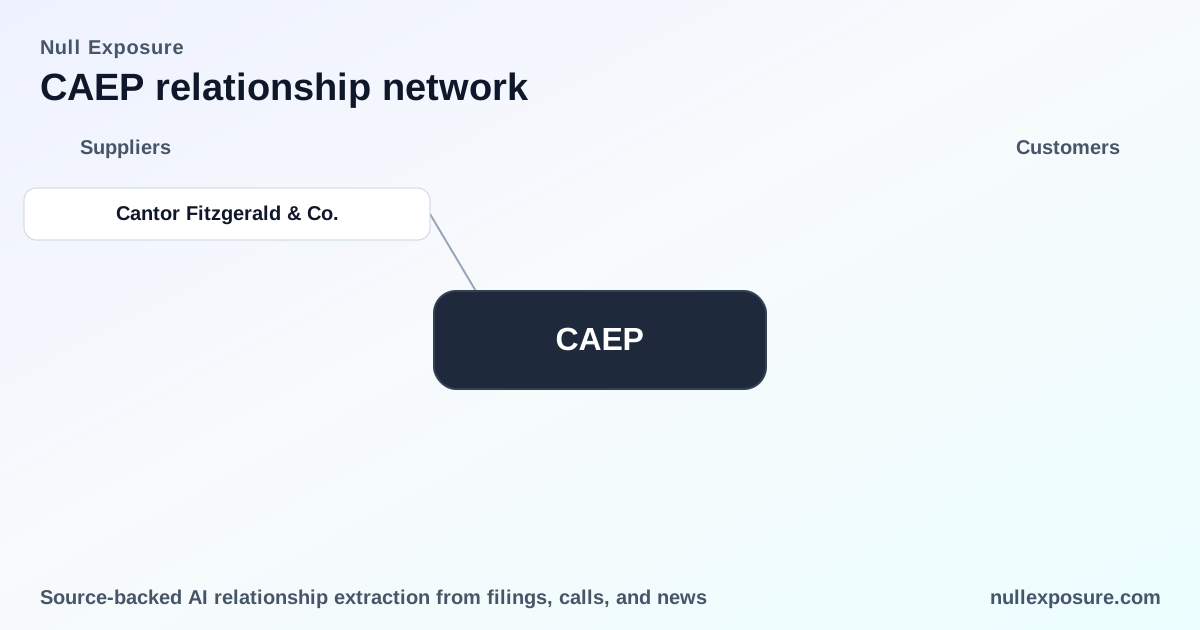
The supplier relationship uncovered: Cantor Fitzgerald & Co.
A single supplier relationship appears in public coverage: Cantor Fitzgerald & Co. served as the sole book‑running manager for the offering associated with CAEP. According to a StockTitan news entry dated March 9, 2026, Cantor Fitzgerald acted as the sole bookrunner for the offering related to CAEP’s capital raise. (Source: StockTitan, news entry 2026‑03‑09 — https://www.stocktitan.net/news/CAEP/)
Why this matters in one line: a sole bookrunner relationship concentrates execution and pricing power in one firm, increasing single‑counterparty risk while simplifying coordination for the issuer.
Implications of a sole bookrunner arrangement
Cantor Fitzgerald’s role as sole bookrunner signals that CAEP chose a single lead intermediary to underwrite and place securities, which has three practical consequences for investors and operators:
- Execution control: The underwriter controls allocation and syndicate strategy, which affects institutional placement and aftermarket liquidity.
- Concentration of counterparty risk: If the bookrunner encounters market or regulatory friction, deal timing or pricing can be materially impacted.
- Negotiation leverage: As sole bookrunner, Cantor Fitzgerald captures a larger share of underwriting fees and exerts outsized influence on deal terms.
Financial context and market signals you cannot ignore
CAEP’s financial snapshot reinforces the supplier dynamics:
- Zero operating revenue and classification as a shell company underline that the firm’s continuity depends on completing a transaction, not on recurring business.
- Market capitalization of $359.6M and a trailing P/E of 128.12 reflect a market pricing largely tied to deal expectations and limited earnings history; standard valuation metrics are less informative than deal success probabilities.
- Institutional ownership reported at 100.428% is an unusual figure that investors should flag for reporting idiosyncrasies or custodial accounting artifacts rather than interpret as literal ownership.
- Shares outstanding (~28.18M) and float (~25.4M) reveal the liquidity base; with institutional concentration high, aftermarket trading can be thin and price sensitive to block trades.
For a concise supplier risk brief and to monitor updates to CAEP’s counterparties, see NullExposure’s coverage.
What investors and operators should watch next
- Deal timeline and underwriting terms. Calendar and fee structure disclosed in offering documents will determine the economics of the transaction and the durability of the Cantor Fitzgerald relationship.
- Post‑deal counterparty transitions. If CAEP completes a business combination, the role of short‑term capital‑markets suppliers will shift to longer‑term commercial or financing partners—monitor announcements closely.
- Disclosure clarity. Given CAEP’s shell status and unusual data points (e.g., institutional ownership >100%), prioritize primary documents and underwriting agreements for granular risk assessment.
Practical takeaways
- Concentration of execution risk: With Cantor Fitzgerald as sole bookrunner, CAEP’s capital access and pricing are concentrated in one counterparty — expect higher negotiation leverage for the bookrunner and monitor any public notices from Cantor Fitzgerald.
- Transactional supplier posture: Suppliers are engaged for a discrete offering; their continued importance depends on whether CAEP completes a combination.
- Data anomalies require diligence: Reported metrics such as institutional ownership above 100% indicate the need to verify filings and transfer agent records before drawing investment conclusions.
For ongoing supplier diligence and signal monitoring on CAEP and comparable issuers, visit NullExposure.
Closing recommendation: treat CAEP as a transaction‑centric investment where counterparty selection (bookrunner, legal, and placement agents) is the principal operational risk, and Cantor Fitzgerald’s sole‑bookrunner role is the primary supplier relationship to monitor through the next offering milestones. For deeper supplier intelligence and to subscribe to alerts on counterparties, go to NullExposure’s homepage.