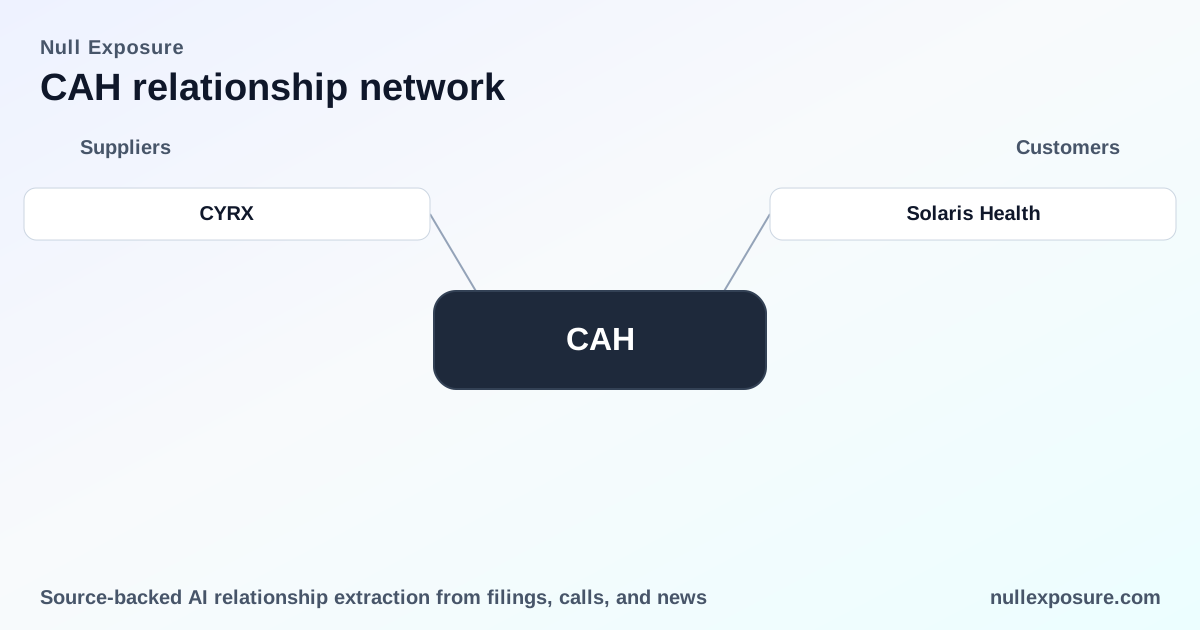
Cardinal Health (CAH) — Supplier relationships and what they mean for investors
Cardinal Health operates as a global medical distribution and health care services company that monetizes primarily through product distribution, logistics services, and value‑added supply chain solutions to hospitals, pharmacies and manufacturers. The company's scale drives thin but stable operating margins: revenue of $244.7 billion (TTM) with EBITDA of $3.82 billion, and a market capitalization near $51.2 billion, reflecting a large, mature distributor whose profit pool derives from volume, efficiency and adjunct service fees. For investors and operators evaluating supplier risk and partner strategy, the critical questions are supplier concentration, strategic fit of niche logistics partners, and how supplier relationships map to growth areas such as cell and gene therapy. For a consolidated view of supplier exposures and relationship signals visit the NullExposure homepage: https://nullexposure.com/.
Why supplier posture matters for a distributor of Cardinal's scale
Cardinal Health’s business model is contract‑intensive and scale‑dependent: the company commits capital to inventory and logistics networks and relies on predictable supplier flows to keep inventory turns and gross margin stable. That operating posture creates four actionable constraints investors should track:
- Concentration: Cardinal disclosed in its fiscal 2025 filing that revenue from its five largest suppliers aggregated 37% of revenue, with the largest supplier representing about 9% of revenue. That degree of concentration is a structural exposure for a distributor whose margins are sensitive to input availability and pricing.
- Contracting leverage: Large suppliers that supply specialized or branded products hold pricing leverage; Cardinal’s negotiating position is strongest when a supplier’s products are commoditized, and weakest when products are critical or differentiated.
- Criticality: For high‑value, time‑sensitive products—especially in cell and gene therapy—supplier performance is mission‑critical; logistic failures translate directly into lost revenue or reputational damage.
- Maturity and diversification: Cardinal’s core model is mature and cash generative, but growth trajectories increasingly depend on adjacent logistics and specialty services rather than core distribution alone.
These company‑level constraints inform diligence: monitor supplier mix disclosures, contract renewals with top vendors, and any movement into specialty cold‑chain logistics partnerships that alter revenue mix or margin profile (Cardinal’s fiscal 2025 filing provides the concentration disclosure referenced above).
The Cryoport relationship — a single, strategic collaboration
Cryoport Systems announced in its FY2026 earnings call transcript that it expanded global partnerships by entering strategic collaborations with Cardinal Health and Parexel, with Cardinal leveraging Cryoport’s supply chain solutions to support cell and gene therapy offerings (reported by InsiderMonkey on March 9, 2026 — https://www.insidermonkey.com/blog/cryoport-inc-nasdaqcyrx-q4-2025-earnings-call-transcript-1709603/).
This relationship positions Cardinal to access Cryoport’s cold‑chain logistics capabilities—a capability set that is strategically aligned with the high growth, high‑margin segment of cell and gene therapy distribution. For a quick supplier map and continuing updates, see https://nullexposure.com/.
Relationship listing — plain language, investor‑ready
- Cryoport Systems (CYRX): Cryoport said in its FY2026 earnings call transcript (reported by InsiderMonkey on March 9, 2026) that it entered into a strategic collaboration with Cardinal Health to embed Cryoport’s supply chain solutions into Cardinal’s cell and gene therapy offerings; this is a targeted logistical partnership designed to support specialty biologics distribution (InsiderMonkey, March 9, 2026 — https://www.insidermonkey.com/blog/cryoport-inc-nasdaqcyrx-q4-2025-earnings-call-transcript-1709603/).
How to read this relationship in the context of Cardinal’s supplier map
The Cryoport collaboration is not a core product supplier relationship in the sense of a top‑five revenue contributor; it is a strategic, capability‑enhancing partnership that aligns with Cardinal’s pivot into specialty logistics. That dynamic matters for two reasons:
- Growth optionality: Embedding specialized cold‑chain logistics into Cardinal’s service portfolio supports higher‑margin services and strengthens customer stickiness for hospital and manufacturer clients requiring cell and gene therapy handling.
- Operational complexity: These partnerships increase service complexity and require tight SLA enforcement; given Cardinal’s supplier concentration, adding specialized third‑party logistics relationships increases counterparty dependency in segments that are both critical and low‑tolerance for failure.
Investors should treat Cryoport as a strategic enabler rather than a material revenue supplier given current disclosures, but one that could influence future margin mix and service differentiation.
Financial and strategic implications investors should monitor
Cardinal’s headline metrics underscore the tradeoffs between scale and specialty: low single‑digit profit margins, high revenue base, and a PE in the low 30s reflect a mature distribution franchise priced for stability and modest growth. Key investor signals to monitor:
- Contract renewals and disclosure of revenue contribution from specialty logistics and services.
- Any shift in the concentration profile of suppliers beyond the fiscal 2025 37% top‑five bucket.
- Operational KPIs tied to specialty partnerships (cold‑chain SLAs, on‑time delivery, spoilage metrics) disclosed in earnings commentary.
- Analyst expectations: consensus target price sits around $249.27 with a mix of buy/hold ratings—track whether specialty partnerships change revenue quality assumptions.
For a mapped view of these supplier relationships and to track updates, go to https://nullexposure.com/.
Bottom line — risk, opportunity, and next steps for investors
Cardinal Health is a large, mature distributor whose economics are driven by scale, inventory turns and service fees. Supplier concentration is a material corporate signal—the top five suppliers accounted for 37% of revenue in FY2025—and that structural reality amplifies the importance of strategic partnerships that diversify service offerings without excessively increasing counterparty risk. The Cryoport collaboration is a targeted strategic move into high‑value cold‑chain logistics that increases Cardinal’s exposure to specialty biologics while also offering a pathway to higher margin services (InsiderMonkey, March 2026).
Actionable next steps:
- Review Cardinal’s next quarterly filing for updates on specialty logistics revenue and supplier breakouts.
- Monitor operational metrics around cell and gene logistics performance in earnings commentary.
- Use third‑party relationship mapping to validate claims around strategic partnerships at scale; for a practical supplier view, visit https://nullexposure.com/.
Bold, measurable supplier disclosures and rigorous monitoring of specialty logistics KPIs will separate informed investors from the market noise when assessing Cardinal’s ability to translate partnerships into durable growth.