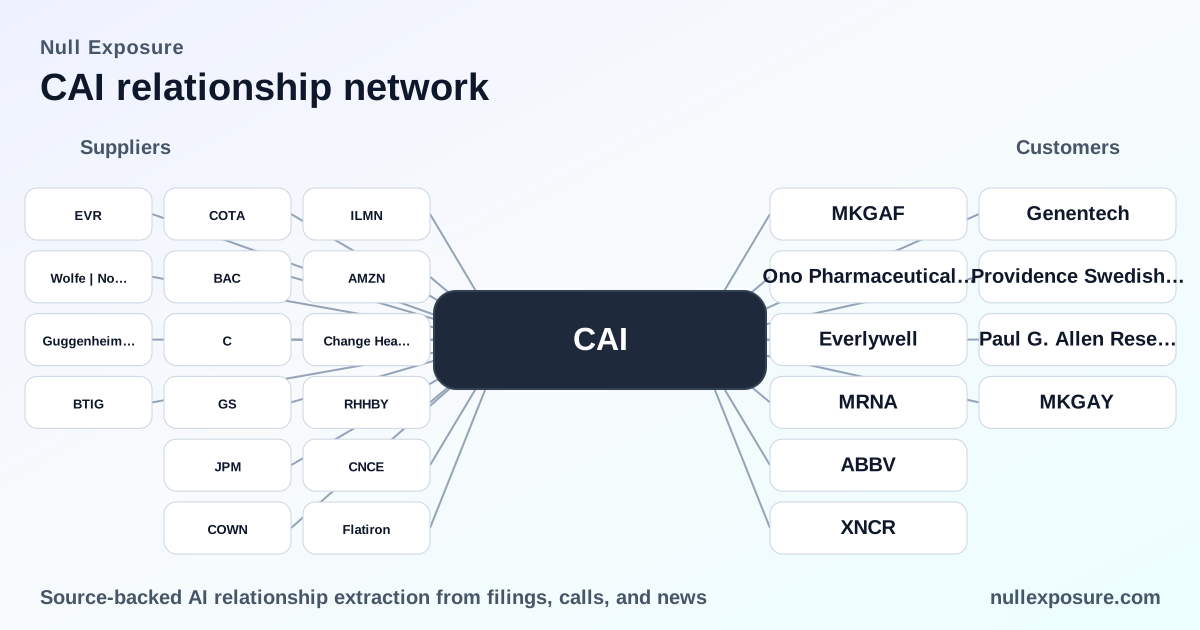
Caris Life Sciences (CAI): Supplier footprint and what it means for investors
Caris Life Sciences operates an end-to-end precision oncology business that runs high-throughput sequencing and clinical testing labs, builds matched clinico‑genomic data products, and licenses that information to biopharma and clinical customers. The company monetizes through laboratory testing revenue, recurring data and analytics licenses to drug developers, and commercialization of companion diagnostics and related services. Supplier relationships are therefore central to throughput, cost structure and data completeness — and they directly influence margin and go‑to‑market cadence. For a deeper dive into supplier and third‑party risk mapping, visit NullExposure.
Why supplier strategy is a financial lever for Caris
Caris’s operating model combines capital‑intensive lab infrastructure with data licensing. That creates three supplier imperatives: (1) reliable sourcing of sequencing instruments and reagents to maintain capacity and quality, (2) stable cloud and claims infrastructure to support billing and analytics, and (3) curated clinical partnerships that enable commercial data products for biopharma. These relationships drive both gross margin (through reagent and instrument economics) and revenue growth (through the breadth and commercializability of matched clinical data).
- Concentration risk is visible. The company discloses a small number of critical suppliers for sequencing and lab supplies, which elevates operational leverage to supplier performance and contract terms.
- Contract maturity varies. Multi‑year master supply agreements with major vendors signal a move toward supply stability, but sole‑source relationships create single points of failure that are material to lab operations.
- Regulatory and operational criticality is high. Vendors that touch protected health information (PHI), claims processing, or sequencing chemistry are operationally critical because disruptions affect reimbursement, regulatory reporting and data completeness.
If you want a consolidated supplier risk briefing tailored to underwriting or M&A diligence, see NullExposure for vendor intelligence and contract signal tracking.
Supplier relationships — what the record shows
Below are every supplier and partner named in the available results, each with a concise plain‑English summary and a source reference.
-
Illumina, Inc. (ILMN) — Caris relies on Illumina as the sole supplier of next‑generation sequencing (NGS) instruments and associated reagent kits for its solutions; the relationship is governed by an open offer supply agreement (entered November 2022) and a supply agreement dated September 21, 2022. According to the company’s FY2026 10‑K (published via StockTitan, March 2026), Illumina is the exclusive provider of key sequencing hardware and reagents.
Source: FY2026 10‑K filing summarized on StockTitan (March 2026). -
Roche Diagnostics Corporation (RHHBY) — In July 2024 Caris executed a master supply agreement with Roche for sequencing probes and other testing supplies and equipment to support clinical and research lab operations. The FY2026 10‑K describes the Roche Agreement as a strategic supplier addition for probes and consumables.
Source: FY2026 10‑K filing summarized on StockTitan (March 2026). -
Amazon Web Services (AWS / AMZN) — Caris hosts patient and analytic data on AWS and conducts certain data analysis through AWS cloud infrastructure while also operating co‑located and on‑premise compute. The FY2026 filing notes AWS as its cloud hosting provider.
Source: FY2026 10‑K filing summarized on StockTitan (March 2026). -
Change Healthcare — A February 2024 cybersecurity incident at Change Healthcare, a claims processor Caris used, caused delays in submitting claims for payment and highlighted exposure to third‑party billing infrastructure; Caris disclosed potential notification obligations if PHI was affected. The FY2026 filing references the operational impact from that attack.
Source: FY2026 10‑K filing summarized on StockTitan (March 2026). -
ConcertAI (CNCE) — Caris has agreements with ConcertAI to create matched clinico‑genomic resources that can be licensed to biopharma for drug discovery and development, expanding the commercial utility of Caris’s multimodal offerings. The FY2026 10‑K references ConcertAI as a clinical data partner.
Source: FY2026 10‑K filing summarized on StockTitan (March 2026). -
Flatiron — Caris partners with Flatiron to broaden its matched clinical–genomic resources for biopharma licensing, as disclosed in the FY2026 filing.
Source: FY2026 10‑K filing summarized on StockTitan (March 2026). -
COTA — Caris has agreements with COTA to support the creation of matched clinical–genomic resources for licensing to biopharma customers. The FY2026 filing lists COTA among clinical data partners.
Source: FY2026 10‑K filing summarized on StockTitan (March 2026). -
BofA Securities (BAC) — BofA is a lead arranger/book‑runner for Caris’s public offering; banks were named in the company’s IPO syndicate announcement. Dallas News reported the underwriting group when Caris filed to go public.
Source: Dallas News corporate finance article (May 27, 2025). -
J.P. Morgan (JPM) — J.P. Morgan is a co‑lead underwriter for Caris’s offering as reported in the public filing coverage.
Source: Dallas News (May 27, 2025). -
Goldman Sachs (GS) — Goldman Sachs is a co‑lead underwriter on the company’s IPO syndicate.
Source: Dallas News (May 27, 2025). -
Citigroup (C) — Citigroup participated in the syndicate offering alongside the lead banks.
Source: Dallas News (May 27, 2025). -
TD Cowen (COWN) — TD Cowen was named as an additional book‑runner on the offering.
Source: Dallas News (May 27, 2025). -
Evercore ISI (EVR) — Evercore ISI was named as an additional book‑runner for the IPO.
Source: Dallas News (May 27, 2025). -
Guggenheim Securities — Guggenheim acted as an additional book‑runner for the public offering.
Source: Dallas News (May 27, 2025). -
BTIG — BTIG provided assistance to the syndicate on the company’s offering.
Source: Dallas News (May 27, 2025). -
Wolfe | Nomura Alliance — The Wolfe | Nomura Alliance assisted in the transaction as part of the offer team.
Source: Dallas News (May 27, 2025).
Operational and commercial implications for investors
- High operational concentration on Illumina increases single‑supplier exposure to reagent supply shocks, pricing pressure and technology roadmaps that affect Caris’s throughput and unit cost. The Roche agreement reduces some exposure by diversifying reagent/probe supply, but Illumina’s role as sole NGS hardware provider is the dominant single point of failure (FY2026 10‑K disclosures).
- Cloud and claims vendors are strategically critical. AWS provides core hosting and analytics; a claims processor outage (Change Healthcare) materially impacted cash flow timing and operational continuity in the recent past.
- Clinical data partnerships are strategic revenue multipliers. Agreements with ConcertAI, Flatiron, and COTA expand the addressable market to biopharma licensing and improve product defensibility by enriching clinical context.
For a vendor‑level risk score and prioritized mitigation roadmap, consult NullExposure.
Bottom line and recommended actions for operators and investors
- Prioritize continuity risk mitigation for NGS supply — ensure management has contingency plans and inventory cadence in investor updates.
- Scrutinize contract terms and maturity in Illumina and Roche agreements when modeling downside scenarios to gross margin and capacity ramp timelines.
- Validate third‑party cyber and claims resilience since billing interruptions directly hit cash flow; require evidence of vendor hardening and SLA commitments.
To commission a tailored supplier diligence memo or get ongoing alerts on Caris’s vendor exposures, go to NullExposure.
Investor takeaway: Caris’s supplier base is concentrated and strategically consequential — critical suppliers underpin both near‑term lab economics and the long‑term value of data licensing. Active monitoring of these supplier relationships is essential for accurate valuation and operational forecasting.