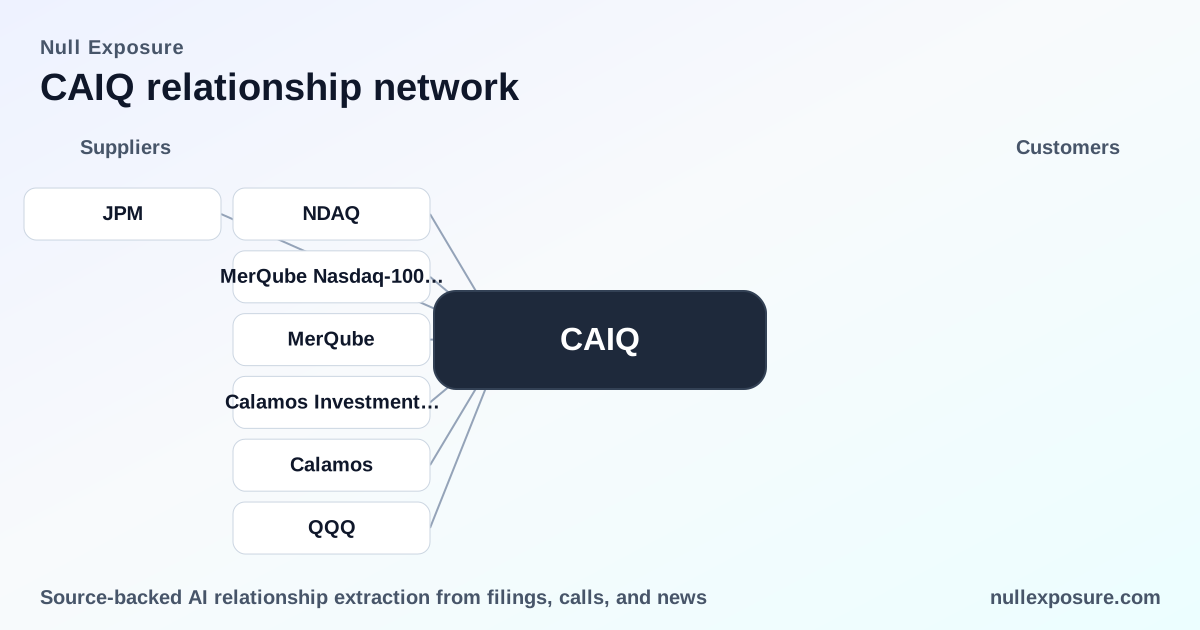
Calamos Nasdaq Autocallable Income ETF (CAIQ): Supplier Map and Investment Thesis
The Calamos Nasdaq Autocallable Income ETF (ticker: CAIQ) operates as a packaged income product that monetizes by converting structured-note style payouts into an ETF wrapper—generating investor-facing coupons and collecting management/operational fees as the asset base grows. CAIQ achieves yield through a ladder of autocallable notes that reference a single proprietary index, and the sponsor (Calamos) commercializes distribution, index licensing, and partner arrangements to scale the strategy. For investors and operators evaluating counterparty exposure and operational risk, the supplier map and contract posture are the primary determinants of durability and execution risk. For an annotated supplier rundown and further commercial context visit https://nullexposure.com/.
How CAIQ delivers income and where value is captured
CAIQ aggregates over 50 laddered autocallable notes that pay high coupons when certain barrier and observation conditions are met; these notes are all linked to the MerQube Nasdaq-100 Vol Advantage Autocallable Index, which embeds exposure to the Nasdaq-100 (via QQQ) with explicit volatility targeting and decrement mechanics. Calamos captures value by packaging these structured payouts into a liquid ETF format, earning management and issuer economics while leveraging third-party index licensing and distribution partnerships. This operating model concentrates critical functions—index licensing, structured-note counterparties, and exchange listing—into a narrow supplier set, which has implications for contracting leverage and operational continuity. Learn more about supplier risk and coverage at https://nullexposure.com/.
Who CAIQ works with — the concise supplier roster
Below are every counterpart mentioned in public coverage to date, with plain-English descriptions and source citations.
Calamos Investments LLC
Calamos is the ETF sponsor and asset manager behind CAIQ and is actively positioning multiple autocallable income products within its lineup. According to Benzinga coverage from November 2025, Calamos launched CAIQ to deliver structured-note-style payouts in ETF form and has promoted the strategy as a flagship income offering. (Benzinga, Nov 2025)
MerQube Nasdaq-100 Vol Advantage Autocallable Index
All of CAIQ’s notes use the MerQube Nasdaq-100 Vol Advantage Autocallable Index as their reference index, meaning the ETF’s payout structure and autocall mechanics are centralized on this single index methodology. ETF Trends and StructuredRetailProducts reported that CAIQ’s laddered notes uniformly reference this index and its barrier mechanics. (ETF Trends, Mar 2026; Structured Retail Products, Nov 2025)
MerQube (index provider)
MerQube is the index provider that designed the Vol Advantage Autocallable Index used by CAIQ, including the volatility targeting and decrement parameters that drive coupon and knock-in/knock-out behavior. StructuredRetailProducts and ETF Trends noted MerQube’s role in shaping the exposure rules and barrier levels for the CAIQ notes. (Structured Retail Products, Nov 2025; ETF Trends, Mar 2026)
Nasdaq, Inc.
Nasdaq is involved as the exchange brand and IP licensor; Nasdaq® is a registered trademark licensed for use by Calamos Advisors LLC in connection with this ETF. ETF Trends referenced the licensing arrangement in its coverage of autocallable ETFs. (ETF Trends, Mar 2026)
Invesco QQQ Trust (QQQ)
The MerQube index provides exposure mechanics that reference the Invesco QQQ Trust (QQQ) as the underlying equity exposure, meaning CAIQ’s structured notes ultimately derive their equity leg from QQQ performance under specified volatility and decrement settings. StructuredRetailProducts documented the index’s linkage to QQQ and its volatility target parameters. (Structured Retail Products, Nov 2025)
J.P. Morgan
J.P. Morgan is a commercial partner in the broader rollout of Calamos’s autocallable ETF offerings; Calamos extended a partnership with J.P. Morgan in launching its autocallable products, according to StructuredRetailProducts. This relationship suggests institutional distribution or structured-note counterparty support on prior Calamos products. (Structured Retail Products, Nov 2025)
Operating-model and business-model signals investors should weight
- Contracting posture: CAIQ’s model relies on licensed third-party intellectual property (index design from MerQube and Nasdaq trademark use) and established distribution relationships (e.g., J.P. Morgan); these are standard commercial licenses rather than bespoke strategic investments, implying moderate switching costs but concentrated supplier bargaining power.
- Concentration: The fund’s mechanics are highly concentrated around one index provider (MerQube) and a single underlying exposure (QQQ), which compresses operational complexity but increases vendor and reference-asset concentration risk.
- Criticality: The index and supplier relationships are mission-critical—if MerQube changes methodology or license terms, the product’s payout profile and investor expectations change materially; Nasdaq’s IP and exchange listing are similarly indispensable.
- Maturity and optionality: The autocallable ETF is a recent innovation in the ETF market; the model is commercially mature for structured products but novel at ETF scale, giving Calamos first-mover optionality while exposing early adopters to model risk and limited historical performance through different market cycles.
Risk profile distilled for investors and operators
- Operational dependency: Centralizing all notes on one index creates clear failure modes—index vendor disputes or method changes would be immediately consequential.
- Counterparty and distribution concentration: J.P. Morgan and other large partners enhance credibility but also concentrate negotiation leverage and operational touchpoints.
- Market-structure sensitivity: CAIQ’s payout generation depends on volatility targeting and barrier observation schedules; macro volatility regimes will directly compress or expand distributable coupon streams.
For a structured supplier-risk scan and ongoing monitoring of CAIQ counterparties, visit https://nullexposure.com/ for detailed coverage and alerts.
Practical takeaways and next steps
- Positive: CAIQ packages high-yield structured income into an ETF with clear supplier relationships—MerQube for index mechanics, QQQ for equity exposure, Nasdaq for IP/listing, and Calamos as sponsor—enabling efficient market access to autocallable payouts.
- Negative: The product is structurally concentrated and operationally dependent on a small number of suppliers; under stress, replacement or renegotiation of index licensing and counterparties could be disruptive.
- Investors should evaluate contract terms, index governance, and backup arrangements for the index provider and counterparties before allocating meaningful capital.
Explore deeper supplier analytics and scenario stress tests at https://nullexposure.com/ to validate counterparty resilience and contractual protections for CAIQ investors.