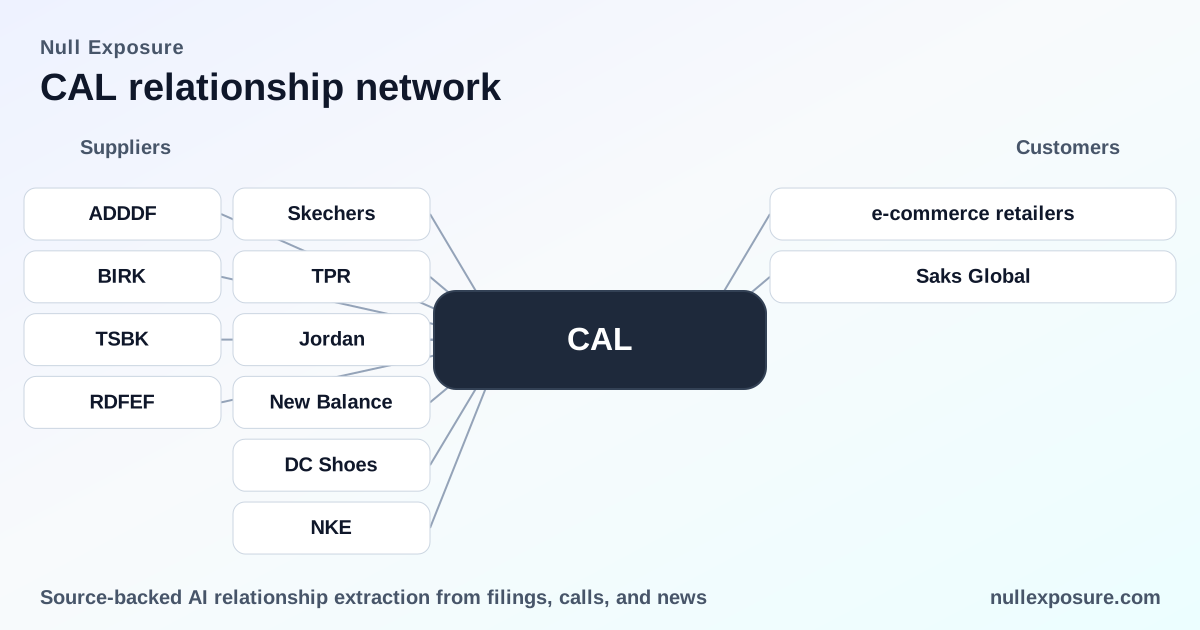
Caleres (CAL) — supplier map and commercial implications for investors
Caleres runs a vertically informed footwear business that monetizes through retail and wholesale channels: it sources and sells branded footwear via its Famous Footwear retail chain and direct-to-consumer channels, owns and integrates proprietary and licensed brands (recently acquiring Stuart Weitzman), and supports margin capture through a mix of third‑party sourcing and in‑house manufacturing. Revenue comes from retail sales of national brands and owned labels, with supplier relationships directly shaping gross margin and working capital exposure. For a fast, actionable supplier-risk view, visit https://nullexposure.com/.
How Caleres structures buying and where risk concentrates
Caleres operates a hybrid sourcing model: the company purchases large volumes from global brand partners while also contracting with independent footwear manufacturers and operating internal factories in the U.S. and the Dominican Republic. Three third‑party brand suppliers — Nike, Skechers and adidas — together accounted for roughly 24% of consolidated net sales in 2024, a concentration that determines both bargaining power and inventory risk in promotional cycles. The company also reported sourcing approximately half of its footwear from China in 2024, which ties supply-chain risk to APAC manufacturing dynamics.
Caleres runs accounts‑payable programs and has disclosed specific program exposures (roughly $22.0 million as of February 1, 2025), and its broader sourcing operations processed nearly $494.4 million of shoes through third‑party manufacturers in 2024. That scale places some suppliers in the $100M+ spend band while program-level payables cluster in the $10M–$100M band. These dynamics create a working‑capital profile where supplier payment terms and program continuity materially affect liquidity and margin timing.
For a focused supplier analysis that converts disclosures into actionable risk scores, stop by https://nullexposure.com/.
Contracting posture, concentration and criticality
- Contracting posture: a mix of long‑term brand distribution agreements and transactional purchase relationships with manufacturers; Caleres also uses transition service arrangements when integrating acquisitions.
- Concentration: material — leading brands account for a substantial share of Famous Footwear sales, increasing exposure to vendor pricing and allocation decisions.
- Criticality: high — key brands are revenue drivers and top growth categories in stores.
- Maturity: established partnerships with multinational brands and an ongoing push to integrate recently acquired labels into Caleres’ operating model.
Relationship-by-relationship roundup (source-backed)
Below are every supplier/brand relationship mentioned in the collected results, with a concise investor-oriented take and source.
-
Skechers — Products purchased from Skechers were one of three third‑party suppliers that collectively represented approximately 24% of consolidated net sales in 2024, underscoring Skechers’ material contribution to Famous Footwear revenue (FY2025 10‑K filing, February 2025).
Source: Caleres FY2025 10‑K (filed Feb 2025). -
Tapestry — Caleres operated under a transition service agreement with Tapestry during brand integration, indicating an active short‑term service contract while Caleres folded assets into its ecosystem (Q3 2025 earnings call transcript, reported March 2026).
Source: InsiderMonkey coverage of Caleres Q3 2025 earnings transcript (March 2026). -
Tapestry Inc. (Stuart Weitzman sale) — Caleres completed the acquisition of the Stuart Weitzman brand from Tapestry Inc. for $108.7 million, signaling a strategic shift to own higher‑end branded inventory rather than only retail national brands (WWD footwear news, March 2026).
Source: WWD report on Caleres acquisition of Stuart Weitzman (March 2026). -
Jordan — The Jordan brand launched across Caleres’ channels in mid‑July and quickly became one of Famous Footwear’s top brands, showing the company’s ability to scale new brand introductions into retail sales (SEC 10‑Q / TradingView news summary, FY2025).
Source: TradingView summary of Caleres 10‑Q (FY2025). -
New Balance — Identified as one of the top growth brands for Caleres’ Famous Footwear operation, contributing to the composition of their growth mix in FY2025 earnings commentary (Q3 2025 transcript coverage).
Source: InsiderMonkey coverage of Caleres Q3 2025 earnings transcript (March 2026). -
DC Shoes — Listed among top growth brands in Caleres’ channel commentary, reflecting category diversification beyond core running and lifestyle brands (Q3 2025 transcript coverage).
Source: InsiderMonkey coverage of Caleres Q3 2025 earnings transcript (March 2026). -
Nike — Nike is one of the three third‑party suppliers accounting for ~24% of consolidated net sales in 2024, making Nike a material commercial partner whose allocation decisions influence Caleres’ top line (FY2025 10‑K filing, Feb 2025).
Source: Caleres FY2025 10‑K (filed Feb 2025). -
adidas — adidas is also named among the three key third‑party suppliers representing ~24% of consolidated net sales in 2024, reinforcing brand concentration risk (FY2025 10‑K filing, Feb 2025).
Source: Caleres FY2025 10‑K (filed Feb 2025). -
Jordan brand (duplicate listing) — The company explicitly notes the Jordan brand launch as a rapid success in both online and retail stores, confirming brand-level contribution to comps and store traffic (Caleres 10‑Q narrative, FY2025).
Source: Caleres SEC reporting summarized on TradingView (FY2025). -
Adidas (duplicate listing) — Caleres’ earnings commentary lists Adidas among the portfolio of top growth brands, supporting the 10‑K disclosure on brand concentration in Famous Footwear (Q3 2025 transcript coverage).
Source: InsiderMonkey coverage of Caleres Q3 2025 earnings transcript (March 2026). -
Birkenstock — Cited among the top growth brands in FY2025 commentary, indicating expanded lifestyle and sandal categories in the retail mix (Q3 2025 transcript coverage).
Source: InsiderMonkey coverage of Caleres Q3 2025 earnings transcript (March 2026). -
Timberland — Timberland is named as a growth brand in company commentary, helping broaden category exposure beyond performance running and casual footwear (Q3 2025 transcript coverage).
Source: InsiderMonkey coverage of Caleres Q3 2025 earnings transcript (March 2026). -
Brooks — Brooks appears in the list of top growth brands, reflecting Caleres’ participation in the performance running market (Q3 2025 transcript coverage).
Source: InsiderMonkey coverage of Caleres Q3 2025 earnings transcript (March 2026).
Constraints and what they say about operating risk
Caleres’ disclosure set includes structured signals that clarify supplier risk beyond individual relationships:
- Large‑enterprise counterparties: Filings note counterparties are major international financial institutions in certain agreements; Caleres characterizes the risk of loss from nonperformance as minimal — a company‑level signal for low counterparty credit risk on financial arrangements.
- APAC sourcing concentration: Approximately 50% of footwear sourced in 2024 was from China, exposing supply continuity to Chinese manufacturing capacity, tariffs, and logistical shifts.
- Material supplier concentration: The 24% of net sales tied to three external brands is a materiality signal that vendor actions directly impact sales and inventory risk.
- Manufacturer role and in‑house production: While most footwear is sourced from independent manufacturers, Caleres operates its own manufacturing sites in Port Washington, WI and Santiago, Dominican Republic, which reduces single‑source reliance but keeps operational complexity in play.
- Spend bands and working capital: Reported accounts payable under program arrangements were $22.0 million at Feb 1, 2025, while sourcing operations processed ~$494.4 million of third‑party shoes in 2024 — a dual signal that program payables are material to short‑term liquidity, and aggregate sourcing is large.
Investment implications and next steps
Caleres’ supplier profile is a double‑edged sword: brand concentration provides retail traffic and margin opportunities when allocation and product mix are favorable, but creates outsized exposure to a few suppliers’ pricing and allocation decisions, and to China-sourced manufacturing. For investors and operators evaluating supplier relationships, prioritize monitoring vendor allocation notices, accounts‑payable program continuity, and integration progress on acquisitions such as Stuart Weitzman.
For deeper supplier scoring and to convert these public disclosures into procurement and balance‑sheet signals, explore our detailed supplier intelligence at https://nullexposure.com/.
Concluding takeaways:
- Concentration is material — three brands = ~24% of sales.
- APAC exposure is significant — ~50% sourced from China.
- Working capital sensitivity — program payables and large sourcing volumes make supplier terms a lever on cash flow.
If you want a tailored supplier risk brief for Caleres or comparable retail chains, visit https://nullexposure.com/ and request a bespoke analysis.