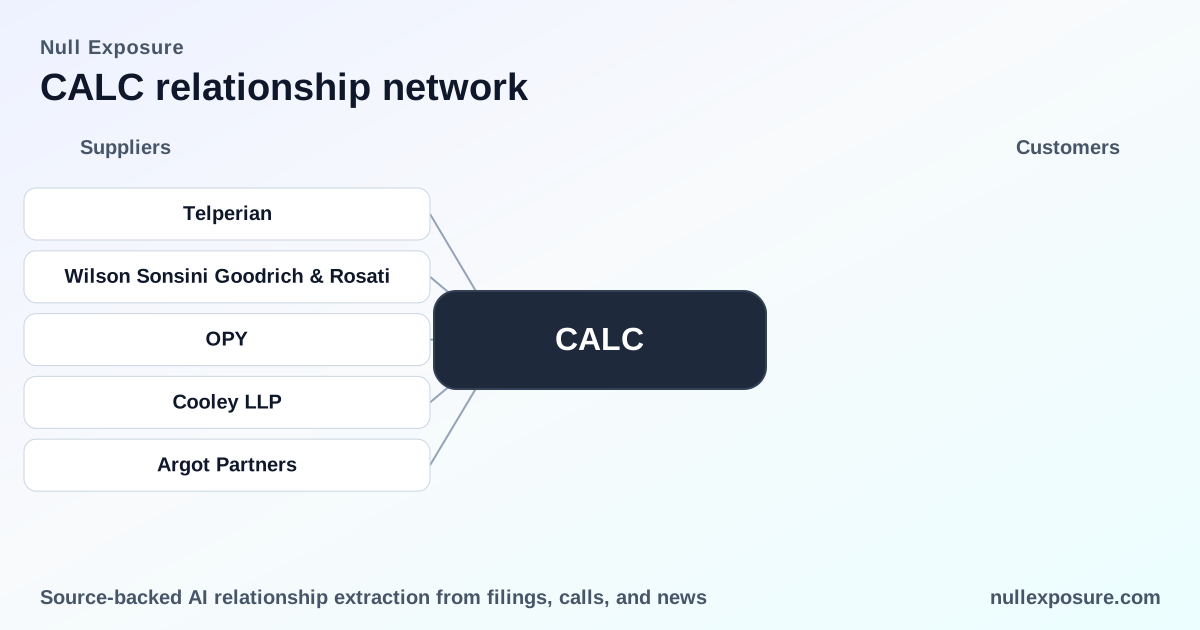
CALC supplier relationships: what investors need to know
CalciMedica (CALC) is a clinical-stage biopharma that develops calcium-pathway modulators with a lead program for severe muscle cramps (Auxora/CM4620). The company monetizes through clinical advancement, strategic partnerships, occasional capital markets transactions and transaction-driven uplifts; in the near term value is driven entirely by program progression, control of intellectual property and the ability to secure outsourced development and manufacturing at acceptable cost and quality. Investors evaluating supplier exposure should treat CalciMedica as a small-cap, development-stage operator with concentrated external dependencies and transaction-driven financing history. For an ongoing map of CALC’s supplier footprint visit https://nullexposure.com/.
How CALC operates and how that shapes supplier risk
CalciMedica runs a lean, outsourced development model: research and trials are conducted largely through third-party contract research organizations (CROs) and contract manufacturing organizations (CMOs), while legal, investor relations and financing work is performed by external advisors. The company’s balance sheet and operating metrics reflect this stage: market capitalization around $14.1 million, negative EBITDA and no revenue in TTM results, which forces reliance on equity and transaction-based capital to fund outsourced work. That operating posture creates two structural characteristics: concentration risk in a small set of critical partners, and contract-length risk driven by short-term engagements and project-level scopes.
If you are modeling counterparty exposure or negotiating supplier terms, keep that twofold axis in mind: supplier criticality is high even when individual contracts are short-term, and a single disruption to a CMO could materially delay a program given CalciMedica’s zero in-house manufacturing.
Supplier relationships — the public record
Below I cover every relationship surfaced in the supplier search and provide a concise, source-linked summary for each partner.
Telperian — AI analysis of Auxora trial datasets
CalciMedica announced a collaboration to integrate Telperian’s artificial intelligence engine into analysis of completed Auxora clinical trial datasets and simulated datasets from publications, positioning Telperian as an analytics partner to re-examine existing trial evidence. This collaboration is reported across multiple industry outlets in March 2026 (MarketScreener, ClinicalTrialsArena and AIJourn coverage in March 2026).
Sources: MarketScreener (March 2026), ClinicalTrialsArena (March 2026), AIJourn (March 2026).
Wilson Sonsini Goodrich & Rosati — patent counsel on merger-related IP
Wilson Sonsini advised CalciMedica on patent matters connected to a $35 million merger with Graybug, providing specialist intellectual property counsel during a transaction that reshaped the company’s asset and capital structure. Coverage of the patent advisory role is noted on the Wilson Sonsini site (article referencing the post-merger advisory).
Source: Wilson Sonsini Goodrich & Rosati insights (transaction commentary, referenced 2026).
Oppenheimer & Co. Inc. — financial advisor on merger and financing
Oppenheimer served as financial advisor to CalciMedica in the transaction closing with Graybug Vision and the concurrent private placement, supporting the company’s transaction and capital raise strategy. The role is recorded in the company press release covering the merger close in March 2023.
Source: GlobeNewswire press release announcing the merger close (March 2023).
Cooley LLP — legal counsel on transaction work
Cooley LLP acted as legal counsel to CalciMedica in the same merger and private placement transaction, handling transactional legal work common to small-cap life-science M&A and financings. The engagement is documented in the merger closing announcement.
Source: GlobeNewswire press release announcing the merger close (March 2023).
Argot Partners — investor relations / press contact
Argot Partners is listed as the investor and media contact on corporate announcements (for example, the appointment of Dr. Alan Glicklich to the board), functioning as the company’s external communications and investor-relations partner. The engagement appears in company press releases distributed via PR Newswire in 2025.
Source: PR Newswire release on board appointment (2025).
Constraints and what they signal about the operating model
The company-level constraints in CalciMedica’s filings produce clear operational signals:
- Short-term contracting posture. Filings note office leases renewed in December 2024 on a twelve‑month term and the absence of long-term agreements with many third parties, indicating a preference for short, flexible commitments rather than multi-year, captive arrangements. This reduces fixed overhead but increases renewal and continuity risk.
- APAC single-source supplier exposure. A component for Auxora is sourced from a single supplier in China, creating geographic concentration and geopolitical/supply-chain vulnerability for clinical material supply.
- Material dependence on CMOs/CROs. Management explicitly identifies reliance on third-party manufacturers and research vendors for R&D and potential commercialization, highlighting that supplier performance could delay programs or increase costs.
- Active and project-level relationships with mid-range spend. Filings describe seven current third-party contracts, with residual contractual costs in the low millions (examples around $1.2–$1.3 million), consistent with a spend band roughly in the $1–10M range and active supplier engagements supporting ongoing trials.
These constraints should be treated as company-level risk signals for counterparties and investors because they affect timing, cost and the binary nature of program outcomes.
What investors should watch next
- Supplier continuity and backup sourcing for the China component — lack of a redundant supplier amplifies program disruption risk.
- Progress and outputs from the Telperian analytics work — re-analysis of Auxora datasets can change the evidentiary profile and affect partner interest or licensing value.
- Contract cadence and cash runway — given negative EBITDA and no revenue, the company will continue to rely on financings and transactional advisors (Oppenheimer, Cooley) to fund outsourcer commitments. If you need a consolidated supplier-risk dashboard, visit https://nullexposure.com/ for detailed relationship mapping.
Mid-analysis CTA: For a full supplier exposure report and to track counterparty concentration, review the company profile at https://nullexposure.com/.
Investment implications — concise takeaways
- High counterparty criticality, short contract lengths. CalciMedica outsources nearly everything that matters to program success; contracts are mostly short-term, so operational continuity depends on frequent contract renewals.
- Geographic concentration is a top single-point risk. A China-based single-source component supplier creates outsized supply-chain vulnerability.
- Transactional advisory footprint shows active financing posture. Repeated use of investment banks, law firms and PR shops signals a company that funds operations through deals and market-facing transactions rather than product revenues.
Final recommendation and next steps
For investors and operators, the right posture is active monitoring: track supplier continuity plans, the outcome of the Telperian analysis, and any amendments to CMOs or sourcing arrangements that reduce APAC concentration. CalciMedica’s upside is tied to clinical evidence and IP preservation; the most material downside for equity holders is supplier failure or delays that push milestones out of funding windows.
If you are modeling counterparty exposure or preparing diligence on CALC, begin with the supplier map and constraints summarized here and then request the company’s current CMO redundancy plan. For an updated supplier risk assessment and tailored exposure analytics, see https://nullexposure.com/.