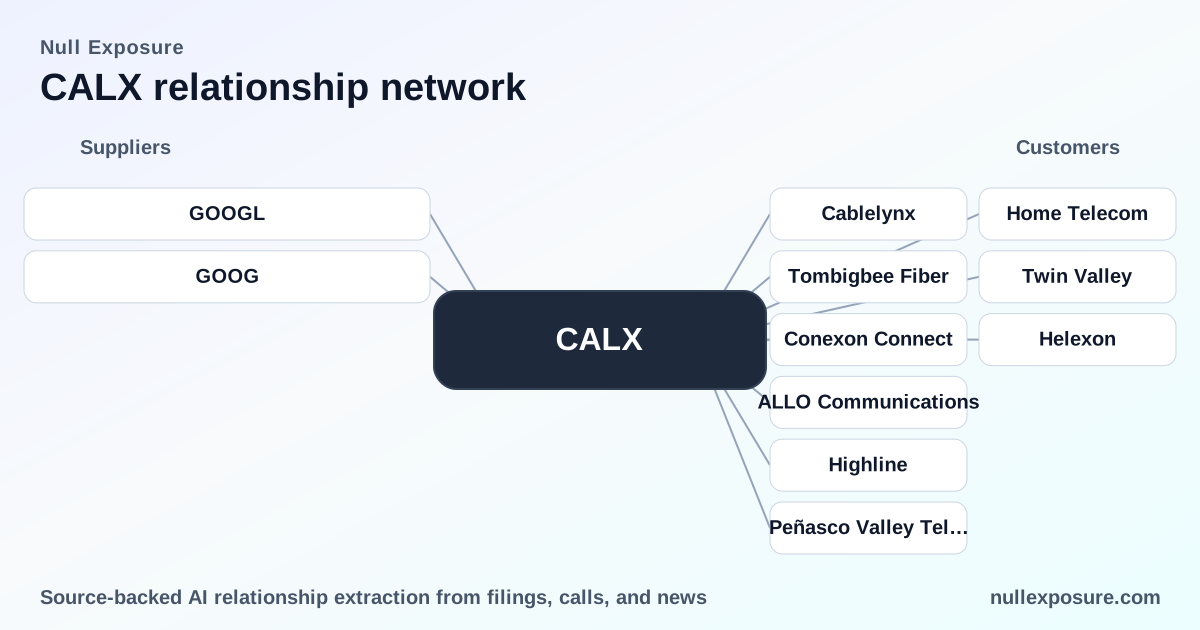
Calix (CALX) suppliers: what the Google Cloud tie-up and manufacturing posture mean for investors
Calix builds cloud-native software and network systems for broadband service providers and monetizes through a mix of subscription cloud services (the Calix One platform), hardware sales fulfilled through contract manufacturers and original design manufacturers, and professional services. The company converts its installed base into recurring software revenue while using outsourced manufacturing to scale hardware deliveries, creating a profile that is both software-driven and supply-chain dependent. For investors and procurement teams evaluating Calix as a supplier or partner, the interaction between its cloud strategy (AI-enabled product differentiation) and its concentrated manufacturing footprint is the central investment thesis.
Explore supplier intelligence and relationship signals at https://nullexposure.com/.
Why the Google Cloud relationship matters now
Calix launched Calix One as an AI-native platform that embeds AI agents into service provider workflows. The partnership with Google Cloud is positioned as the cloud and AI infrastructure underpinning that capability and is being promoted as a revenue and efficiency accelerator for Calix customers.
According to a press release distributed via Markets.FinancialContent / BusinessWire on February 17, 2026, Calix One is introduced as an AI-native platform for service providers and the company explicitly references its partnership with Google Cloud in that launch. Industry coverage on March 9, 2026 — including an Intellectia write-up and a Yahoo Finance summary — reiterates that Calix One leverages Google Cloud to operate AI agents natively inside customer workflows, intended to reduce operational costs while enabling personalized customer experiences at scale. These communications frame the Google Cloud tie-up as a capability enabler that supports Calix’s recurring-revenue strategy and customer retention profile.
Key relationship takeaway: the Google Cloud partnership amplifies Calix’s software-led monetization by providing the scalable AI infrastructure required to push customers from one-off hardware purchases toward richer, recurring cloud services.
The Google Cloud relationship — plain-English summary and sources
Calix announced that Calix One runs AI agents natively and that Google Cloud is a strategic cloud partner enabling those AI capabilities, positioning Calix to sell more subscription services to its broadband-provider customers. This was communicated in Calix corporate materials and press coverage in early 2026, including the February 17, 2026 BusinessWire/Markets.FinancialContent release and March 9, 2026 reports on Intellectia and Yahoo Finance.
- Source: BusinessWire / Markets.FinancialContent press release, Feb 17, 2026.
- Source: Intellectia news summary, Mar 9, 2026; Yahoo Finance coverage, Mar 9, 2026.
Supplier footprint and procurement constraints investors must weigh
Calix’s operating model couples high-margin cloud software aspirations with outsourced, materially sized hardware procurement. The company’s public disclosures make the following company-level signals clear:
- Short-term contracting posture: Calix “generally purchases its products through purchase orders with its suppliers” and places monthly POs with CMs and ODMs, indicating transactional, short-duration commitments rather than lengthy fixed-price contracts. This cadence supports inventory flexibility but increases exposure to spot shortages when demand spikes.
- Concentrated manufacturing in Asia / APAC: A substantial portion of manufacturing is performed at facilities outside the U.S., largely in Asia, which raises logistics and geopolitical risk as a structural supply constraint.
- High materiality and audit focus on inventory: The company reported components and finished goods inventories with a carrying value of $102.7 million and identified excess and obsolete component liabilities of $27.5 million as of December 31, 2024; inventory valuation was identified as a critical audit matter.
- Dependence on a small number of CMs/ODMs: Calix depends primarily on a small number of contract manufacturers and original design manufacturers for most finished goods, centralizing single points of failure in the supply chain.
- Meaningful purchase commitments: Outstanding purchase commitments for inventory were reported at approximately $138.8 million as of December 31, 2024, indicating material near-term spend to suppliers.
These constraints are company-level facts that shape how investors should evaluate Calix’s supplier risk and contract negotiating posture. Short-term POs, APAC concentration, and large purchase commitments together create a profile where supply interruptions can quickly translate to revenue and margin impact.
Explore supplier risk and relationship analytics at https://nullexposure.com/.
How the constraints change the risk-reward calculus
The combination of AI/cloud-led monetization and hardware manufacturing exposure produces a mixed but manageable risk-reward profile:
- Upside: Google Cloud integration strengthens Calix’s ability to upsell cloud subscriptions and entrench customers, driving higher lifetime value per account and smoother revenue visibility on the software side.
- Downside: concentrated manufacturing and short-term supplier arrangements increase operational volatility — both topline timing risk from hardware delivery and margin risk from supply-driven cost inflation. The company’s inventory valuation being a critical audit matter signals real-world financial sensitivity to these supply dynamics.
Investors should treat the supplier picture as a dual lens: technology partnerships increase growth optionality; procurement posture increases cyclicality and event risk.
Practical implications for investors and operator due diligence
For investors running diligence or operators negotiating with Calix as a supplier or partner, focus on three priorities:
- Validate cloud-to-hardware monetization: confirm how contracts translate Calix One adoption into measurable recurring revenue and contracting terms for software vs. hardware.
- Stress-test supply continuity: require transparency on CM/ODM diversification, lead times, and contingency plans given APAC concentration and short-term PO practice.
- Monitor inventory and purchase-commitment trends: follow quarterly disclosures for fluctuations in inventory carrying values, excess and obsolete reserves, and changes to outstanding purchase commitments.
Actionable next step: if you need a consolidated view of supplier relationships and operating constraints for targets like Calix, review integrated supplier intelligence at https://nullexposure.com/.
Bottom line: a hybrid story with clear levers
Calix presents an investment case built on software-driven revenue expansion enabled by high-profile cloud partnerships, most notably with Google Cloud, while simultaneously carrying non-trivial supply-chain concentration and inventory risk from its CM/ODM model and APAC manufacturing footprint. For investors, the key question is execution: can Calix scale subscription monetization fast enough to offset the volatility inherent in hardware procurement and inventory management? For procurement and partner teams, the imperative is to quantify continuity assurances and contract terms that reflect the company’s short-term purchasing posture.
Final call to action: for a deeper supplier-risk brief and relationship mapping on Calix and comparable vendors, visit https://nullexposure.com/.