CAMP4 Therapeutics: financing-first biotech with outsourced R&D and tight third‑party dependencies
CAMP4 Therapeutics (CAMP) operates as an early‑stage biotechnology company focused on developing a first‑in‑class treatment for SYNGAP1‑related disorders and similar genetic disease programs, monetizing today through equity financings and planning commercialization value capture upon regulatory progress. The company’s business model is capital‑intensive, dependent on licensing and outsourced development and manufacturing, and therefore driven by repeat interactions with investment banks, placement agents, and specialist investor relations firms that control access to liquidity and dilution dynamics.
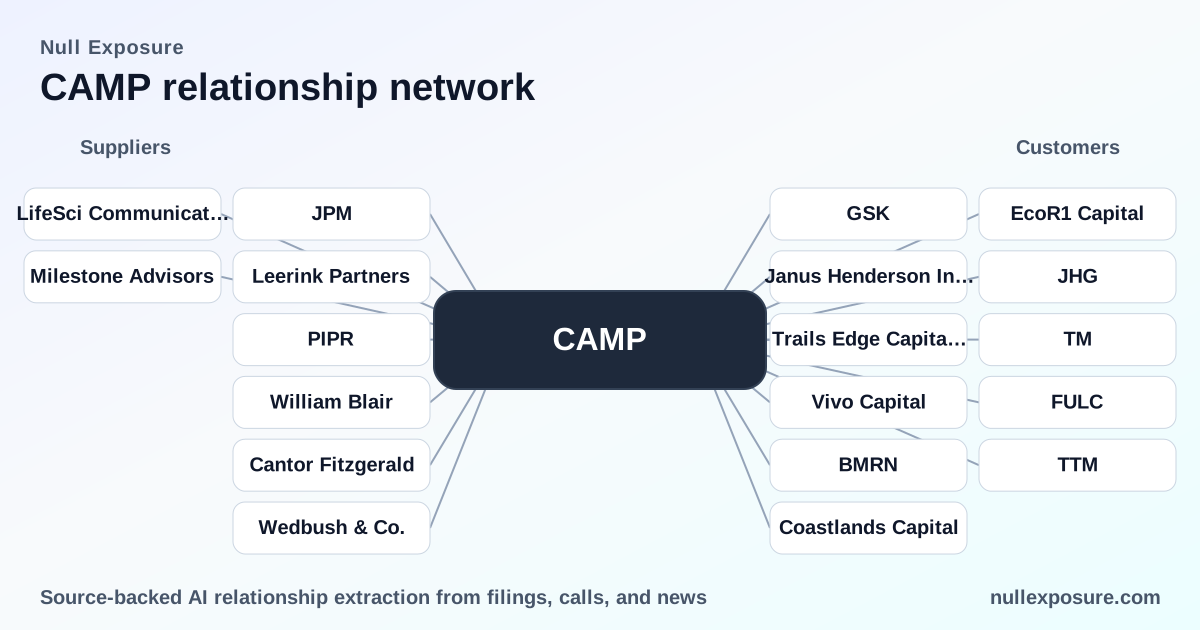
Explore CAMP4’s supplier and capital network at https://nullexposure.com/ for a visual map and deeper signals.
The capital and supplier choreography that defines CAMP4
CAMP4’s observable activity in 2025–2026 centers on three financing patterns: a private placement (up to $100 million), an underwritten common‑stock offering ($30.0 million priced in December 2025), and a broadly registered S‑3 shelf (up to $300 million with an at‑the‑market program up to $100 million). Those financing channels are the immediate revenue lifeline, and the company’s relationships with underwriters and placement agents therefore carry outsized importance for dilution scheduling, investor composition, and market access. The company also relies on licensors and contract research/ manufacturing organizations for technology and operations — a structural tradeoff between balance‑sheet lightness and counterparty concentration risk.
If you evaluate suppliers or counterparty exposure for CAMP4, start with the capital markets partners below and then layer on the licensing and CRO/CMO posture described in the next section. For a deeper supplier risk profile, visit https://nullexposure.com/.
What the financing activity signals
- Equity finance dependence: Multiple transactions and a large S‑3 shelf indicate management will use the capital markets proactively to fund development rather than operating cash flow.
- Single lead underwriter concentration: Leerink Partners repeatedly shows up as a lead or sole underwriter, implying a concentrated banking relationship that shapes timing and execution.
- Investor syndicate breadth: Institutional participants named in coverage (Janus Henderson, Vivo, EcoR1, etc.) suggest a mix of long‑only and specialist biotech investors on deal books.
Operating constraints and what they tell investors
CAMP4’s supplier posture is defined by licensing, outsourcing, and critical third‑party dependencies:
- Licensing is core to the technology stack. Multiple excerpts document patent and development licenses (e.g., Whitehead Institute, Children’s Medical Center Corporation), indicating the company does not own all foundational IP and is contractually bound to pay license fees and royalties. This is a company‑level signal: licensing is a principal route for access to core science with associated encumbrances and sublicensing options.
- Third‑party dependency is material to critical. CAMP4 states reliance on licensors and outside vendors for patent rights, clinical trials, and manufacturing; these suppliers are material and, in some cases, critical to program continuity.
- Manufacturing and distribution are outsourced. CAMP4 lacks internal manufacturing capabilities and contracts CMOs and distributors for clinical supply and potential commercialization — a mature outsourcing posture that reduces fixed costs but increases execution risk if a provider fails.
- Service provider mix is broad but specialized. The company uses CROs, CMOs, academic partners, and IT vendors for development and trials, signaling a typical early‑stage biotech operational model with multiple single‑point suppliers for key activities.
Who’s on the deal — every listed relationship and what it means
- J.P. Morgan. Listed as a joint bookrunner on the IPO filing referenced in coverage, indicating a role in initial public markets execution and investor outreach (Renaissance Capital, IPO news, 2026).
- Leerink Partners. Appears repeatedly as joint bookrunner (IPO coverage) and as the sole underwriter on a December 18, 2025 underwritten offering; Leerink also is named as lead placement agent on a private placement and is the designated partner for an ATM program on an S‑3 shelf — the clear primary capital markets partner (GlobeNewswire, Dec 18, 2025; GlobeNewswire, Sep 10, 2025; StockTitan reporting S‑3 shelf, Nov 10, 2025).
- Piper Sandler / Piper Sandler & Co. Named as a joint bookrunner on the IPO filing and as a co‑placement agent on the oversubscribed private placement, showing repeated placement activity and distribution support (Renaissance Capital, 2026; GlobeNewswire, Sep 10, 2025).
- William Blair. Identified as a joint bookrunner on the IPO filing, providing additional sell‑side distribution capability for public offerings (Renaissance Capital, 2026).
- Cantor Fitzgerald. Served as a co‑placement agent for the September 2025 private placement, contributing to institutional placement allocation (GlobeNewswire, Sep 10, 2025).
- Wedbush & Co. Listed as a co‑placement agent on the September 2025 financing, part of the dealer group that executed the oversubscribed private placement (GlobeNewswire, Sep 10, 2025).
- Janus Henderson Investors. Reported as a participant in the underwritten offering, indicating buy‑side demand from established fund managers (StockTitan reporting of the offering, 2026).
- Coastlands Capital. Named among participating institutional investors in the underwritten offering, signaling allocation to long/activist or specialized managers (StockTitan reporting, 2026).
- EcoR1 Capital. Identified as a participating investor in the offering, representing specialized biotech equity interest in CAMP4 (StockTitan reporting, 2026).
- Trails Edge Capital Partners. Included among offering participants, reflecting venture or crossover investor appetite for the equity placement (StockTitan reporting, 2026).
- Vivo Capital. Reported as a participant in the offering, reinforcing strategic biotech investor involvement (StockTitan reporting, 2026).
- LifeSci Communications. Cited as the media contact for several press releases, functioning as the company’s PR vendor and controlling public messaging around financings (StockTitan; GlobeNewswire; Sahm Capital press items, 2025–2026).
- Milestone Advisors. Named as investor relations contact across filings and press releases, indicating responsibility for investor outreach and sell‑side coordination (Sahm Capital and StockTitan press distribution, 2025–2026).
Each of the above relationships is supported in public press coverage and deal notices; the repeated presence of Leerink Partners as lead underwriter and placement agent is the single most consequential counterparty for near‑term financing execution.
Midway check: to see the full supplier map and historical relationship timelines, visit https://nullexposure.com/.
Investment implications and risk checklist
- Financing risk dominates near term. With limited revenue (Revenue TTM ~$3.5M) and negative operating margins, CAMP4 will continue to depend on equity markets; the S‑3 shelf and ATM capacity create flexibility but also dilution risk.
- Counterparty concentration in capital markets. Leerink’s central role concentrates execution and pricing leverage with a single bank.
- Operational dependency on licensors and CMOs/CROs is material to critical. Loss of a licensor or a manufacturing failure would disrupt trials and timelines.
- Investor base is institutionally heavy. Participation by major managers and specialized biotech investors can stabilize syndication but also accelerate dilution if pipeline milestones underperform.
For operational due diligence and supplier risk heatmaps, review the full company profile at https://nullexposure.com/.
Bottom line
CAMP4 is a classic, capital‑driven biotech: value creation depends on clinical progress but is funded and controlled by iterative equity raises and a small set of capital markets partners, with Leerink Partners central to that execution. Investors and counterparties should prioritize monitoring financing cadence, the status of key licenses, and the performance of CRO/CMO relationships as the proximate determinants of valuation realization. For a curated supplier network view and ongoing alerts on CAMP4 counterparties, go to https://nullexposure.com/.