Camtek (CAMT): Supplier relationships, operating constraints, and what investors should watch
Camtek builds inspection and metrology equipment for advanced semiconductor packaging, memory, image sensors, MEMS and RF markets and monetizes primarily through capital equipment sales complemented by after‑sales services, spare parts and maintenance. The company’s value proposition is process control and yield improvement—products that become operationally critical inside fabs—while the public equity story reflects a profitable, growing equipment vendor trading at a premium multiple. For investors and operators evaluating supplier relationships, the question is not whether Camtek sells important machines, but how contracting posture, revenue mix and valuation shape counterparty risk and partnership leverage. Learn more at https://nullexposure.com/.
How Camtek makes money and why that matters to partners
Camtek sells high‑value inspection/metrology systems and then captures recurring revenue through service contracts and consumables, which gives the business both cyclical capital equipment exposure and a recurring aftermarket component. The company reported roughly $496M revenue (TTM) with a ~24.7% operating margin and is profitable—evidence of a mature commercial model with healthy unit economics. Market capitalization (about $6.98B) and a high forward valuation (forward P/E ~44, trailing P/E ~146) indicate investor expectations for continued growth in advanced packaging and related end markets.
- Commercial implication: Equipment vendors operate with long sales cycles and high customer switching costs; that enhances pricing power but concentrates risk on a limited number of large fab customers.
- Balance‑sheet implication: Profitability and positive operating margins support R&D and services expansion, but the stretched valuation increases downside sensitivity to order cyclicality.
Contracting posture, concentration and criticality — business signals for counterparties
Camtek’s product set is capital-intensive and mission-critical for customers who need high-precision inspection to maintain fab yield. That creates a supplier posture where Camtek negotiates complex, long-term contracts (capital purchase terms, installation, acceptance criteria, service agreements). The company’s commercial footprint covers multiple end markets—advanced interconnect packaging, memory, CMOS image sensors, MEMS and RF—providing end-market diversification rather than dependence on a single device category.
Financial and governance signals that matter:
- Operational maturity: Positive operating margin and consistent quarterly revenue growth (quarterly revenue growth YoY ~9.2%) indicate a company that has scaled product delivery and aftermarket services.
- Valuation risk: Elevated price multiples (P/S ~14, P/B ~11) signal that growth expectations are already priced in; any order softness would pressure the share price.
- Ownership structure: Institutional ownership (~56%) and sizable insider ownership (~38%) suggest active investor engagement and significant insider alignment with long-term outcomes.
Supplier‑scope mentions observed (one direct relationship)
A single supplier‑scope item was identified in the study window:
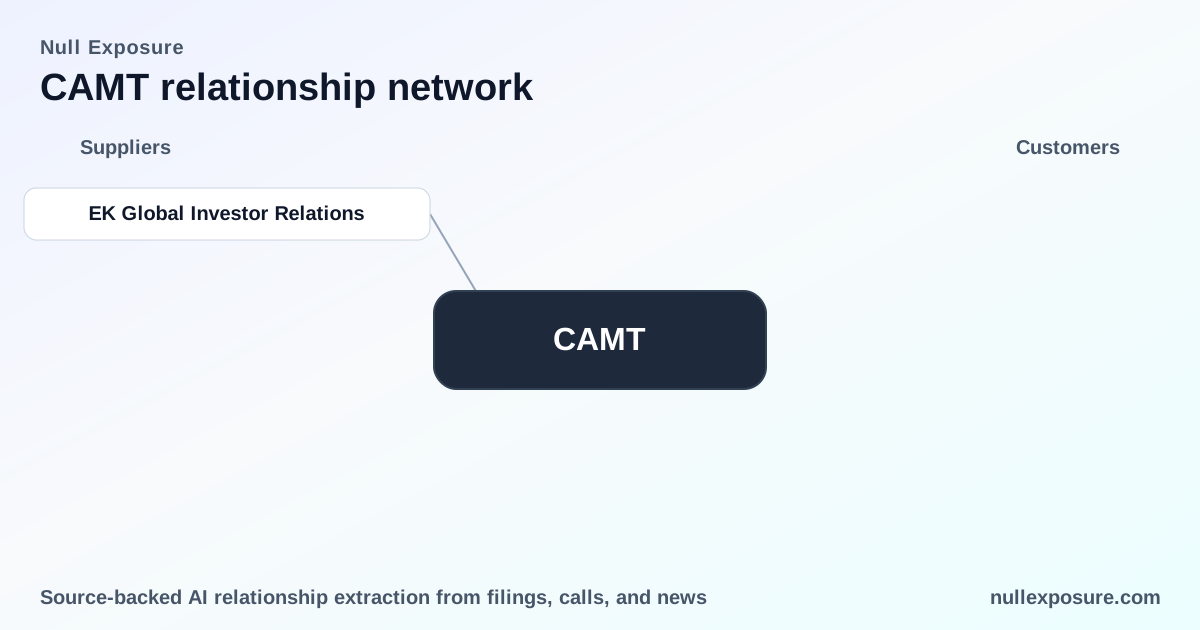
- EK Global Investor Relations — A PR Newswire release from EK Global Investor Relations (first seen March 9, 2026) provided investor‑relations contact details and announced that Camtek would report fourth‑quarter and full‑year 2025 financial results on February 18, 2026. This is a standard investor communications item, useful for sourcing company reporting cadence and contacts. Source: PR Newswire / EK Global Investor Relations (FY2026 / March 2026).
Takeaway: The relationship item identified is an investor‑relations announcement rather than a third‑party supplier contract; it confirms corporate reporting timelines and IR channels but does not reveal supplier counterparty terms or material third‑party constraints.
Constraints and operating signals relevant to supplier risk
No explicit third‑party constraints were provided in the relationship results, so there are no documented supplier contractual constraints surfaced in this sample. At the company level, available public metrics and business descriptors provide actionable signals:
- Contracting maturity: Camtek’s market position and margins indicate established contracting practices—capital purchase agreements with installation and service SLAs are the likely norm.
- Counterparty criticality: Inspection and metrology are operationally critical to customers; losing a Camtek system mid‑production would have immediate yield consequences, strengthening Camtek’s bargaining position on service and uptime guarantees.
- Diversification vs. concentration: The product focus across several device segments suggests diversification of end markets, limiting single‑customer concentration risk at the market-segment level, though specific customer concentration data is not reported here.
- Market cyclicality exposure: As a capital-equipment vendor, Camtek’s revenue profile is exposed to semiconductor capex cycles; high valuation increases the importance of maintaining order momentum.
What this means for investors and supply‑chain operators
For equity investors, Camtek is a profitable, high‑quality equipment provider with strong operating margins and growth exposure to advanced packaging and sensor markets, but the stock carries elevated valuation risk that amplifies order cyclicality. For procurement and operator teams considering Camtek as a supplier or partner, the key commercial questions are service coverage, spare‑parts logistics, and contractual remedies for uptime.
- Risk items to push on in diligence: contractual uptime SLAs, mean time to repair/replace, parts availability and lead times, and escalation paths for critical production failures.
- Opportunity items: multi‑year service agreements and parts contracts can create predictable recurring revenue for Camtek and predictable uptime for customers—structures that reduce total cost of ownership despite higher upfront equipment prices.
Midway action: review Camtek’s most recent earnings release and IR materials for order backlog and service revenue breakdown at https://nullexposure.com/.
Practical next steps for relationship evaluation
- Request evidence of installed base density in relevant fabs and the customer‑specific SLAs that apply to critical tools.
- Obtain spare‑parts lead‑time commitments and historical service response metrics for your region.
- Negotiate layered remedies: expedited repairs, loaner units, and rebate structures tied to uptime metrics.
- Validate financial covenant sensitivity for long‑term deals given the company’s premium valuation.
Final note and call to action: Camtek is a strategic supplier with mission‑critical products and attractive unit economics, but its premium valuation and capex cyclicality require disciplined contract design and operational assurances. For a deeper supplier risk profile or comparative analysis, visit https://nullexposure.com/ for tailored research and relationship due‑diligence services.
Concluding thought: align contracting to the criticality of the tool—pay for uptime and certainty, not just hardware—and structure longer service commitments to convert Camtek’s aftermarket into measurable production resilience. For more on turning supplier intelligence into actionable decisions, start at https://nullexposure.com/.