Canaan Inc (CAN): North American expansion reshapes supplier dynamics and operating posture
Canaan Inc. designs and sells bitcoin-mining ASICs and operates mining infrastructure; it monetizes by selling hardware and by owning/operating mining assets that generate crypto revenue and hardware sales synergies. The company's recent purchase of a 49% interest in West Texas mining projects paid in stock shifts Canaan from pure hardware supplier to an integrated miner-operator with direct exposure to North American power markets and third‑party infrastructure partners. For investors and counterparties, that dual role changes contracting leverage, counterparty concentration, and capital intensity in supplier relationships. Learn how this affects supplier risk and opportunity at https://nullexposure.com/.
Quick company snapshot you need to know
Canaan is a China-headquartered computer-hardware company listed on NASDAQ (Ticker: CAN) with a market capitalization around $325.6M and trailing twelve‑month revenue of roughly $529.7M (latest quarter ended 2025‑12‑31). The company reported a negative net margin and recurring operating losses (TTM profit margin -39.7%, EBITDA -$75.2M), while capacity to capture upside rests on ASIC sales and mining economics. High operating leverage, negative profitability and a concentrated pivot into North American mining assets are the central commercial signals for suppliers and operators.
Why the West Texas deal matters to suppliers
On February 23–24, 2026 Canaan disclosed an acquisition of a 49% equity interest in several West Texas mining projects from Cipher Mining paid for in stock worth $39.75 million. That transaction converts Canaan into an active site operator in a U.S. power market, creating vendor opportunities (equipment, site services, O&M) and new counterparty exposures. Multiple industry outlets covered the transaction, highlighting both the size and the non‑cash consideration.
- According to CoinDesk (Feb 24, 2026), Canaan bought a 49% equity interest in a joint venture tied to West Texas mining projects from Cipher Mining for $39.75M in stock.
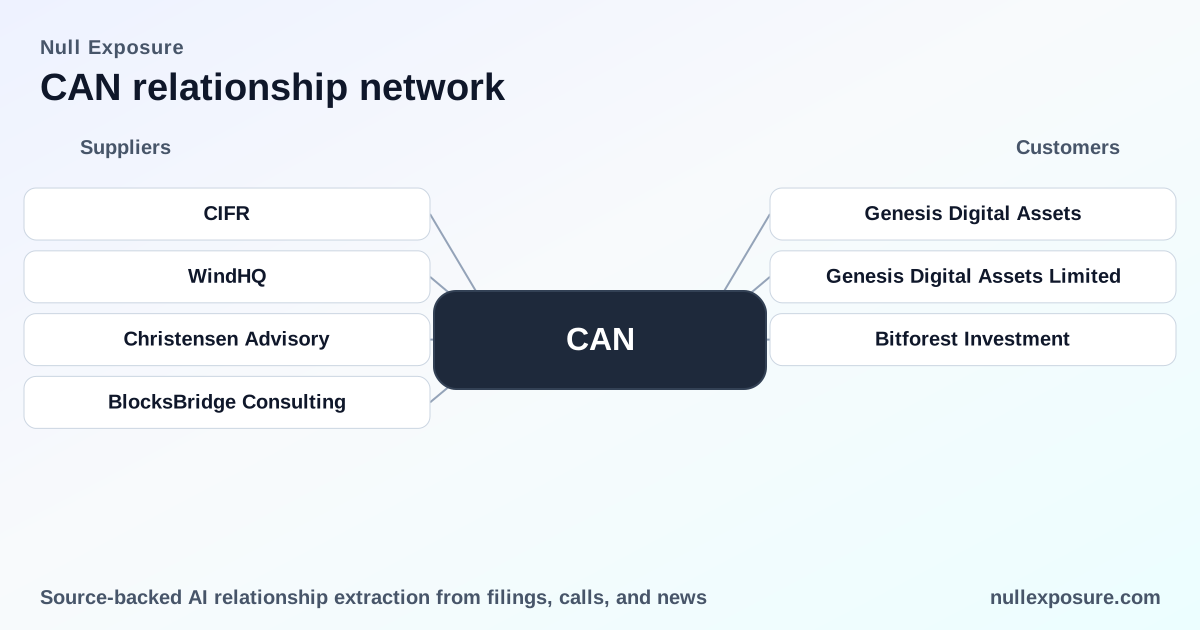
- Financier and press summaries position WindHQ as the local partner retaining a majority stake and operational know‑how in the projects.
A practical implication for suppliers: expect procurement to blend ASIC hardware supply contracts with infrastructure service agreements governed by multi‑party JV arrangements rather than simple vendor purchase orders.
Full relationship run‑down (each relationship in the results)
Cipher Mining — the JV seller and former partner
Canaan acquired Cipher Mining’s 49% interest in the West Texas mining venture for $39.75 million in stock, effectively transferring equity and operational upside into Canaan’s balance sheet while increasing its operating footprint in North America. Source: CoinDesk report (Feb 24, 2026) and corroborating press coverage (Decrypt, Mugglehead, WhalesBook, March 2026).
WindHQ — local majority partner on site operations
News coverage indicates WindHQ retains a 51% stake in the West Texas projects and provides local energy infrastructure and grid‑stabilization expertise that complements Canaan’s ASIC and mining technology. This positions WindHQ as the operational majority owner and a strategic service partner for suppliers working on site. Source: FinViz news summary (March 2026).
Christensen Advisory — investor relations contact
Canaan listed Christensen Advisory (Christian Arnell) as an investor relations contact in its current report (6‑K), which signals an outsourced communications/IR relationship for investor engagement and disclosures. Source: Canaan current report filed and distributed via StockTitan (6‑K, reported March 2026).
BlocksBridge Consulting — public relations partner
BlocksBridge Consulting (Jesse Colzani) is named as the company’s public relations contact in the same 6‑K, reflecting a retained PR relationship for media and stakeholder communications. Source: Canaan 6‑K (as posted on StockTitan, March 2026).
What these relationships reveal about Canaan’s operating model
- Contracting posture: Canaan is transitioning from transactional hardware sales toward strategic, equity‑backed project participation. Suppliers should expect a mix of commercial contracts and JV governance terms, including performance milestones and capex/service schedules tied to joint‑venture economics.
- Concentration and criticality: With West Texas projects and WindHQ as a majority partner, vendor importance becomes more concentrated regionally; local partners will control day‑to‑day site decisions, making relationships with WindHQ and on‑site service providers critical for timely deployment.
- Capital and maturity: The stock‑paid acquisition indicates constrained near‑term cash deployment and a preference for equity financing. Suppliers should price counterparty credit and payment risk accordingly—stock consideration reduces immediate cash inflows for vendors and signals higher working‑capital pressure.
- Operational shift: Owning operating assets raises Canaan’s exposure to power‑market volatility and regulatory changes in U.S. energy markets, increasing the variance in demand for replacement gear and site services over time.
These are company‑level signals—derived from the transaction structure and financial snapshot—not attributed to any single supplier relationship unless explicitly stated.
Risk and opportunity for suppliers and investors
- Risk: counterparty and payment structure. The use of stock as consideration and negative profitability (TTM profit margin -39.7%) increase commercial risk for suppliers extending material credit or long lead‑time commitments.
- Opportunity: integrated demand. Vertical integration into mining operations creates recurring demand for spare parts, power‑management equipment and O&M services; suppliers that secure JV or WindHQ buy‑ins can lock multiyear revenue streams.
- Regulatory and operational risk. U.S. grid interconnection, curtailment rules, and local permitting now matter as much as ASIC performance; suppliers must align commercial terms to these non‑commodity risks.
Major takeaway: the West Texas purchase transforms Canaan into a hybrid supplier/operator, raising both counterparty complexity and long‑run procurement opportunity.
What suppliers and analysts should do next
- Revisit commercial terms with Canaan to include stronger credit protections or shorter payment cycles given the stock‑based consideration and negative margins.
- Engage WindHQ directly for on‑site contracting, since they retain majority control and will likely govern operational procurement decisions.
- Monitor Canaan’s reported mining yields and power contracts—these will be the leading indicators of equipment replacement cycles and service demand.
For a concise supplier risk profile and tailored counterparty monitoring, visit https://nullexposure.com/ to see how integrated supplier intelligence can support negotiations.
Closing: practical calls to action
Canaan’s shift into North American mining operations changes the supplier landscape: expect deeper JV governance, regional concentration of operational control, and payment structure risk tied to equity consideration. Suppliers and investors should update risk models, renegotiate credit terms, and cultivate direct ties with WindHQ and on‑site operators to capture the upside. Learn more about supplier scoring and tailored alerts at https://nullexposure.com/.
For support in assessing counterparty credit, contract terms, or to map your exposure across Canaan’s new operating footprint, get detailed intelligence at https://nullexposure.com/.