Can-Fite Biopharma (CANF): Capital structure and service-provider map every investor should know
Can‑Fite is a clinical‑stage Israeli biotech that develops small‑molecule therapeutics for cancer, liver and inflammatory diseases, COVID‑19 and erectile dysfunction. The company generates negligible product revenue (Revenue TTM $560k) and negative operating cash flow, so monetization today is concentrated in equity financings, ADS mechanics and milestone/license receipts rather than product sales. That structure makes supplier and service-provider relationships — placement agents, depositary banks and exchange venues — operationally critical to funding, governance and liquidity. Read on for a concise map of those relationships and what they signal for investors and operators. For platform-level analysis and tracking, visit https://nullexposure.com/.
Recent corporate moves change the mechanics of liquidity and governance
Can‑Fite’s recent announcements combine a reverse share split and active capital raises. The reverse split and ADS ratio change consolidate tradable units and reset on‑exchange mechanics, while recent warrant exercises produced roughly $4.0 million in gross proceeds. That combination is classic for small biotechs: preserve listing continuity while using financing windows to extend the runway. Given the company’s operating metrics — negative EBITDA and limited revenue — these service providers are not peripheral vendors; they are gates to liquidity and investor access.
The relationships you need to monitor (and why)
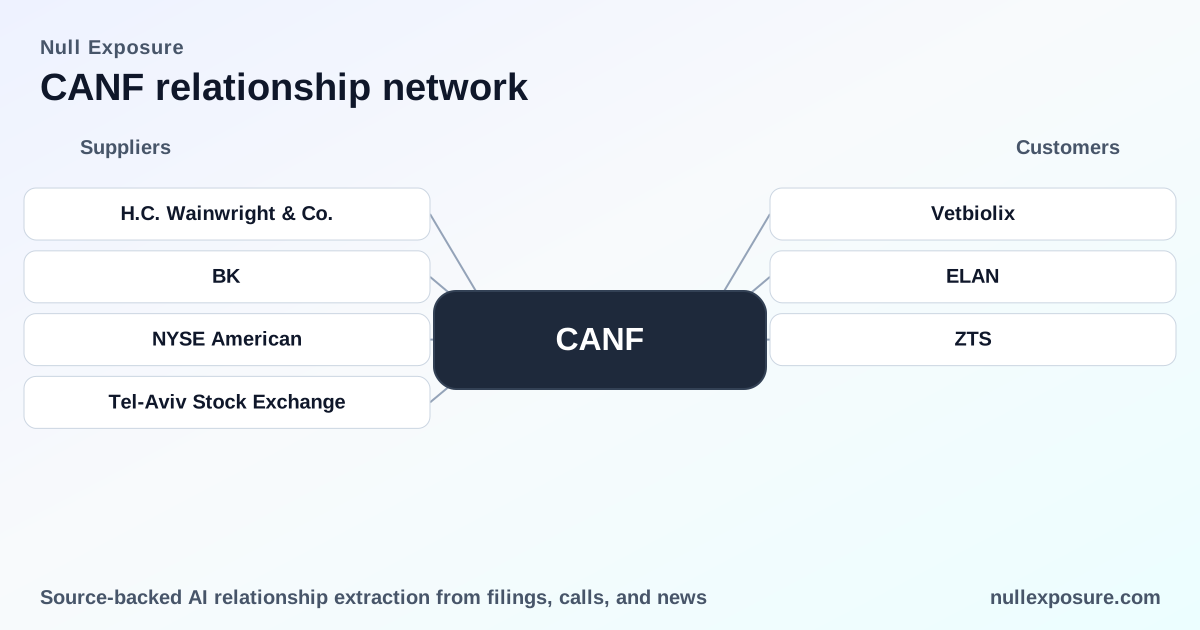
Below I cover every supplier relationship in the public results set and what it practically means for investors. Each entry is short, plain English, and sourced to the press or filing cited in the merchant data.
-
H.C. Wainwright & Co.
Can‑Fite engaged H.C. Wainwright & Co. as the exclusive placement agent for an offering tied to the exercise of warrants that produced approximately $4.0 million in gross proceeds in early 2026, underlining dependence on external equity markets to fund operations. This activity was announced in a GlobeNewswire release on March 4, 2026, and corroborated in related filings in FY2026. -
The Bank of New York Mellon (BNY Mellon)
BNY Mellon serves as the company’s depositary bank for its American Depositary Shares (ADSs), arranging exchanges under the deposit agreement and executing ADS conversions related to the reverse split; the depositary also handles voting instructions per the deposit agreement. These responsibilities are described in Can‑Fite notices published in FY2025–FY2026 and in a FY2026 filing summarizing depositary duties. (See GlobeNewswire/StockTitan and the FY2026 6‑K references.) -
NYSE American
The company confirmed that its ADSs will continue trading on the NYSE American under the ticker “CANF” with a new CUSIP following the reverse split and ratio change, preserving US market visibility and liquidity mechanics. That confirmation appeared in market notices and media coverage of the reverse split in late 2025 and early 2026 (Yahoo Finance and StockTitan coverage of the FY2025 announcement). -
Tel‑Aviv Stock Exchange (TASE)
Can‑Fite recorded the reverse split with the Tel‑Aviv Stock Exchange and scheduled first trading of the consolidated ordinary shares on TASE in early January 2026, ensuring continuity of the local listing and shareholder registers in Israel. This timetable was published in the December 23, 2025 GlobeNewswire release and in subsequent market bulletins (SahmCapital/StockTitan coverage of the FY2025 announcement).
What these service relationships reveal about the operating model
- Contracting posture and concentration: The firm uses a single, exclusive placement agent for the offering activity noted in FY2026, implying concentrated execution risk around capital raises. An exclusive placement agent accelerates placement but concentrates negotiation leverage and execution dependency with H.C. Wainwright & Co.
- Criticality of depositary and exchange services: BNY Mellon’s role in ADS exchanges and voting is operationally critical — ADS mechanics directly affect shareholder rights, voting and the logistics of any future capital actions. Likewise, continuity on NYSE American and TASE preserves liquidity and access for US and Israeli investors.
- Maturity and financial posture: Can‑Fite is a clinical‑stage, non‑revenue‑driven operation requiring periodic financing. With a market cap and balance‑sheet profile consistent with early‑stage biotech, the company’s uptime depends on timely capital markets access rather than operating cash flow.
- Counterparty risk: Exclusive placement relationships and single depositary arrangements leave the company exposed to counterparty execution and timing risk in funding events, ADS servicing and investor communications.
Investment implications and risk checklist
Investors and operator teams should treat these relationships as part of the company’s core infrastructure, not peripheral suppliers. Key takeaways:
- Funding dependency: The March 2026 warrant exercise that brought in ~ $4.0 million confirms current reliance on capital markets rather than product cash flow (GlobeNewswire, March 4, 2026).
- Concentration risk with placement agents: An exclusive placement agent model compresses time to close but increases execution single‑point failure risk (H.C. Wainwright & Co., FY2026 notices).
- Operational leverage of the depositary bank: BNY Mellon controls ADS exchange mechanics and voting processing; any service disruption would directly affect liquidity and corporate governance (BNY Mellon / FY2026 6‑K language).
- Listing continuity preserved: Maintenance of NYSE American and TASE listings reduces the probability of abrupt liquidity loss tied to venue discontinuity (NYSE American and TASE press in FY2025).
Major action items for risk management:
- Confirm fallback arrangements or secondary agents for future capital raises.
- Monitor depositary notices and CUSIP changes closely around corporate actions.
- Track timing differences between TASE and NYSE American mechanics; cross‑listing timing can create temporary arbitrage or liquidity gaps.
Where to go from here
To monitor these supplier and capital‑markets dependencies in real time, and to model counterparty risk into runway scenarios, use consolidated tracking and document alerts. For institutional monitoring and supplier relationship intelligence, visit https://nullexposure.com/.
In summary, Can‑Fite operates as a capital‑markets dependent clinical biotech where placement agents, the depositary bank and exchange venues are core strategic suppliers. Their actions determine runway, shareholder mechanics and voting outcomes — all of which directly affect valuation and execution risk. Stay current on placement activity, ADS mechanics and exchange notices; for ongoing coverage and supplier analytics, see https://nullexposure.com/.