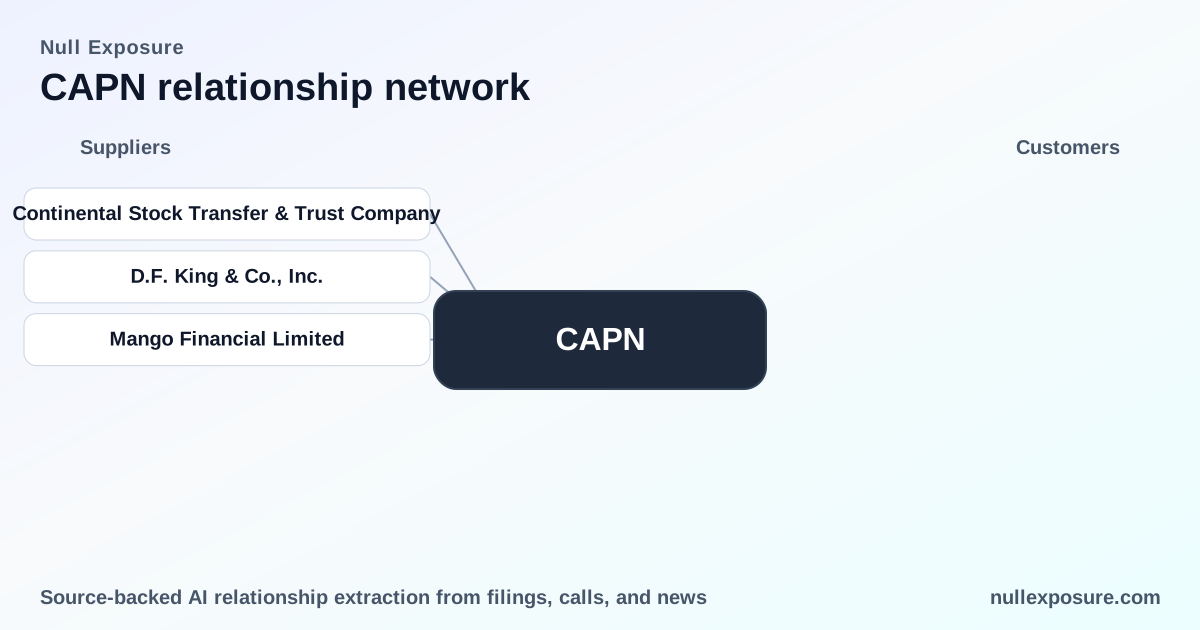
CAPN supplier profile: what Cayson Acquisition’s vendors reveal about operational risk and runway
Cayson Acquisition Corp (CAPN) operates as a SPAC: it monetizes by raising capital through an IPO, holding cash in a Trust Account invested in government securities, and funding sponsor and service arrangements while it sources an initial business combination. Revenue generation is contingent on completing a business combination, so supplier contracts, cash-in-trust composition, and short-term financing are the active levers that determine runway and transactional flexibility. Learn more about how supplier intelligence informs investment decisions at https://nullexposure.com/.
High-level takeaway: suppliers are operationally critical and concentrated
Cayson’s supplier footprint is compact and purpose-built for SPAC operations: transfer agent services, proxy solicitation, administrative sponsorship, and short-term lending cover the essential functions for shareholder communications and transaction execution. That concentration creates both clarity and single-point exposures—when these vendors execute, a SPAC runs smoothly; when they fail, redemptions, voting and deal cadence stall.
Key company-level signals derived from filings:
- Trust composition favors U.S. government securities, indicating low credit risk on the cash buffer but limited yield and strict redemption mechanics.
- Service-provider posture is active and contract-driven: the company pays monthly administrative fees and has engaged consultants and underwriters with documented payments.
- Geopolitical exposure is present at the target/opportunity level: filings acknowledge that target companies or counterparties could generate or hold data in APAC jurisdictions such as China, introducing non-financial operational risks.
- Spend profile spans small recurring fees and multi-hundred-thousand supplier payments, consistent with early-stage SPAC cash flows and underwriting costs.
These signals combine into a clear operating model: short maturity, high operational dependency on a few vendors, and a funding runway defined by trust assets and occasional sponsor loans.
Supplier-by-supplier: what each relationship is and why it matters
Continental Stock Transfer & Trust Company — transfer agent and trustee
Continental serves as the Company’s transfer agent and is the named trustee under the Trust Agreement; shareholders must use Continental for certificate redemptions or DWAC deliveries. According to the FY2026 definitive proxy statement, Continental is central to redemption mechanics and to an amendment proposed to the Trust Agreement. Source: definitive proxy statement (FY2026) filed via StockTitan — https://www.stocktitan.net/sec-filings/CAPN/def-14a-cayson-acquisition-corp-definitive-proxy-statement-933cefafba5c.html.
D.F. King & Co., Inc. — proxy solicitation
D.F. King is engaged as the proxy solicitor for the Extraordinary General Meeting, with a disclosed fee of $10,000 and contact information provided for holders to submit proxies or requests. The proxy statement (FY2026) documents the engagement and the firm’s role in soliciting votes for the Extension Proposal. Source: definitive proxy statement (FY2026) filed via StockTitan — https://www.stocktitan.net/sec-filings/CAPN/def-14a-cayson-acquisition-corp-definitive-proxy-statement-933cefafba5c.html.
Mango Financial Limited — short-term lender
Mango Financial loaned an aggregate $600,000 to the company effective December 17, 2025, providing near-term liquidity outside the Trust Account. The FY2026 filing records this loan as a discrete financing event supporting operations. Source: definitive proxy statement (FY2026) filed via StockTitan — https://www.stocktitan.net/sec-filings/CAPN/def-14a-cayson-acquisition-corp-definitive-proxy-statement-933cefafba5c.html.
What the supplier mix implies for investors
- Criticality: Transfer agent and proxy solicitor relationships are mission-critical for redemptions and shareholder approvals; failures or disputes here directly throttle a SPAC’s ability to complete a transaction. Continental and D.F. King are therefore operationally essential.
- Concentration: The vendor list is intentionally narrow. That reduces vendor-management overhead but increases single-vendor risk for core functions.
- Cost structure and maturity: Spend signals show a combination of small recurring administrative fees (an allocable sponsor overhead up to $10,000/month) and larger, one-off underwriting and reimbursement figures (underwriting discount payments of $1.2M and reimbursements of $300k appear in filings), consistent with an early-stage public shell. These figures establish a predictable near-term cash outflow profile.
- Liquidity posture: The Trust Account balances are invested in money market funds that purchase U.S. government securities—a conservative cash-preservation stance that limits credit risk but constrains yield and requires careful timing for redemptions and deal closings.
- Non-financial risk: The filing flags APAC data and business presence as a potential target-level exposure; this is a company-level signal about geopolitical and compliance risk on eventual deal targets rather than a vendor-specific issue.
If you want granular supplier scoring and monitoring for CAPN and comparable issuers, start with our research hub at https://nullexposure.com/.
Tactical risks and monitoring triggers for operators and investors
- Redemption mechanics: any change to the Trust Agreement administered by Continental will materially affect investor liquidity and deal viability; monitor trustee notices and amendments closely.
- Proxy timeline and vote outcomes: D.F. King’s solicitation and any extension votes are direct governance milestones; the proxy solicitor’s communications cadence is a short-term risk vector.
- Sponsor and related-party funding: Mango’s loan and sponsor administrative fees reveal dependence on sponsor liquidity to bridge operating periods—track repayment terms and accruals.
- Spend and runway: the combination of ongoing monthly admin fees and cash underwriting/reimbursement flows sets the near-term burn; monitoring Trust Account balances versus redemption requests is essential.
What to watch next — the investor checklist
- Confirm Trust Account balance movements and any trustee amendments filed after the FY2026 proxy statement.
- Watch the outcome of the Extraordinary General Meeting and any proxy-solicitation addenda from D.F. King.
- Track repayment or extension terms for Mango Financial’s $600,000 loan and any additional sponsor funding disclosures.
- Monitor mentions of APAC exposures in subsequent filings if target selection progresses toward companies with operations or data in China.
For ongoing supplier intelligence and timely alerts on CAPN supplier activity, subscribe at https://nullexposure.com/.
Cayson’s supplier footprint portrays a classic SPAC operational model: lean, mission-focused vendors that are indispensable for redemptions and voting, supported by conservative Trust Account investments and occasional sponsor finance. Investors and operators who track these contracts and the cash flows they support will have the clearest view of transaction timing, redemption risk, and runway.