Capricor Therapeutics (CAPR): Balance-sheet dependent biotech with concentrated capital partners
Capricor Therapeutics develops cell- and exosome-based therapies and monetizes primarily through equity financing and milestone-driven development progress rather than commercial revenue today. The company is capital-intensive, operating at a loss with limited recurring revenue, and relies on public offerings and underwriting relationships to fund clinical development and manufacturing scale-up. For investors evaluating supplier exposure, the most material supplier-type relationships over FY2025 are underwriting and bookrunning banks that facilitated the company’s December 2025 equity raise — these relationships directly affect liquidity and runway. Learn more about supplier and counterparty signals on the firm at https://nullexposure.com/.
Market snapshot and operating posture
- Market capitalization: $1.753 billion.
- Revenue (TTM): $11.13 million; EBITDA: negative $106.3 million; EPS (TTM): -2.26.
- Valuation: extreme premium to revenue (Price/Sales ~124x) and high forward P/E (78.7) based on forward estimates, reflecting speculative growth expectations and funding dependency.
- Analyst positioning: consensus skewed positive with analyst target $53.70 and 10 buy/strong-buy votes total, indicating institutional interest in upside tied to development milestones.
Why the underwriting relationships matter Capricor’s operating model is development-stage biotech: value is created through R&D milestones and preserved through timely capital markets access. The December 2025 public offering — priced at $150 million — demonstrates that underwriting relationships are not peripheral suppliers but critical counterparts that determine timing, execution cost, and dilution. Institutional banks that act as bookrunners or co-managers are therefore strategic suppliers of liquidity and market access.
Read more supplier intelligence and counterparty scoring at https://nullexposure.com/.
What the FY2025 relationship data shows Capricor’s supplier-scope relationships returned by our review are exclusively capital markets counterparties tied to its December 2025 offering. Each relationship is transactional, public-facing, and centered on execution of the equity raise.
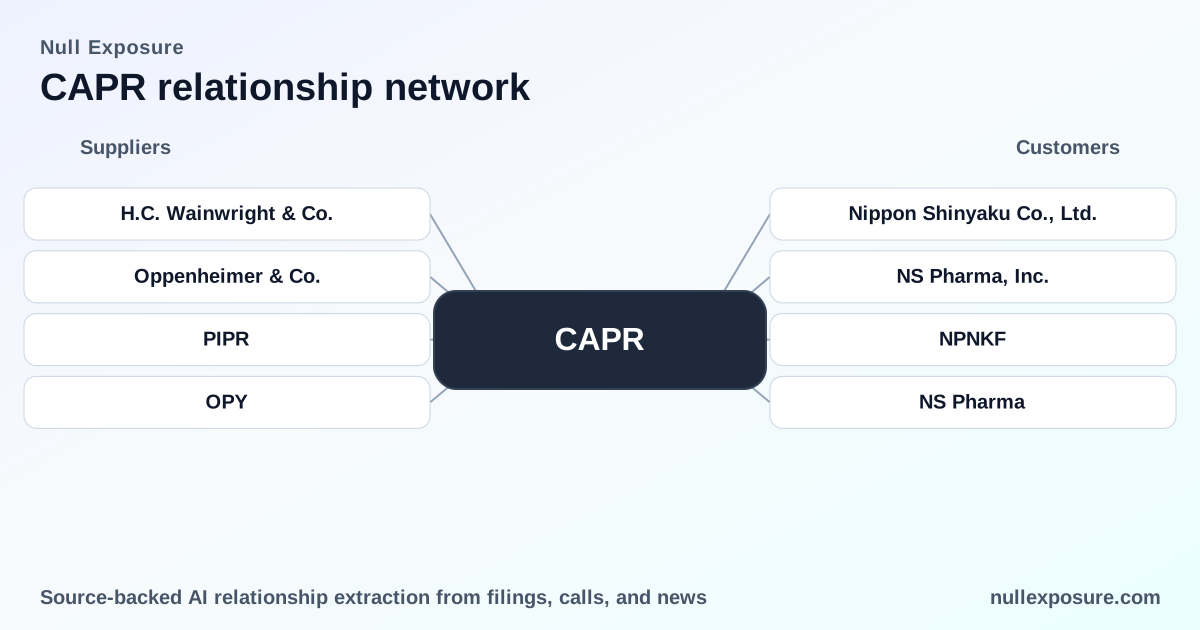
H.C. Wainwright & Co. H.C. Wainwright served as a co-manager on Capricor’s $150 million public offering announced in early December 2025, supporting placement and distribution of the equity sale. According to the GlobeNewswire pricing release dated December 5, 2025, H.C. Wainwright is listed explicitly as a co-manager for the transaction. (Source: GlobeNewswire press release, Dec 5, 2025.)
Oppenheimer & Co. Oppenheimer acted as a joint book-running manager alongside Piper Sandler for the proposed and later priced December 2025 public offering, leading bookbuilding and investor syndication functions. The company announced Oppenheimer’s role in the offering in its GlobeNewswire release on December 4–5, 2025. (Source: GlobeNewswire press releases, Dec 4–5, 2025.)
Piper Sandler & Co. Piper Sandler is the named joint book-running manager on the December 2025 proposed and priced offering, taking primary responsibility for pricing strategy and investor distribution. Public filings and press releases in early December 2025 list Piper Sandler in the lead underwriting slot for the equity transaction. (Sources: GlobeNewswire press releases, Dec 4–5, 2025; StockTitan reprints, Dec 2025.)
Operational constraint signal to factor into supplier risk At the company level — independent of any single underwriter — Capricor’s manufacturing process for its clinical-stage product deramiocel begins with material from an entire donor heart collected from an organ procurement organization (OPO). This operational detail is a structural constraint on supply chain flexibility and scale: reliance on OPO-sourced human tissue creates sourcing concentration, regulatory complexity, and potential bottlenecks for manufacturing scale-up, and it raises the bar for quality and traceability in production. (Constraint evidence excerpt reported in the company materials.)
Interpreting contracting posture, concentration, criticality, maturity
- Contracting posture: Underwriting relationships are standard capital markets engagements (bookrunning, co-manager roles) and therefore governed by transactional underwriting agreements; these are short-term, execution-focused contracts rather than long-term strategic supply contracts.
- Concentration: Liquidity sourcing is concentrated among a handful of banks (Piper Sandler, Oppenheimer, H.C. Wainwright), which increases counterparty concentration risk for future raises if market sentiment turns.
- Criticality: These counterparties are critical to Capricor’s near-term runway and ability to execute clinical programs; failure to secure underwriting capacity would force alternative, likely more dilutive, financing routes.
- Maturity: The relationships are recent and transactional (FY2025 activity), reflecting an active capital markets cycle rather than long-established supply partnerships.
Key investment takeaways
- Liquidity dependence is the primary supplier risk: with minimal recurring revenue and heavy negative EBITDA, Capricor’s operational continuity is tied to successful equity raises and their underwriters’ distribution capabilities.
- Operational supply constraint around donor tissue increases execution risk for manufacturing scale-up and downstream commercialization. Investors should treat tissue sourcing channels and regulatory approvals as value drivers and potential bottlenecks.
- Concentrated capital relationships amplify execution leverage: the company works with a small set of investment banks for large raises, which simplifies syndication but raises counterparty concentration exposures.
Recommended next steps for investors and operators
- For investors: monitor underwriter engagement and the timing of any follow-on financings; track OPO partnerships and manufacturing control points as early indicators of scalable supply.
- For operators and procurement teams: formalize multi-channel OPO relationships and contingency sourcing, and codify traceability in manufacturing agreements to reduce regulatory friction.
Explore deeper counterparty and supplier intelligence on Capricor and similar biotechs at https://nullexposure.com/. For procurement, compliance, or investor diligence on supplier concentration and capital counterparties, visit https://nullexposure.com/ for tools and advisories.
Conclusion and action Capricor’s FY2025 supplier footprint in public records is dominated by a concentrated set of underwriting banks that executed a material public offering; that financing enabled continued development while exposing the company to concentrated counterparty and capital access risk. Investors should underwrite both the capital markets relationships and the intrinsic supply-side constraint tied to human tissue sourcing when modeling risk-adjusted value. For tailored supplier and counterparty profiling, consult https://nullexposure.com/.