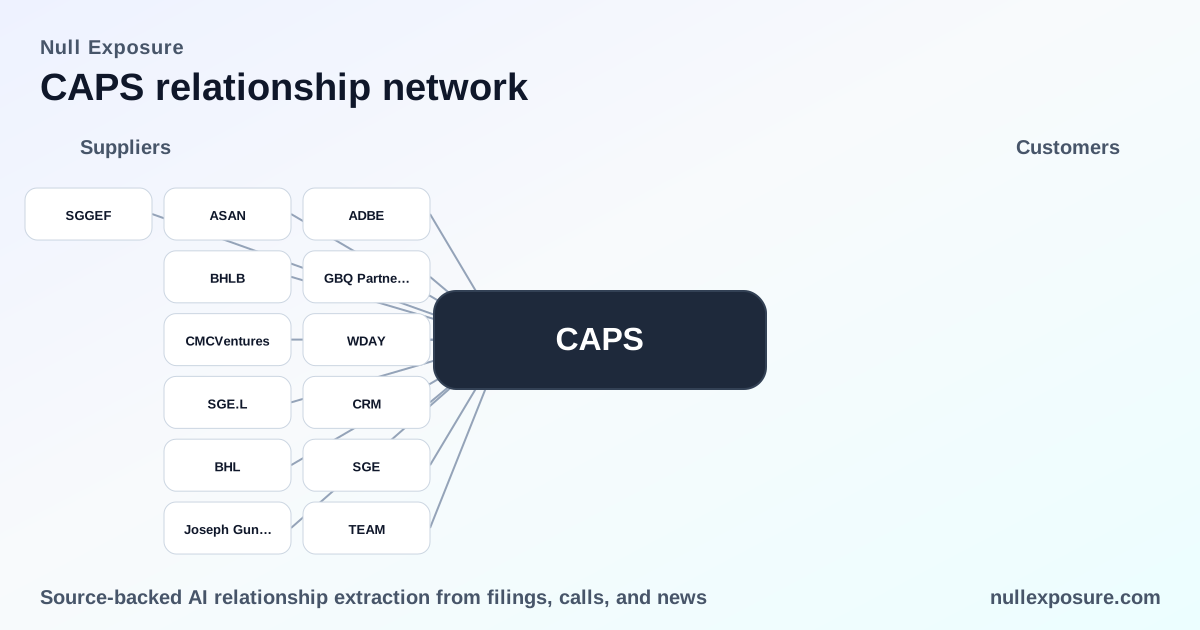
Capstone Holding (CAPS): a supplier map that signals a tech pivot and tight capital posture
Capstone Holding Corp. operates as a tech-enabled distributor of building products, monetizing through the sale and distribution of construction materials across a national network while layering technology services to improve logistics and margins. The company reported $44.7 million in trailing twelve‑month revenue with negative EBITDA and high insider ownership, and in early 2026 management announced a strategic pivot to a “full stack AI” operating model that will reduce reliance on several legacy software vendors. For investors evaluating supplier counterparty risk, the story is a mix of short‑term financing concentration, modest supplier spend bands, and an active program to internalize software capabilities. Explore more supplier and counterparty signals at https://nullexposure.com/.
What the recent vendor headlines mean for returns and risk
Capstone’s announcement that it will “rely less heavily on legacy software vendors” is explicit: the company is pursuing an internal technology stack to capture operating leverage and reduce recurring SaaS spend. That shift is a revenue‑adjacent strategic decision — intended to improve gross and operating margins over time — but it also creates near‑term execution risk as integrations, data migration, and replacement development are capital and time intensive. From a capital markets lens, the firm is small (market capitalization roughly $6.4M) with negative EPS and limited institutional ownership, so supplier choices and credit lines have outsized impact on liquidity and operating continuity.
Visit https://nullexposure.com/ for additional supplier relationship analytics and market context.
Relationship rundown — each counterparty in the public record
Below are the counterparties surfaced in public coverage and what each relationship concretely signals.
-
Adobe — Management said Capstone expects to rely less on legacy vendors such as Adobe as part of a 2026 push to a full‑stack AI platform, indicating potential termination or downscaling of creative/marketing SaaS relationships. Source: Globe and Mail ACCESS Newswire (March 9, 2026), reporting Capstone’s FY2026 transformation plan (https://www.theglobeandmail.com/investing/markets/markets-news/ACCESS%20Newswire/42559/capstone-transitions-away-from-legacy-software-and-targets-full-stack-ai-transformation-in-2026/).
-
Workday — Workday was named among the legacy HR/payroll and finance software vendors Capstone expects to rely on less as it builds internal AI capabilities, suggesting future reductions in HRIS/SaaS spend. Source: Globe and Mail ACCESS Newswire (March 9, 2026) (same release).
-
Salesforce — Salesforce was explicitly listed as a legacy vendor Capstone will scale back from while migrating to a proprietor AI stack, implying changes to CRM and sales automation sourcing. Source: Globe and Mail ACCESS Newswire (March 9, 2026).
-
Sage — Capstone flagged Sage as a legacy ERP/vendor candidate for replacement under the full‑stack AI initiative, which points to potential ERP transition costs and integration work in FY2026. Source: Globe and Mail ACCESS Newswire (March 9, 2026).
-
Atlassian — Atlassian tools were included among software vendors Capstone plans to reduce reliance on, signaling a move to either in‑house tooling or alternate collaboration platforms during 2026. Source: Globe and Mail ACCESS Newswire (March 9, 2026).
-
Asana — Asana was also named as a legacy collaboration/work‑management vendor targeted for reduced dependence as part of Capstone’s internal platform build. Source: Globe and Mail ACCESS Newswire (March 9, 2026).
-
Berkshire Bank — Capstone extended its revolving credit facility with Berkshire Bank through June 19, 2026, reflecting active short‑term bank financing to support working capital and reaffirming a $100M growth target stated by management. Source: Globe and Mail ACCESS Newswire (FY2025 facility extension) and related coverage on StockTitan/Stockstotrade (March 2026).
-
GBQ Partners LLC — GBQ was ratified as an independent auditor for the company in a FY2025 filing, indicating the external audit relationship used to validate financials following recent corporate changes. Source: Globe and Mail/TipRanks coverage (reincorporation and auditor ratification; March 2026).
-
CMCVentures — CMCVentures is identified as an investor relations firm working with Capstone, a retained communications relationship that supports market outreach and small‑cap investor engagement. Source: simplywall.st news summary on Capstone (FY2025 commentary; March 2026).
-
Joseph Gunnar — Joseph Gunnar acted as the sole bookrunner on Capstone’s Nasdaq uplisting and related capital markets activity, indicating concentrated underwriting support for equity transactions. Source: Renaissance Capital IPO Center (coverage of uplisting/pricing; FY2025–FY2026).
What the public constraints tell us about Capstone’s operating model
The publicly reported constraints and disclosures form a coherent company‑level signal about commercial posture and maturity:
-
Contracting posture is mixed. Disclosures show both long‑term creditor arrangements (Stream Finance Credit Agreement matures Sept 30, 2026) and short‑term facilities (a line of credit maturing Apr 30, 2025, and supplier agreements that can be terminated on limited notice). The firm runs a hybrid of fixed credit obligations and flexible supplier terms.
-
Concentration and criticality are material. A significant portion of short‑term liquidity needs is tied to revolving credit and a mezzanine note; management’s ability to refinance or convert these obligations is consequential for operations and growth initiatives.
-
Spend and relationship maturity sit in the small‑to‑mid range. Multiple excerpts show spend bands between $100k–$1M and $1M–$10M for related‑party consulting and debt facilities, implying most supplier engagements are modest but essential to daily operations (consulting fees and credit lines in particular).
-
Global procurement footprint and buyer role. Capstone sources product from a mix of domestic and international manufacturers, confirming it operates as a buyer and distributor with manufacturing and logistics exposure.
-
Related‑party service provision is active. Brookstone Partners is named as a provider of consulting services and manager of Stream Finance — a company‑level signal that related‑party flows are material and ongoing.
These constraints underline that Capstone is still in a transitional phase: operationally small, reliant on external financing, and now investing to internalize technology that could change vendor economics but introduce near‑term execution risk.
Implications for investors and operators
For investors, the upside is operational leverage if the AI stack reduces recurring SaaS expense and raises gross margin; the downside is execution and liquidity risk given small market cap, negative EBITDA, short‑dated credit maturities, and concentrated underwriting/IR relationships. Suppliers and partners should treat Capstone as an active, low‑scale buyer that is simultaneously reengineering its tech estate and managing tight credit windows.
If you are tracking counterparty exposure or evaluating partnership strategies, see the full supplier analytics and ongoing monitoring at https://nullexposure.com/ — the homepage centralizes relationship signals and constraint context.
Bottom line and next steps
Capstone’s public supplier map describes a company in active transformation: a move to reduce reliance on established SaaS vendors, a reliance on short‑term credit (with extensions to mid‑2026), and a set of modest but meaningful related‑party engagements. Investors should price in both the margin upside of insourcing technology and the refinancing/execution risk embedded in the current capital and supplier posture.
For a deeper supplier risk profile and ongoing alerts, visit https://nullexposure.com/ and subscribe for real‑time counterparty intelligence.