Avis Budget Group (CAR): Supplier Relationships and Strategic Constraints That Drive Fleet Economics
Avis Budget Group operates and monetizes a capital-intensive rental and mobility business by acquiring and operating vehicle fleets, renting them through retail and corporate channels, selling used vehicles, and financing fleet purchase programs via securitizations and related-party structures. Revenue is generated through rental fees, ancillary services and fleet disposals, while fleet financing and asset-backed issuance compresses the balance-sheet cost of holding inventory. For investors and operators, the company’s supplier relationships are less about one-off vendors and more about large, repeat procurement and structured financing partners that determine margin and liquidity.
Explore deeper supplier intelligence and competitive signals at https://nullexposure.com/.
The three supplier relationships investors must track now
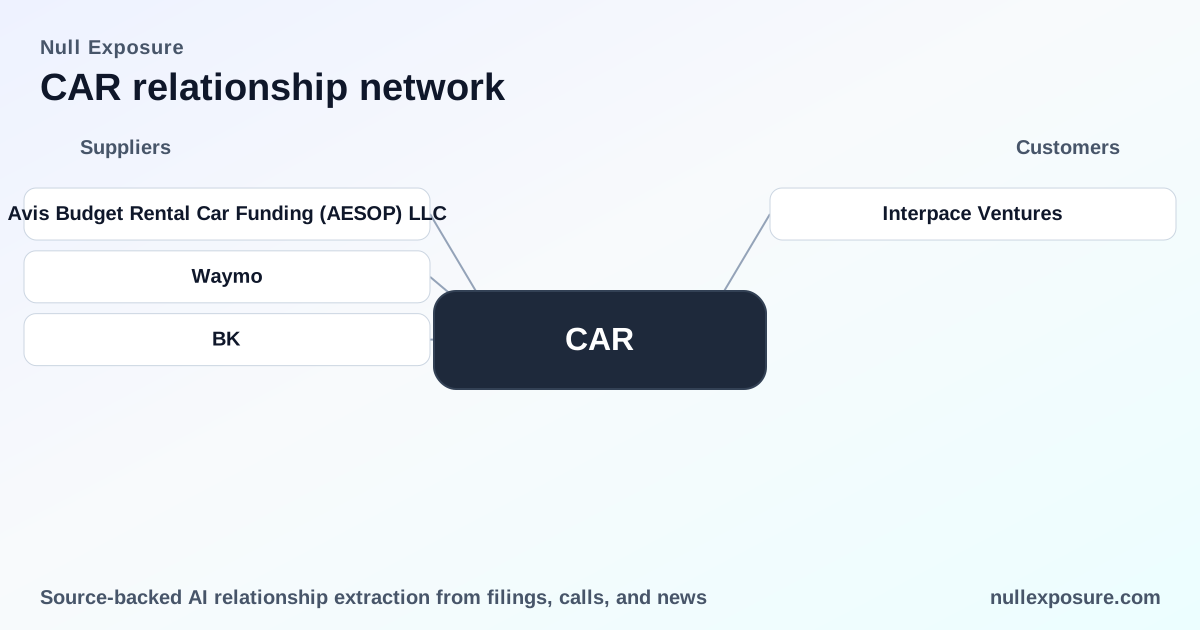
The public signals show three discrete relationships that shape Avis Budget’s operating model: a captive funding vehicle (AESOP), a strategic mobility partner (Waymo), and an ABS / trustee counterparty (Bank of New York Mellon Trust Company). Each relationship is short, sharp and commercially consequential.
Avis Budget Rental Car Funding (AESOP) LLC — captive funding and intercompany notes
Avis Budget disclosed holdings of $826 million of Class R notes due to Avis Budget Rental Car Funding (AESOP) LLC as of December 31, 2025, up from $751 million a year earlier, indicating sizeable intercompany securitization exposure on the consolidated balance sheet. According to Avis Budget’s FY2026 earnings release (Feb 18, 2026), these AESOP notes are an active element of fleet financing and represent a meaningful internal funding conduit. (Source: FY2026 earnings release via GlobeNewswire, Feb 18, 2026.)
Waymo — strategic partner for autonomous ride-hailing deployment
Avis Budget announced a multi-year partnership with Waymo in 2025 to support autonomous ride-hailing operations in Dallas, with a public launch planned for 2026, positioning Avis as a fleet operator and logistics partner for Waymo’s service. Trading reports confirm this is a commercial, operational arrangement that layers new revenue and operational complexity onto the core rental business. (Source: TradingView report on the Waymo partnership, first reported 2025; referenced in FY2026 summaries, March 2026.)
Bank of New York Mellon Trust Company — trustee for ABS issuance
Through its Interpace Funding subsidiary, Avis issued $965 million of notes under a Series 2025‑1 supplement to a base indenture with Bank of New York Mellon Trust Company serving as trustee and agent, showing continued market access to structured ABS markets and institutional trustee relationships. Public reporting on this transaction confirms the use of third‑party trustees to distribute vehicle-backed debt. (Source: TradingView report on the asset-backed securities indenture, March 2026.)
How supplier constraints shape negotiating posture and execution
Avis Budget’s supplier footprint reflects several intersecting constraints that determine procurement strategy, balance-sheet design and counterparty risk:
-
Short-term contracting posture with high recurring spend: The company disclosed agreements to purchase approximately $6.3 billion of vehicles over the next 12 months, financed primarily through vehicle-backed debt and proceeds from disposals. This indicates a procurement model built on rapid fleet turnover and annualized commitments rather than multi‑year fixed supply contracts. (Company disclosure in recent filings.)
-
Materiality and concentration around fleet suppliers: Fleet costs represented ~21% of aggregate expenses in 2024, making vehicle manufacturers and fleet financers materially important to operating margins and liquidity. This concentration creates a high dependency on timely vehicle deliveries and predictable pricing from manufacturers.
-
Buyer role with manufacturer program participation: Avis acquires vehicles both through manufacturer repurchase and guaranteed depreciation programs and via open-market purchases; the company’s role is predominantly as a large-volume buyer that leverages manufacturer programs to manage residual risk and capital intensity.
-
Large spend bands and purchase obligations: The company reported ~$145 million of purchase obligations extending through 2029 in addition to the $6.3 billion near-term commitments, flagging significant committed capital outlays that drive funding needs and securitization activity.
These are company-level signals that shape supplier selection, contract terms, and the need for structured financing partners—not attributes of any single named counterparty unless explicitly stated.
What these relationships mean for investors and operators
-
Balance-sheet and liquidity sensitivity: The AESOP intercompany notes and the $965 million ABS issuance demonstrate Avis’ dependence on securitization markets to fund fleet purchases. Investors should treat securitization capacity, trustee access, and ABS pricing as core liquidity factors that affect leverage and return on invested capital.
-
Operational diversification and execution risk from Waymo: The Waymo partnership diversifies revenue into autonomous mobility but introduces operational integration risk, capex cadence shifts, and different asset-utilization dynamics compared with traditional retail rentals. Monitor fleet utilization metrics and unit economics for autonomous deployments separately from legacy rental pools.
-
Counterparty and concentration risk with manufacturers: Given fleet costs’ share of expenses and the company’s buyer posture, manufacturer program terms (repurchase guarantees, guaranteed depreciation schedules) and delivery cadence are strategic levers for margins. Changes in OEM capacity, incentives, or residual value assumptions directly affect Avis’ cost of goods sold and asset disposal proceeds.
Mid-deck resource: for more supplier-centric intelligence and scenario workstreams, visit https://nullexposure.com/.
Practical monitoring checklist for the next 12 months
- Track AESOP note balances and any change in intercompany holdings or impairment recognition in quarterly filings.
- Watch ABS issuance cadence, spreads, and trustee arrangements—any tightening in ABS markets will raise fleet funding costs.
- Review quarterly disclosures on vehicle purchase commitments ($6.3B) and the evolution of the $145M purchase obligations that extend through 2029.
- Monitor operational KPIs for the Waymo rollout (launch timing, utilization, per-ride revenue) to quantify incremental margin contribution.
- Scrutinize manufacturer program terms around repurchase and depreciation guarantees, as tightening terms or lower residual value assumptions will compress profitability.
Prioritize ABS market access, AESOP transparency, and OEM contract terms when modeling downside scenarios for liquidity and unit economics.
Bottom line: supplier relationships are balance-sheet levers
Avis Budget’s supplier landscape is not a set of passive vendors; it is a network of financing conduits (AESOP), institutional distribution partners (BNY Mellon for ABS), and strategic operational partners (Waymo) that collectively determine funding costs, fleet availability, and future revenue streams. For investors, the key questions are whether Avis can maintain low-cost access to securitization markets, preserve favorable manufacturer program terms, and execute higher‑margin mobility partnerships without diluting core rental economics. For operators, supplier management must remain focused on negotiation of repurchase guarantees, timing of vehicle disposals, and operational integration for new mobility contracts.
If you want a deeper, supplier-focused diligence package on Avis Budget and its financing counterparties, start here: https://nullexposure.com/.