Carter Bankshares (CARE): supplier relationships that matter for liquidity, branch growth and operational risk
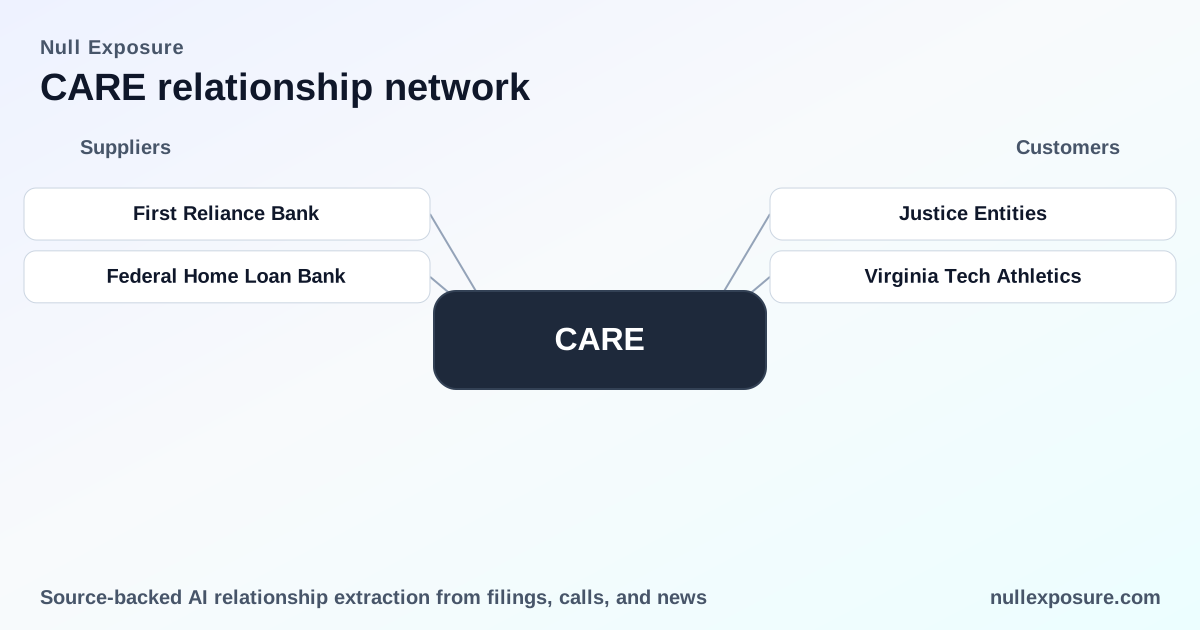
Carter Bankshares operates as the holding company for Carter Bank & Trust, a regional bank focused on community lending and deposit services in Virginia and neighboring states. The company monetizes through net interest margin on loans and securities, fee income from banking services, and incremental scale benefits from targeted branch acquisitions and deposit intake. Recent supplier and partner activity — notably branch facility purchases and Federal Home Loan Bank access — directly shape short‑to‑medium‑term liquidity and efficiency metrics for investors. For deeper supplier-focused intelligence visit https://nullexposure.com/.
Why these supplier relationships are material to investors
Carter’s strategy is conventional regional banking: deploy capital into loans and securities, gather low‑cost deposits, and use wholesale funding options when necessary. Supplier and partner interactions drive three investor‑critical outcomes: liquidity capacity, deposit and branch footprint growth, and operational/compliance expense (third‑party auditors, cybersecurity vendors, transaction counterparties). The relationships below explain recent moves on each front.
First Reliance Bank — two leased branches purchased in North Carolina
Carter completed acquisition of two leased branch facilities in Mooresville and Winston‑Salem, North Carolina, from First Reliance Bank, a move that brought associated deposits and generated acquisition costs that impacted the bank’s efficiency ratio. According to a TradingView press release covering Q2 2025 activity, Carter closed the purchase of the two leased branches; follow‑up reporting in Q3 2025 noted the acquisition‑related costs were a discrete drag on efficiency. (TradingView, March 2026; StockTitan coverage of CARE Q3 2025 results, March 2026.) A corporate investor presentation update also cites recent expansion through those First Reliance branches. (The Globe and Mail press release updating CARE investor presentation, March 2026.)
Federal Home Loan Bank — a core committed liquidity source
Carter’s membership in the Federal Home Loan Bank system provides a meaningful committed liquidity backstop: company disclosures state FHLB borrowing availability equal to 25% of assets — approximately $1.2 billion — and list additional eligible borrowing capacity in corporate filings. In the FY2025 disclosure the company quantified the additional eligible borrowings at about $544.0 million; corporate filings as of December 31, 2024 referenced an eligible figure of $735.3 million in related disclosures, reflecting how available capacity is presented across filings. (StockTitan summary of CARE Q3 2025 results, March 2026; company filing disclosures as of Dec 31, 2024.)
What the relationships collectively reveal about Carter’s operating posture
These supplier relationships combine into a coherent operating profile with actionable implications:
- Contracting posture: Carter uses a mix of membership arrangements (FHLB) and one‑off acquisition deals (branch purchases), and it outsources control testing and audit functions to established service providers. This indicates a hybrid posture that balances in‑house banking operations with external expert services for control and IT monitoring.
- Concentration and criticality: FHLB access represents a critical and high‑capacity liquidity channel for Carter, while single‑counterparty branch acquisitions (like First Reliance) are less systemic but can move efficiency and deposit mix rapidly.
- Maturity of relationships: Engagements are active and operational — the bank discloses ongoing third‑party cybersecurity testing and uses an established audit firm (Crowe LLP) for financial reporting controls — indicating enterprise‑grade third‑party governance rather than ad hoc relationships.
- Spend and balance implications: Public disclosures show the bank maintains material FHLB stock (reported at $6.5 million) and has large potential borrowing capacity measured in the hundreds of millions to over $700 million, signaling both routine and contingency funding scale.
These operating characteristics mean investors should treat FHLB access as a core balance‑sheet lever and branch acquisitions as tactical growth actions that can compress near‑term efficiency while improving deposit scale.
Constraint signals to watch and their investor implications
Carter’s filings and news coverage produce a set of company‑level signals relevant to supplier risk and financial planning:
- Geographic lending and investment reach: The bank holds investments in national government‑agency bond vehicles targeted at affordable housing across the United States, but it aligns individual instruments to the bank’s local footprint — a balance between national market exposure and local credit focus.
- Service provider reliance: Carter uses external auditors (Crowe LLP), third‑party cybersecurity testers and continuous monitoring vendors, and the FHLB as a funding partner — all of which are institutional service providers rather than boutique suppliers.
- Active third‑party engagements: Cybersecurity and IT programs explicitly employ external testing and continuous monitoring, indicating ongoing operational dependence on outside suppliers for security controls.
- Spend scale: The bank reports FHLB stock ownership of roughly $6.5 million (a mid‑single‑digit million spend line) alongside borrowing capacity measured in the hundreds of millions — a mix of routine supplier spend and large contingent funding access.
These signals point to a supplier profile that's institutional and stable, but with concentrated reliance on a few high‑impact partners for liquidity and control assurance.
For more supplier‑level intelligence and cross‑company comparisons, see https://nullexposure.com/.
Investment implications: risk, runway, and next steps
- Liquidity upside, efficiency drag: FHLB availability underpins Carter’s ability to fund asset growth, but recent branch purchases produced acquisition costs that compressed efficiency in reported quarters; investors should model temporary expense hits when the bank pursues similar inorganic expansions.
- Operational resilience: Use of reputable auditors and continuous cybersecurity testing reduces operational counterparty risk; however, reliance on external providers creates vendor management considerations that require periodic diligence.
- Balance‑sheet sensitivity: The company’s public filings disclose material additional borrowing capacity that materially changes balance‑sheet flexibility; track quarterly captions for changes to eligible collateral and borrowable amounts.
Bold takeaways for investors: FHLB membership is a primary liquidity lever; First Reliance branch purchases are a clear, tactical growth mechanism that impacts near‑term efficiency; third‑party audits and continuous security testing indicate mature control practices.
If you evaluate regional banks from a supplier and funding perspective, extend your analysis across counterparties and access the portal at https://nullexposure.com/ for structured supplier insights.
Final recommendations and call to action
Monitor upcoming quarterly filings for (1) changes in reported FHLB borrowing capacity and collateralization rules, (2) any additional branch acquisitions or deposit purchase deals that could shift efficiency metrics, and (3) disclosures around vendor concentration in cybersecurity and audit services. For targeted supplier research and continuous monitoring tools that surface the exact relationships discussed here, visit https://nullexposure.com/.