Carlsmed (CARL): Surgical platform scaling toward an IPO — what investors and operators need to know
Carlsmed builds a surgical platform for complex adult spinal deformity, combining clinical intelligence, advanced image recognition, and 3D printing to deliver patient-specific planning and implants. The company monetizes through product and service sales to hospitals and surgical centers—recurring per-case revenue from implants and software-enabled planning—and is preparing a public capital raise underwritten by a top-tier syndicate to accelerate commercialization and scale. For investors evaluating supplier relationships, the immediate signal is a classic medtech growth story: strong top-line acceleration with sustained operating losses and concentrated insider ownership that will influence future funding and governance. Learn more at https://nullexposure.com/.
What Carlsmed does and how it makes money
Carlsmed positions itself as a vertically integrated surgical solution for spine deformity procedures. Revenue derives from device sales (3D‑printed, patient-specific implants), procedural planning services, and associated software tools that embed image recognition and clinical intelligence into the operating workflow. The company reported TTM revenue of roughly $44.8 million and a gross profit of about $33.5 million, showing healthy unit-level margins, while operating losses persist (operating margin TTM: -69%). The latest quarter ended 2025-06-30 shows rapid commercial traction with nearly 100% quarterly revenue growth year-over-year, indicating accelerating adoption among surgeons.
Key financial snapshot:
- Market capitalization: $335.2M
- Revenue TTM: $44.8M
- Gross profit TTM: $33.5M
- Operating margin TTM: -69%
- Shares outstanding: ~26.6M with 42% insider ownership and only ~7% institutional ownership
These figures paint a company at the commercial growth inflection: unit economics that support profitable product sales once fixed-cost leverage arrives, but current profitability is negative due to investment in commercialization and R&D.
Why the bookrunners matter to investors and operators
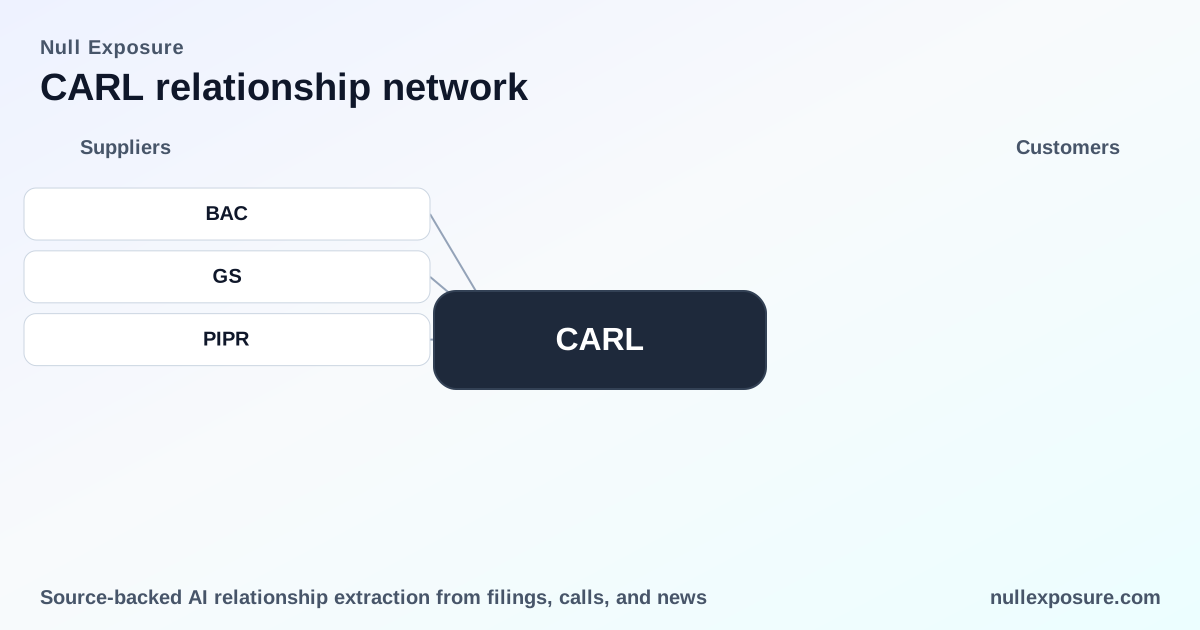
Carlsmed has engaged a heavyweight underwriting syndicate for its public offering, an operational signal with implications for distribution, credibility, and capital access. According to Renaissance Capital’s IPO coverage (March 9, 2026), BofA Securities, Goldman Sachs, and Piper Sandler are the joint bookrunners on the deal, validating the company’s market positioning and increasing the likelihood of broad distribution to institutional and strategic buyers. This syndicate will shape valuation, roadshow positioning, and secondary-market liquidity—factors operators should monitor as commercial partnerships expand. Find more at https://nullexposure.com/.
Who the supplier relationships are — the exact partners in the record
Carlsmed’s public materials and news coverage list three financial institutions engaged on the IPO: BofA Securities, Goldman Sachs, and Piper Sandler. Each plays a specific role in underwriting and market access.
BofA Securities
BofA Securities is a joint bookrunner on Carlsmed’s offering, responsible for distribution and pricing support across institutional accounts; its involvement signals broad-dealer commitment to the transaction. According to Renaissance Capital (March 9, 2026), BofA is one of the co-managers on the deal. Source: Renaissance Capital IPO coverage — 2026-03-09.
Goldman Sachs
Goldman Sachs is named as a joint bookrunner, bringing strategic investor reach and research amplification that typically helps high-growth medical device IPOs secure anchor investors and cross-border placement. Renaissance Capital’s IPO note lists Goldman Sachs as a co-lead for the offering. Source: Renaissance Capital IPO coverage — 2026-03-09.
Piper Sandler
Piper Sandler is the third joint bookrunner, adding middle‑market and specialist medtech distribution channels that can support aftermarket liquidity and targeted healthcare investor coverage. Renaissance Capital’s article cites Piper Sandler alongside BofA and Goldman as bookrunners. Source: Renaissance Capital IPO coverage — 2026-03-09.
Contracting posture, concentration, criticality, and maturity — enterprise signals for partners
Carlsmed’s operating model conveys several important characteristics that matter for suppliers, hospital partners, and investors:
- Contracting posture: Carlsmed sells directly into healthcare providers and surgical teams; contracts will combine product purchase agreements, site licenses for software, and per-case planning arrangements. Expect multi-year commercial terms with volume commitments as the company scales.
- Concentration: Insider ownership of ~42% creates concentrated control that influences strategic direction, exit timing, and potential future equity raises; institutional float is low at ~7%, so early investors and management will materially shape governance.
- Criticality: The product set targets complex spine deformity procedures—clinically critical use cases where device performance directly affects surgical outcomes—making Carlsmed’s platform a strategic supplier to high-acuity surgical programs.
- Maturity: Commercial traction is early but accelerating. Near-doubling quarterly revenue growth YoY shows rapid product adoption, while persistent negative operating margins and negative EBITDA underscore that the company is still in an investment phase rather than a cash-flow-positive maturity stage.
No supplier-level contractual constraints were provided in the materials reviewed; the record contains only the underwriting relationships noted above.
Investment implications and operational watch items
The underwriting syndicate composition and near-term IPO process are meaningful for investors and operators alike. A syndicate led by BofA, Goldman, and Piper Sandler increases the odds of a well-executed offering that funds commercial expansion, but investors should balance that against concentrated insider ownership and continued operating losses. Analysts have set a consensus target (analyst target price: $19.60) and multiple buy ratings, indicating bullish practitioner sentiment in sell-side coverage.
Operationally, partners and buyers should monitor:
- Rate of hospital adoption and per-case utilization metrics;
- Margins on 3D-printed implants as manufacturing scales;
- Contract terms and volume commitments in enterprise agreements;
- The IPO pricing and how secondary share unlocking will affect governance.
For a deeper supplier‑risk and relationship analysis, visit https://nullexposure.com/ for actionable research and deal tracking.
Bottom line: growth with typical medtech execution risk
Carlsmed is a high-growth medtech supplier with technology that addresses clinically critical spine procedures and demonstrates improving unit economics. The company’s IPO sponsorship by BofA Securities, Goldman Sachs, and Piper Sandler validates the commercial story but does not eliminate execution risk tied to scaling manufacturing, expanding surgeon adoption, and converting revenue growth into positive operating leverage. Investors and hospital operators should watch the IPO outcome, subsequent capital deployment, and evolving contract terms closely. For continuous coverage and supplier relationship intelligence, go to https://nullexposure.com/.