Cars.com (CARS) — supplier relationships and what institutional buyers should know
Cars.com operates a digital marketplace that connects dealers, OEMs and consumers, and monetizes through a combination of advertising, dealer subscription products and transactional wholesale tools that accelerate vehicle turn. The firm’s revenue mix blends recurring dealer fees with higher-margin services tied to wholesale and remarketing, creating direct supplier exposures where third-party integrations translate into revenue and operational dependency. For deeper research and supplier mapping, visit https://nullexposure.com/.
How Cars.com makes money and why supplier links matter
Cars.com is a publicly traded digital marketplace headquartered in Chicago and reports revenue of approximately $723 million TTM, with an operating margin near 11.8% and market capitalization around $455 million (latest quarter 2025-12-31 public financials). Its core monetization vectors are paid listings and dealer products, augmented by software and services that push inventory through wholesale channels—an area where partner integrations directly influence product uptake and stickiness. Suppliers and platform partners that accelerate wholesale transactions therefore represent both revenue drivers and operational risk vectors.
The specific supplier integrations on the record
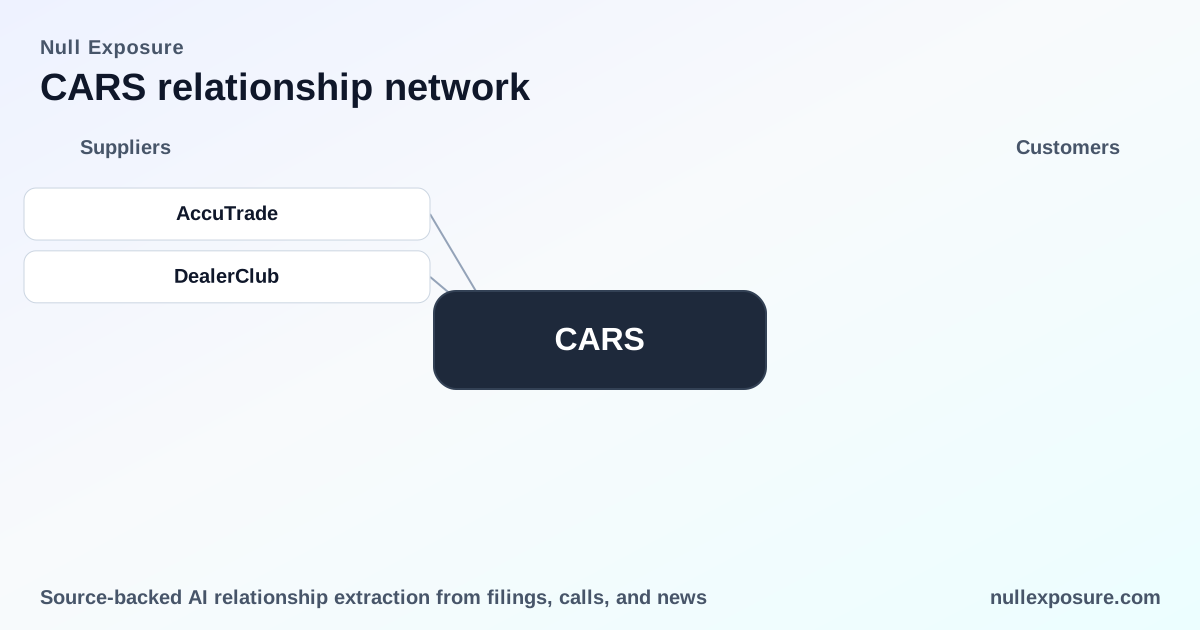
Cars.com’s public relationship mentions in the available results reference two wholesale-platform integrations. Both are characterized as integration of Cars.com’s wholesale tools to speed remarketing of aging inventory.
AccuTrade — wholesale connectivity to accelerate remarketing
Cars.com has integrated its wholesale tools with AccuTrade to accelerate wholesale transactions for aging units, positioning the company to capture fees and data flow from remarketing activity. According to an InsiderMonkey news piece published March 9, 2026, Cars.com uses AccuTrade as a conduit for wholesale volume and dealer workflow acceleration.
DealerClub — another channel for wholesale execution
Cars.com’s wholesale tooling is also integrated with DealerClub to provide dealers an alternate path to move used inventory faster, supporting Cars.com’s strategy to monetize end-to-end dealer lifecycle services. The same InsiderMonkey report (March 9, 2026) specifically cites DealerClub as a partner for Cars.com’s wholesale acceleration.
What those relationships mean for investors and operators
Both integrations are strategic extensions of Cars.com’s product set: they transform the platform from an advertising and lead-generation venue into a transaction facilitator for wholesale flows. That transition increases the company’s addressable revenue per dealer and helps deepen dealer relationships through operational utility (inventory turn). From an investor perspective, these partnerships indicate a product-led push into higher-margin, transactional services that can improve revenue per client if adoption scales.
- Revenue upside: Wholesale transaction fees and increased dealer retention from integrated workflows.
- Operational leverage: Data from wholesale flows can enhance pricing algorithms and inventory recommendations.
- Concentration & counterparty risk: The company’s reliance on a small set of distribution partners to move wholesale volume elevates the importance of partner performance and contract terms.
(InsiderMonkey coverage cited above summarized the integrations in a March 9, 2026 article.)
For a closer look at supplier touchpoints across Cars.com’s platform, consider a targeted supplier diligence review at https://nullexposure.com/.
Constraints, contracting posture and business model signals
Cars.com presents as a mid‑market public marketplace operator with a hybrid contracting posture: it sells recurring dealer products (subscription/advertising) alongside transactional wholesale services that require operational integrations with third-party platforms. This implies:
- Contracting posture: Mix of SaaS-like dealer contracts and transactional partner arrangements for wholesale flow; integrations with third-party platforms indicate cooperative commercial agreements rather than pure in-house execution.
- Concentration: The core customer base is dealers and OEM channels, so counterparty concentration risk is client-based rather than supplier-heavy; however, specific platform partners for wholesale execution introduce tactical concentration around distribution of remarketed inventory.
- Criticality: Wholesale integrations are strategically important because they expand monetization beyond listings into transactions, increasing product stickiness and revenue per dealer.
- Maturity: Public financials show positive operating margin and GAAP profitability metrics consistent with a mature marketplace operator that is actively layering higher-margin services onto an established listing business (latest quarter public metrics, 2025).
These signals should be treated as company-level observations derived from Cars.com’s commercial posture and public financials, not as relationship-specific constraints.
Key risks investors must underwrite
- Partner execution risk: If third-party platforms that route wholesale volume (like AccuTrade or DealerClub) underperform or change commercial terms, Cars.com’s wholesale revenue growth could stall. InsiderMonkey’s March 2026 coverage documents these integrations as live commercial channels.
- Margin sensitivity: Despite healthy gross profit, net profit margins are modest; Cars.com’s overall profit margin sits below many high-growth tech peers, so scaling transactional services without incremental cost pressure is essential.
- Cyclicality and macro exposure: Vehicle sales and dealer inventory strategies are cyclical; wholesale volumes compress in downturns, which compresses transaction fees and turnover-driven revenue.
- Competitive intensity: Multiple marketplaces and dealer tools compete for the same workflow integrations; maintaining differentiated integration depth is key to retention.
Financial metrics supporting these points include market cap ($455M), revenue TTM ($723M), operating margin (~11.8%) and beta (~1.48) from the company’s public reporting through the latest quarter (2025-12-31).
If you are mapping supplier risk across multiple portfolio names, a targeted supplier risk scorecard from expert sources can streamline diligence: see https://nullexposure.com/.
Bottom line and recommended next steps for supplier diligence
Cars.com’s integrations with AccuTrade and DealerClub demonstrate a deliberate shift to monetize dealer workflow and wholesale transactions. These partnerships are strategically valuable because they convert platform utility into recurring and transactional revenue, but they also concentrate operational dependency on third-party channels that handle remarketing flows. For institutional investors and operator-level diligence, the next steps are:
- Validate commercial terms and revenue share mechanics with each partner.
- Quantify traffic and transaction flow volume routed through each platform.
- Stress-test revenue sensitivity to partner contract changes and macro downturns.
To commission a focused supplier relationship audit or to integrate these signals into your investment framework, start at https://nullexposure.com/.
Bold takeaway: Wholesale integrations are a material strategic lever for Cars.com — they increase revenue per dealer but create concentrated operational dependencies that require active supplier monitoring.