Instacart (CART) as a Supplier Partner: Commercial Relationships and What They Signal for Investors
Thesis: Maplebear Inc. (trading as CART) operates a high-frequency, two-sided commerce platform that monetizes through retailer and consumer fees, advertising, and value-added B2B services such as same-day delivery for third parties and branded programs; its supplier relationships extend from strategic retail partnerships to software and manufacturing vendors, and these ties shape both cost structure and growth optionality. Investors should evaluate these supplier links for exposure to usage-based cost inflation, concentrated procurement obligations, and execution risk in physical hardware sourcing. For a concise registry of partner signals and supplier constraints, visit https://nullexposure.com/.
Why supplier relationships matter for a marketplace operator
Instacart’s economics depend on a mix of variable and fixed supplier costs. Revenue scales with order volume while certain supplier lines — usage-based software fees, payment infrastructure providers, and hardware manufacturers for in-store automation — scale differently and can compress margins if renegotiations are unfavorable. Maplebear reported roughly $3.742 billion revenue TTM and a market cap north of $10 billion, indicating that supplier cost swings in the mid‑tens of millions can have measurable margin effects.
If you are reviewing CART as an investor or counterparty, focus on three dimensions: contracting posture (usage-based vs. fixed), concentration and criticality (how essential the supplier is to operations), and maturity (long-term purchase obligations or one-off project spend). For a quick operating-read checklist, see https://nullexposure.com/.
Direct supplier relationships called out in public coverage
Below are the partner mentions surfaced in recent coverage. Each relationship is summarized in plain English with the reported source.
-
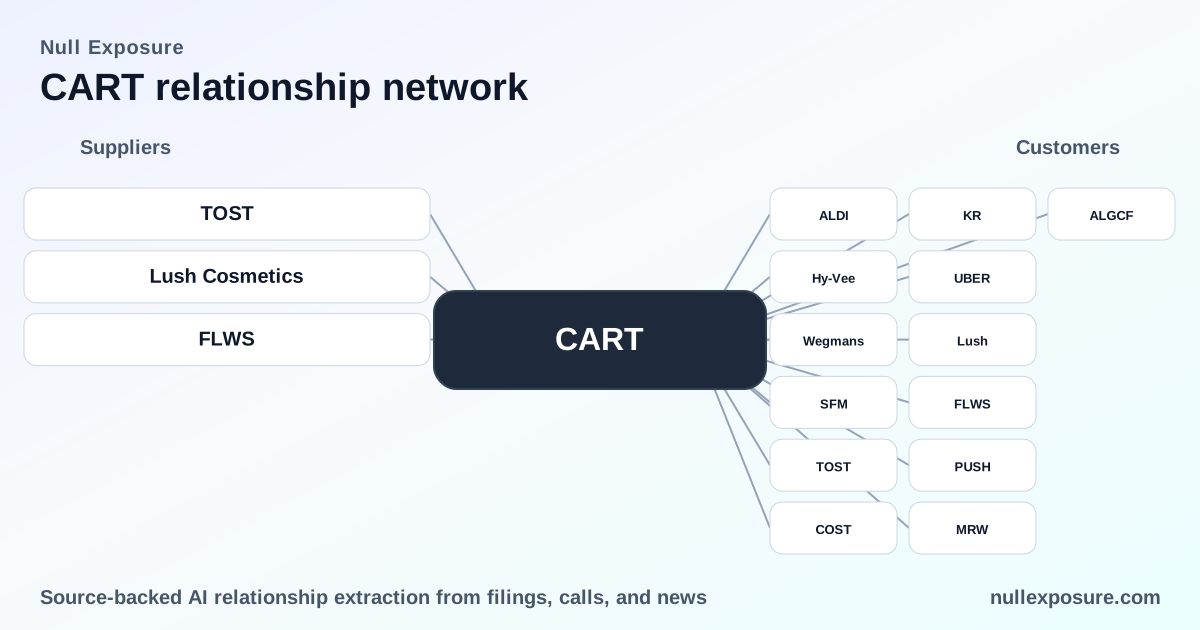
Toast — strategic B2B delivery partnership. Instacart will serve as a supply partner for Toast-powered restaurants, integrating Instacart’s B2B same-day delivery capability to expand restaurant fulfillment without building last-mile logistics internally. Source: InsiderMonkey (March 9, 2026) and supporting reports on Bitget and StockTitan (February–March 2026) — https://www.insidermonkey.com/blog/strategic-partnership-and-strong-earnings-boost-maplebear-cart-stock-1696253/?amp=1; https://www.bitget.com/news/detail/12560605200957; https://www.stocktitan.net/news/CART/instacart-ceo-to-participate-in-fireside-chat-at-morgan-stanley-ioi321b3dvs6.html.
-
Lush Cosmetics — same‑day retail fulfillment expansion. Instacart and Lush announced a partnership to offer same‑day delivery of over 600 products from roughly 250 stores across the U.S. and Canada, positioning Instacart as Lush’s fulfillment channel for time‑sensitive, high-margin retail categories. Source: Simply Wall St. and Sahm Capital coverage (February 2026) — https://simplywall.st/stocks/us/consumer-retailing/nasdaq-cart/maplebear/news/is-instacarts-lush-tie-up-a-small-step-or-a-strategy-shift-f/amp; https://www.sahmcapital.com/news/content/is-instacarts-lush-tie-up-a-small-step-or-a-strategy-shift-for-maplebear-cart-2026-02-25.
-
1‑800‑Flowers — demand-driver partnership framing investor expectations. Commentary references 1‑800‑Flowers alongside new partners as demand drivers whose order volume contribution must translate into sustainable profitability rather than just growth in transactions. Source: Simply Wall St. and Sahm Capital (February 2026) — https://simplywall.st/stocks/us/consumer-retailing/nasdaq-cart/maplebear/news/is-instacarts-lush-tie-up-a-small-step-or-a-strategy-shift-f/amp; https://www.sahmcapital.com/news/content/is-instacarts-lush-tie-up-a-small-step-or-a-strategy-shift-for-maplebear-cart-2026-02-25.
What the supplier constraints say about operating risk
The company-level constraints drawn from filings and disclosures provide a composite view of supplier risk that investors must price into earnings forecasts.
-
Contracting posture: usage-based software exposure. Maplebear pays usage-based subscription fees to at least one software vendor, which implies variable cost pressure as volumes grow; historical payments show tens of millions in year-to-year swings. This structure protects cash in downturns but increases unit costs as usage grows.
-
Counterparty mix: heavy reliance on individual contractors. Instacart’s fulfillment labor is largely independent shoppers paid primarily on a per-batch basis; this creates operational flexibility but also regulatory and retention risk that can reprice delivery economics rapidly.
-
Service-provider criticality: payment and platform dependencies. The company relies on third parties for payment processing and other infrastructure — these relationships are mission-critical and subject to renewal risk on commercial terms.
-
Manufacturing exposure: offshore sourcing for hardware (Caper Carts). Instacart sources Caper Carts from third-party manufacturers in Asia, exposing the company to geopolitical, tariff, IP protection, and FX risks typical of offshore manufacturing.
-
Spend concentration and maturity: mid‑to‑large committed obligations. Public excerpts show $15–$51 million historical software-related payments in individual years and non‑cancellable purchase obligations totaling $278 million as of year‑end 2024, with $106 million due within 12 months — a clear signal of medium-term capital commitments that reduce near-term financial optionality.
Collectively, these constraints indicate an operating model with mixed fixed and variable supplier cost structures, concentrated payment and manufacturing dependencies, and material committed spend that investors must monitor when modeling margins.
What this means for negotiation and downside protection
For corporate counterparties and investors, the practical implications are straightforward:
-
Negotiate for usage caps or blended pricing where possible with major software vendors to limit margin erosion as volumes scale. Usage-based contracts shift the operational leverage profile of the business toward lower gross margin at scale if unmitigated.
-
Model shopper economics conservatively — small shifts in per-batch pay or retention can change unit economics materially given the platform’s reliance on independent contractors.
-
Stress-test supply-chain scenarios around tariffs, FX shocks, and non-renewal of payment processors; the $278 million non-cancellable obligations figure signals tangible execution risk.
If you want a supplier-focused scorecard for CART comparable across peers, check the index at https://nullexposure.com/ for standardized supplier signals and sourcing transparency.
Investor takeaways and next steps
- Growth partnerships (Toast, Lush, 1‑800‑Flowers) are demand multipliers, but each brings cost and execution complexity that must convert to marketing-adjusted, contribution-margin positive orders.
- Company-level supplier signals — usage-based contracts, contractor labor model, offshore hardware manufacturing, and mid-to-large committed spend — collectively increase operational risk relative to a pure software marketplace.
- Action: prioritize monitoring quarterly disclosures for vendor payment trends, shopper economics, and updates to non‑cancellable obligations. For comparative supplier intelligence and ongoing tracking, return to https://nullexposure.com/.
This supplier map frames where Instacart’s margin sensitivity lives and where negotiating leverage is most valuable. For investors and operators building a thesis on CART, supplier dynamics are as consequential as customer growth in the near term.