Meta Financial Group (CASH) — supplier profile and what investors should know
Meta Financial Group, operating as Pathward Financial and the holding company for MetaBank, is a regional banking franchise that earns through net interest margin, commercial and consumer banking fees, and payments/processing services. For investors evaluating supplier risk, the most material external relationships are governance and security partners that underpin financial reporting and operational continuity. Learn more about supplier risk and vendor concentration at https://nullexposure.com/.
The headline relationship: an established audit partner
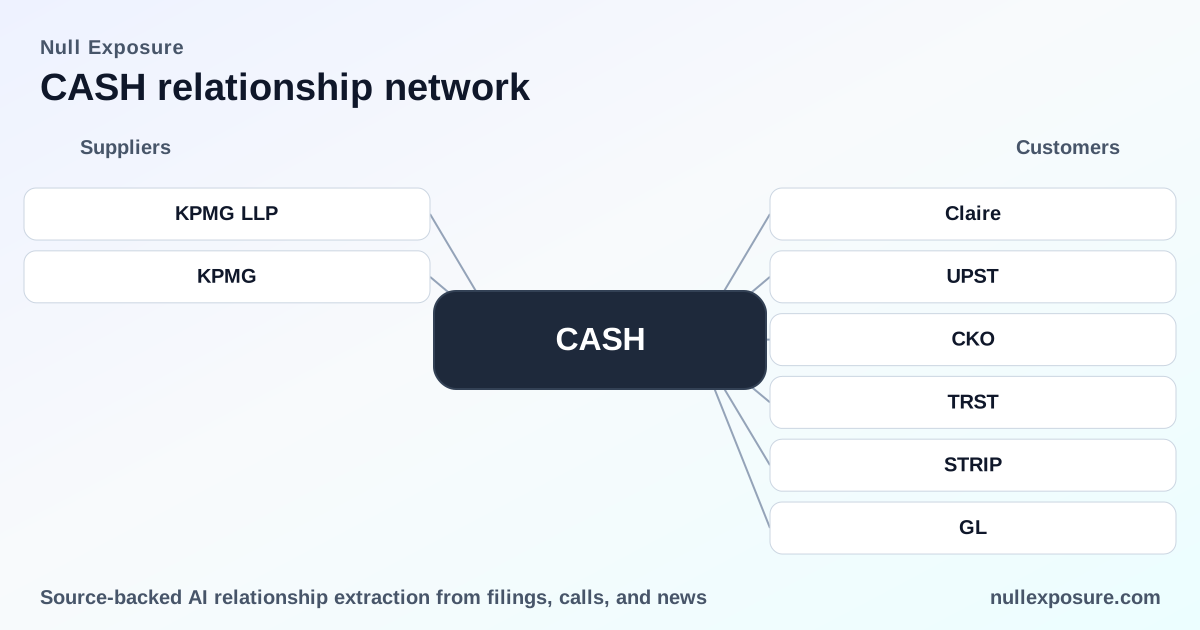
KPMG LLP serves as Pathward’s independent external auditor. According to the company’s 8‑K filed in March 2026, shareholders ratified KPMG LLP as the independent auditors for the fiscal year ending September 30, 2026, confirming continuity in external audit coverage and governance oversight. Finviz reporting from March 2026 also highlighted shareholder support for the re‑election of directors and ratification of KPMG at the 2026 annual meeting. Both items underscore stable audit continuity, a governance signal investors favor for comparability and control stability (8‑K via StockTitan, March 9, 2026; Finviz news coverage, March 2026).
Why the audit relationship matters for valuation and risk
An incumbent Big Four auditor like KPMG delivers three investor‑relevant effects: audit quality and comparability, practical assurance around internal controls, and signaling to the market that financial statements are subject to rigorous external review. For a bank whose balance sheet measurement and reserve judgments are critical to earnings quality, sustained audit continuity reduces the near‑term governance risk premium. The FY2026 ratification reduces the short‑term likelihood of disclosure shocks related to auditor change.
Company-level supplier posture and operational constraints
Constraint signals supplied alongside relationship data show Pathward has contracted with an incident response provider in the event of a security breach. That contract is not vendor‑named in the record, but it is meaningful as a company‑level signal: Pathward purchases external security services to manage breach response, indicating a proactive contracting posture and investment in resiliency.
- Contracting posture: The combination of an incumbent Big Four auditor and a contracted incident response provider indicates a deliberate use of external specialists rather than internalizing every control function. This is a sign of a structured vendor management approach typical of regulated banks.
- Concentration and criticality: With the visible supplier universe dominated by governance and security service providers, supplier concentration risk is low in count but high in criticality — losing an auditor or a key security provider would be operationally disruptive. The materiality of each supplier is high even if the supplier list is short.
- Maturity: Evidence of formal audit engagement and contracted incident response supports a judgment that operational and compliance practices are mature and aligned with regulatory expectations for a regional bank.
These constraints are company‑level signals drawn from governance filings and vendor disclosures rather than vendor‑specific contract terms.
Explore deeper counterparty intelligence and supplier concentration modeling at https://nullexposure.com/.
Operational and investor implications you should price
- Earnings quality: Stable audit engagement reduces disclosure risk and supports consistent financial reporting—an input to lower volatility estimates in valuation models.
- Operational resilience: A contracted incident response capability is a positive indicator for cyber incident preparedness and potentially lowers the operational risk premium.
- Switching and dependency risks: While the pool of governance/security suppliers is small, each supplier is highly critical; investors should monitor auditor tenure, any auditor‑related disclosures, and cybersecurity incidents as potential catalysts for re‑rating.
- Market perception: High institutional ownership in Meta Financial (over 95%) suggests investors already scrutinize governance and service relationships, making transparency on suppliers an active factor in sentiment and analyst coverage.
All supplier relationships identified in the public feed
- KPMG LLP — Pathward’s independent external auditor was ratified by shareholders for the fiscal year ending September 30, 2026, reflecting audit continuity and governance stability; reported in the company 8‑K in March 2026 and covered by market news outlets the same month (8‑K via StockTitan, March 9, 2026; Finviz news, March 2026).
Beyond named providers, constraint information indicates Pathward has engaged an incident response provider to manage security breaches, signaling an externalized approach to critical cyber response functions (company constraint excerpt, 2026).
What investors and operators should monitor next
- Watch for any auditor‑related disclosures (audit adjustments, disagreements, or auditor rotation notices) as they are high‑impact events for valuation and trust.
- Track cybersecurity incident reports and any disclosures about the scope of the incident response provider’s engagement; such events materially affect operational continuity and regulatory scrutiny.
- Evaluate governance cadence around vendor management — board committee reports on risk and vendor oversight will be a leading indicator of whether the current supplier posture remains robust.
For a practical supplier‑risk scorecard and ongoing monitoring tools, see our analyst resources at https://nullexposure.com/.
Bottom line
Meta Financial (Pathward) relies on a small set of high‑impact external suppliers — notably KPMG as its auditor and a contracted incident response provider — which lowers supplier count but raises per‑supplier criticality. For investors, this is a governance and operational profile that supports stable reporting but requires attention to any changes in audit relationships or cybersecurity events. Use supplier continuity and incident response disclosures as forward signals when refining risk premiums or operational due diligence.