CASI Pharmaceuticals: partner-driven development, licensing monetization, and investor implications
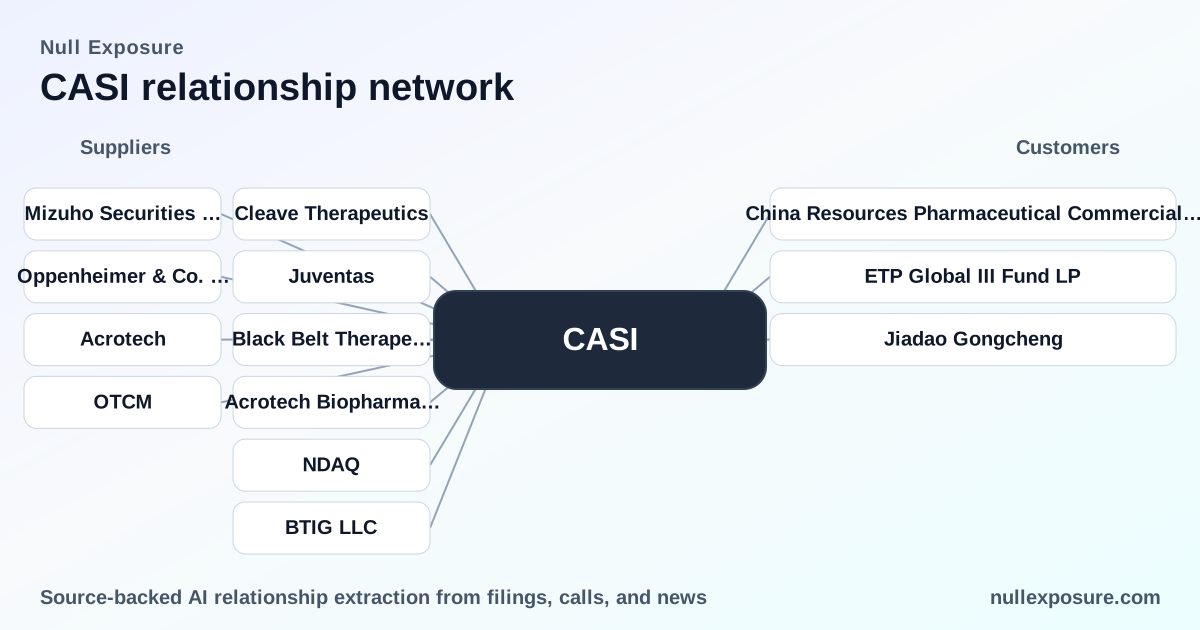
CASI Pharmaceuticals operates as a small-cap biopharma developer that monetizes primarily through license deals, development partnerships, selective product commercialization in China, and periodic capital markets raises. The company sources investigational assets from third parties, outsources clinical development and commercialization rights in key territories, and supplements cash flow with equity offerings—creating a high-leverage operating model for investors and counterparties. For a targeted supplier and counterparty review, this note maps every disclosed relationship and extracts the strategic consequences for investors and operators.
Explore supplier risk and counterparty analytics at Null Exposure.
How the relationships stack up: concise takeaways
- Business model driver: CASI’s P&L and pipeline progress are contingent on licensing-in assets and securing development/commercial partners rather than on large internal R&D capacity.
- Concentration risk: Several documents flag heavy dependence on a small number of partners for clinical development and commercialization.
- Market access risk: Recent market-structure events (Nasdaq delisting decision and expected OTC quotation) materially affect liquidity and capital access.
- Capital strategy: CASI uses underwritten public offerings managed by investment banks to replenish cash when required.
Partner-by-partner review (plain-English summaries with sources)
-
Cleave Therapeutics — CASI licensed the first-in-class VCP/P97 inhibitor CB-5339 for the Greater China region, adding a targeted oncology asset to CASI’s Greater China commercialization pipeline. (Source: PR Newswire release, FY2021.)
-
Juventas — CASI repeatedly discloses dependence on Juventas to conduct clinical development of CNCT19, to co-market that program, and to manage patent prosecution for CNCT19; that dependence is presented as a material operational risk in multiple filings and press releases across FY2024–FY2026. (Source: InvestingNews and company releases, FY2024–FY2026.)
-
Black Belt Therapeutics Limited — CASI in-licensed exclusive worldwide rights to an investigational anti‑CD38 monoclonal antibody program (TSK011010), bringing a biologics program into its global development portfolio. (Source: PR Newswire release, FY2019.)
-
The Nasdaq Stock Market (Nasdaq) — Nasdaq’s Hearings Panel issued a determination to delist CASI’s securities based on failure to meet continued listing requirements; the delisting determination is a key liquidity and compliance event for investors. (Source: InvestingNews coverage of the Nasdaq determination, FY2026.)
-
OTC Markets Group Inc. — Following the Nasdaq delisting determination, CASI expects its ordinary shares to be quoted on the OTC Markets platform to preserve a trading venue for shareholders. (Source: Company filings summarized in StockTitan/InvestingNews, FY2026.)
-
BTIG LLC — BTIG served as a joint book-running manager on a $32.5 million public offering, indicating CASI’s use of small-cap equity syndicates to raise working capital during FY2021. (Source: PR Newswire offering announcement, FY2021.)
-
Mizuho Securities USA LLC — Mizuho acted as a joint book-running manager alongside peers in the FY2021 offering, reflecting CASI’s engagement with international underwriting partners. (Source: PR Newswire offering announcement, FY2021.)
-
Oppenheimer & Co. Inc. — Oppenheimer joined as a joint book-running manager on the FY2021 equity offering, supporting CASI’s capital raise execution. (Source: PR Newswire offering announcement, FY2021.)
-
Acrotech Biopharma Inc. — CASI has an active contractual dispute and operational risk with Acrotech tied to termination of agreements concerning EVOMELA® (and references to FOLOTYN sales having ceased after a prior license expired); this disagreement is repeatedly disclosed as a business risk across FY2025–FY2026 filings. (Sources: StockTitan/InvestingNews summaries and company filings, FY2025–FY2026.)
What this relationship map reveals about CASI’s operating model
CASI is license-and-partner-centric. The company acquires development-stage assets via licensing, then relies on counterparties for clinical execution, IP prosecution, and local commercialization—a contracting posture that reduces fixed R&D cost but concentrates execution risk in third-party performance.
Concentration is a structural feature: Juventas stands out as an operational linchpin for the CNCT19 program, and Acrotech is a commercial/legal counterparty that directly affects marketed product rights. These relationships are critical to CASI’s ability to convert licensed assets into revenue. Where one or two partners hold execution responsibility, pipeline delivery and revenue realization become binary on partner performance.
On market access and funding, CASI uses underwritten equity placements as a standard funding tool (Oppenheimer, Mizuho, BTIG on a FY2021 raise). The recent Nasdaq delisting decision and the planned move to OTC trading deepen financing friction: liquidity constraints and higher capital costs are now explicit balance‑sheet risks, with implications for future deal terms and partner negotiation leverage.
No formal contractual constraints were provided in the source payload; as a company-level signal, this dataset shows no extracted covenant or supplier-side restriction posted against CASI. That absence does not imply absence in reality—only that no constraints were surfaced in the provided relationships feed.
Explore how supplier concentration and market-structure events change valuation and covenant design at Null Exposure.
Maturity and financial posture
CASI’s financial profile is consistent with an early-stage specialty biopharma: negative EBITDA, negative EPS, small market capitalization, and thin revenue, combined with high insider ownership and modest institutional ownership. This profile explains the reliance on licensing, partner-run trials, and periodic equity raises instead of sustained internal R&D spending.
Risk and opportunity map for investors and operators
- Risk — Partner concentration: If Juventas or another development partner delays or discontinues work, the company’s timeline and revenue profile will shift materially. (Documented repeatedly in FY2024–FY2026 sources.)
- Risk — Contract disputes: Ongoing disagreements with Acrotech over EVOMELA® introduce legal and revenue uncertainty that can affect near-term cash flows and reputation in China. (FY2025–FY2026 sources.)
- Risk — Liquidity and market access: Nasdaq delisting increases funding cost and reduces trading liquidity; OTC quotation preserves a market but not at the same capital efficiency. (FY2026 sources.)
- Opportunity — In-licensed assets: Programs such as CB-5339 and the anti‑CD38 antibody expand CASI’s asset mix without the upfront cost and time of early discovery, offering upside if partners execute clinical and regulatory programs successfully. (FY2019–FY2021 sources.)
Key takeaway: CASI is a partner-levered platform where valuation and execution hinge on a small set of counterparties and on capital markets access.
For deeper counterparty scoring or to run a tailored supplier risk report on CASI and its partners, visit Null Exposure and request analyst access.
Closing: For investors, the calculus on CASI is straightforward—assess partner capability and legal exposure first, then evaluate capital runway and market-listing status. For operators and potential suppliers, contract terms should reflect the company’s dependence on third parties and the elevated execution risk that creates.