Cathay General Bancorp (CATY): Liquidity partners, vendor posture, and what investors should price in
Cathay General Bancorp operates as the holding company for Cathay Bank, monetizing through traditional commercial banking channels: net interest income from loans and securities, fee income from deposit and treasury services, and capital deployment across its regional franchise. The balance sheet profile—solid profit margins, a Price/Book near 1.1 and a trailing P/E around 10—reflects a mature regional bank with meaningful liquidity lines that function as contingent funding rather than daily cash sources. For investors evaluating supplier and counterparty risk, the most relevant exposures are liquidity backstops and the firm's operational reliance on third‑party service providers. Learn more about how we track supplier relationships at NullExposure: https://nullexposure.com/
Quick read: what the supplier map tells you about CATY
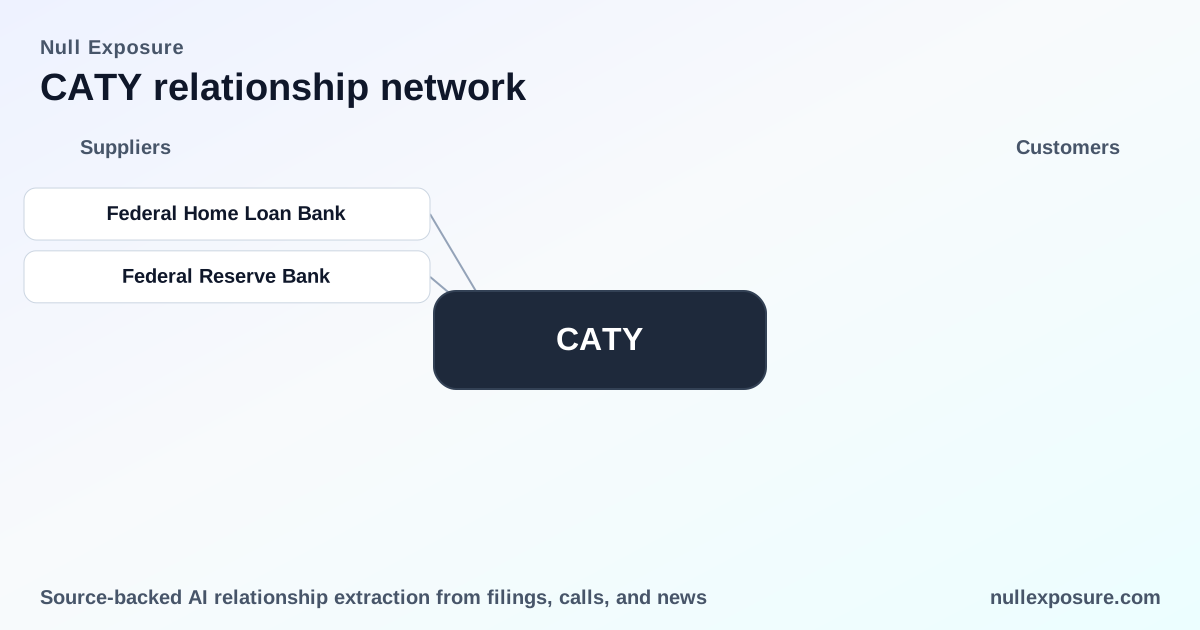
- Primary liquidity counterparties are core funding backstops rather than trading partners: Cathay reports multi‑billion dollars of unused borrowing capacity with the Federal Home Loan Bank and the Federal Reserve Bank, backed by unpledged securities.
- Third‑party vendor posture is material and active: the company discloses ongoing use of service providers and a regulatory warning that inadequate oversight could trigger enforcement or remediation.
- Spend profile signals mid‑sized contractual commitments: modeled constraints indicate vendor spend concentration in a mid‑range band, which matters for remediation cost and contract negotiation leverage.
These elements frame CATY as a bank with conservative contingency funding and material third‑party dependencies that are contractually active. If you manage capital or operational risk, these are the levers to monitor.
How Cathay structures its liquidity relationships and why it matters
Cathay explicitly discloses unused borrowing capacity of $7.5 billion from the Federal Home Loan Bank, $1.3 billion from the Federal Reserve Bank, and $1.6 billion in unpledged securities, positioning those facilities as primary liquidity cushions. These are not fee vendors but critical funding counterparties: they allow the bank to access large amounts of cash quickly under stressed conditions, preserving franchise stability and supporting lending activities. According to the Q4 2025 earnings call transcript reported by InsiderMonkey on March 9, 2026, the company presented these balances as contingent sources of funding available to the bank.
Supplier relationships you must account for
- Federal Home Loan Bank — Cathay reports $7.5 billion of unused borrowing capacity with the Federal Home Loan Bank, which functions as a structured secured funding line against eligible collateral and increases the bank’s liquidity flexibility. This relationship is a core funding backstop disclosed during the Q4 2025 earnings discussion (InsiderMonkey, Q4 2025 earnings call transcript, published March 9, 2026).
- Federal Reserve Bank — The bank carries $1.3 billion of unused borrowing capacity at the Federal Reserve Bank, a second-tier contingency facility that broadens its access to central‑bank liquidity; management cited this capacity in the same Q4 2025 earnings call (InsiderMonkey, Q4 2025 earnings call transcript, published March 9, 2026).
Both facilities are contractual access points that strengthen short‑term funding resilience; for a regional bank, the scale of these lines materially changes stress‑testing and capital planning outcomes. For a deeper supplier map and ongoing supplier monitoring, visit NullExposure: https://nullexposure.com/
Operational supply constraints: contract posture, concentration and regulatory sensitivity
Cathay’s public disclosures present several company‑level signals relevant to supplier risk:
- Contracting posture and maturity: The company confirms that it “regularly uses third party vendors as part of our business” and has “substantial ongoing business relationships with other third parties.” That language defines a mature outsourcing posture where vendors handle routine and critical functions, not one‑off projects.
- Criticality and materiality: The firm’s regulatory disclosure warns that failure of vendor oversight could trigger enforcement actions, civil money penalties, or client remediation—an explicit statement that third‑party risk is material to operating results and regulatory standing.
- Concentration and spend: Constraint modeling flagged a mid‑range spend band ($10m–$100m) as a company signal, which indicates non‑trivial vendor commitments that could create bargaining leverage for suppliers and meaningful remediation or termination costs for the bank if relationships sour.
Together these signals paint a company that is operationally dependent on a portfolio of active service providers, where oversight shortfalls are a direct regulatory risk. For investors, that elevates operational due diligence beyond simple counterparty credit checks to include contract terms, termination mechanics, and compliance documentation.
What investors should price in today
- Liquidity resilience is a positive valuation signal. Multi‑billion borrowing capacity from central funding utilities materially reduces short‑term funding risk and supports lending growth plans in credit cycles.
- Operational vendor risk is an earnings volatility vector. The company’s own disclosure that inadequate third‑party oversight can trigger enforcement or remediation makes vendor governance a potential source of sudden costs and reputation risk.
- Concentration matters. Mid‑sized but material vendor spend implies that a few supplier failures or contract disputes could generate outsized remediation bills relative to operational budgets.
Translate these into actionable items: verify collateral eligibility for FHLB lines, confirm the mechanics and haircuts for Fed‑accessed facilities, and request key vendor contracts or summary risk matrices as part of any counterparty or equity diligence.
Practical next steps for asset allocators and operators
- For credit and equity investors: stress test balance sheet runs incorporating partial drawdowns on the FHLB and Fed facilities while modeling higher vendor remediation costs.
- For operational risk teams: prioritize vendor governance audits for suppliers in the mid‑spend band and confirm contingency playbooks required by regulators.
- For board and audit committees: require transparency on vendor concentration, termination costs, and the frequency of vendor oversight reviews.
If you want an integrated view of Cathay’s supplier and liquidity relationships and how they map to regulatory exposure, NullExposure provides ongoing tracking and relationship scoring — learn more at https://nullexposure.com/
Bottom line
Cathay General Bancorp combines robust contingency liquidity from FHLB and Fed lines with material, active third‑party dependencies that regulators explicitly recognize as a potential source of enforcement risk. Investors should treat the funding lines as value‑supporting safety belts while treating vendor governance as a transparent risk factor that can convert into financial hits or regulatory action. For a practical supplier risk monitoring workflow tied to portfolio decisions, start at NullExposure: https://nullexposure.com/