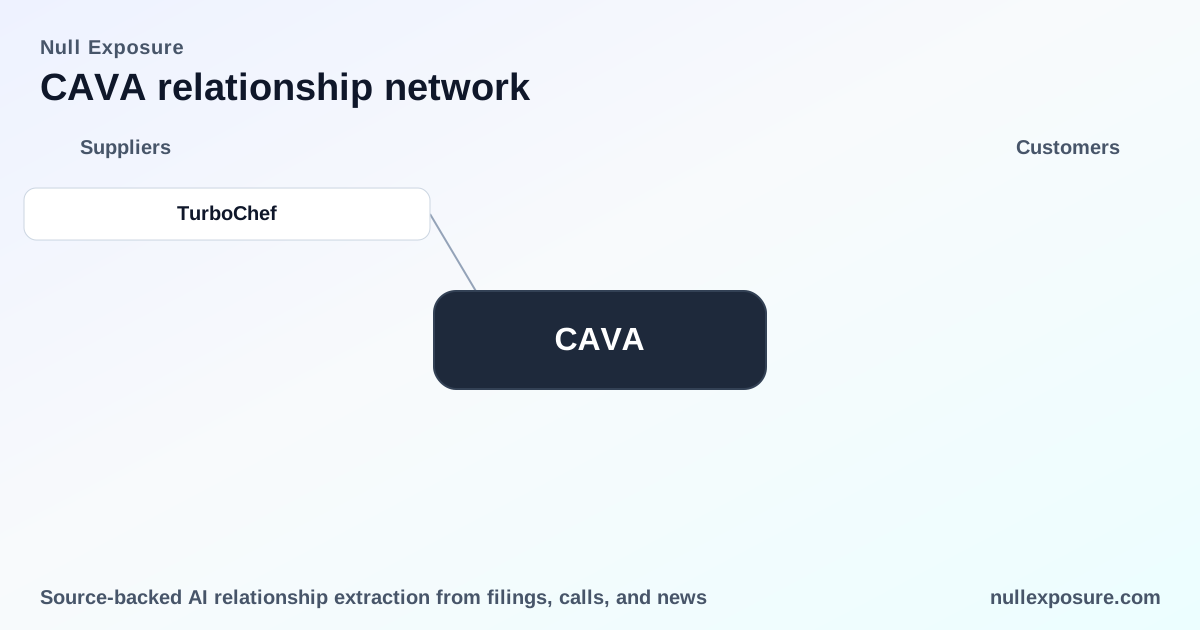
CAVA Group (CAVA) — Supplier posture, operating constraints, and what the TurboChef rollout implies for investors
CAVA operates and monetizes a national chain of Mediterranean quick-service restaurants through retail restaurant sales and a coordinated national distribution program supported by a company-owned production facility. The company captures margin through menu pricing and scale in supply procurement while investing in operations and equipment standardization to drive unit-level consistency and throughput. As of the latest filings through FY2025, CAVA reports trailing twelve‑month revenue of $1.18B, EBITDA of $133.9M, and a market capitalization near $10.2B, a profile that blends growth expectations with operational leverage and concentrated supplier relationships.
Explore supplier and counterparty signals at the company level at https://nullexposure.com/.
Why supplier strategy matters for CAVA’s economic model
CAVA’s operating model is fundamentally retail‑facing but dependent on a handful of upstream service and distribution partners to deliver consistent quality and unit economics. Equipment standardization, a limited distribution partner set, and long‑dated facility leases are structural features that reduce unit-level variability but raise vendor concentration and procurement risk. Those dynamics influence capex timing, working capital needs, and the durability of gross margins as the chain scales.
TurboChef: a single, visible equipment relationship in public results
CAVA disclosed the completion of a company‑wide rollout of TurboChef ovens, signaling a standardized equipment platform across its restaurants. According to an earnings call transcript published on InsiderMonkey on March 9, 2026, CAVA confirmed that the TurboChef rollout is complete and that the ovens give team members "the equipment they need to execute consistently as our menu continues to evolve." This is a coordinated hardware investment that supports throughput and menu execution (InsiderMonkey, Q4 FY2025 earnings call transcript, March 2026).
Supplier roster snapshot (all relationships found)
- TurboChef — CAVA announced a full rollout of TurboChef ovens across its entire restaurant base, a capital/operational decision intended to standardize execution and support evolving menu initiatives; this disclosure appears in the FY2025 earnings call transcript (InsiderMonkey, March 9, 2026).
Operating constraints and what they reveal about supplier risk
CAVA’s public filings and disclosures surface several constraints that shape vendor posture and procurement strategy. These are company‑level signals — not attributed to any single supplier unless the filing explicitly names that partner.
- Long‑term contracting posture: CAVA leases key facilities on multi‑year terms, including a collaboration center under lease through 2035, indicating long‑dated occupancy commitments that stabilize operating locations but fix certain overhead obligations (company filings, lease disclosures through FY2024–FY2025).
- Third‑party service providers as mission‑critical: The company relies on external providers for cybersecurity monitoring (a managed security operations center with 24/7 monitoring and alerting) and third‑party auditors for food‑safety assessments, making these service providers functionally critical for continuous operations and compliance (company filings, cybersecurity and food safety disclosures).
- Active, mature relationships: Disclosures indicate these third‑party engagements are active and integrated into daily operations — the SOC and auditing engagements are ongoing rather than ad hoc (company filings).
- Distribution concentration: CAVA states it relies on a distribution network composed of a limited number of distribution partners for the majority of national distribution, concentrating execution risk around those relationships (company filings).
- Meaningful procurement scale: Purchase obligations disclosed as of December 29, 2024, place expected cash requirements in the $10M–$100M spend band for foreseeable procurements tied to produce, ingredients and supplies, anchoring vendor spend at material levels for supplier negotiations and dependency (company filings, purchase obligations table).
These constraints create a predictable operating footprint — stable cost base and standardization — while creating nodes of concentration that require active vendor management.
Commercial implications and investment takeaways
Standardizing equipment with vendors like TurboChef has classic operational benefits: faster throughput, simplified training, and predictable maintenance schedules that assist unit economics. The strategic tradeoffs are equally clear:
- Positive: Equipment uniformity and a consolidated distribution scheme create scale advantages and easier rollouts of menu changes; the Verona production facility (opened February 2024) provides additional control over product consistency and margin capture (company filings).
- Negative: Heavy reliance on a limited set of distributors and active third‑party service providers concentrates supply‑chain and service risk; a material capex/opex cadence tied to equipment rollouts and purchase obligations exposes the company to supplier execution failure or pricing pressure.
- Valuation context: CAVA trades at premium multiples (trailing P/E ~161.6; EV/EBITDA ~66.8) that price in significant growth and execution success, placing a premium on smooth supplier relationships and predictable distribution performance (market data through FY2025).
For investors, the TurboChef rollout is a positive operational catalyst if it sustains unit throughput and reduces variance, but the broader supplier map — long leases, concentrated distribution, and sizable purchase obligations — is the main vector for operational risk that would materially affect margin leverage.
Learn more about how supplier relationships translate into investment signals at https://nullexposure.com/.
What operators and procurement teams should track
Operators and supplier managers should prioritize these actions:
- Monitor distributor concentration metrics and develop contingency routing to mitigate single‑point failures.
- Track equipment maintenance cadence and warranty terms for TurboChef ovens to model ongoing opex and replacement cycles.
- Ensure third‑party SOC and food‑safety auditors have contractual SLAs that align with downtime and compliance risk thresholds.
Actionable next steps for investors
- Review the company’s most recent 10‑K and earnings call transcript for updates on distribution partner breadth and any vendor concentration mitigation plans.
- Model sensitivity to vendor price increases and delayed equipment deployments; given the company’s valuation premium, small margin erosion has outsized valuation impacts.
- For ongoing tracking of supplier signals and their investor implications, visit https://nullexposure.com/ and subscribe to supplier‑level monitoring to detect changes in contracting posture, spend bands, and relationship stage.
Bold operational moves such as the TurboChef rollout signal management focus on consistency and throughput; the investor debate now centers on whether procurement concentration and long‑dated obligations will scale with the company’s growth without compressing the expected margin upside.