Commercial Bancgroup (CBK): What investors should know about the bank’s supplier and capital-market relationships
Commercial Bancgroup is a regional bank holding company that monetizes through traditional banking — net interest margin on loans and advances, fee income from deposits and services, and capital-market activity tied to its recent public listing. The company levered an upsized IPO to raise primary capital and establish public equity liquidity, using a single-manager underwriting strategy and established legal counsel, which changes its funding posture from private to public and raises both strategic flexibility and market scrutiny. For investors and operators evaluating supplier risk and counterparty exposure, the recent public filings and press coverage show a concentrated set of capital-market partners and ongoing funding ties to the Federal Home Loan Bank system. Read on for a concise vendor-by-vendor breakdown and the operating-model implications.
Learn more about supplier intelligence for financial institutions at https://nullexposure.com/.
Why the IPO counterparties define near-term supplier risk
Commercial Bancgroup’s primary external supplier relationships over the IPO and liquidity transition are concentrated and transactional rather than ongoing third-party service dependencies. The company used a single, boutique bookrunner for its offering and retained outside counsel for the transaction — a lean capital markets footprint that reduces contractual complexity but raises vendor concentration risk should further equity raises be required.
- Concentration: Hovde Group served as sole bookrunner across multiple coverage items, signaling a single point of execution for capital markets access (Renaissance Capital; AccessNewswire; StockTitan, FY2025).
- Criticality: The Nasdaq listing converts CBK to a public reporting company and is material to valuation, liquidity, and governance (Renaissance Capital; StockTitan, FY2025).
- Maturity: The relationship set is consistent with an institution maturing from community bank to publicly traded regional bank — transactional capital markets engagements rather than long-term outsourcing arrangements.
A deeper, transaction-level view of each named relationship follows.
Who’s on the roster and what they did
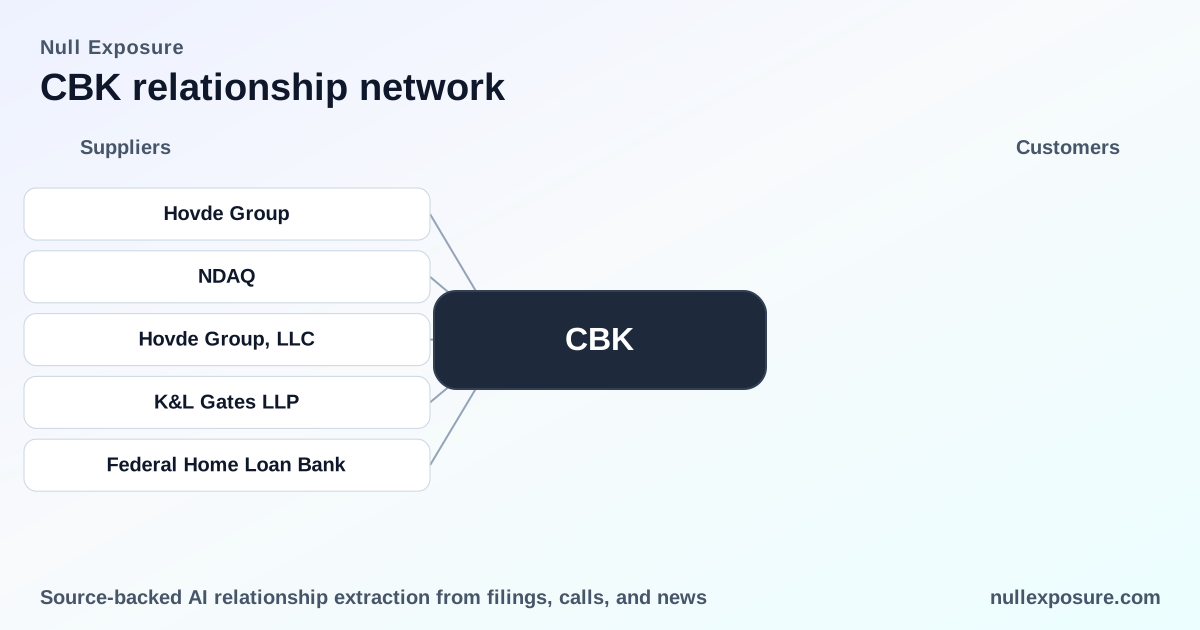
Hovde Group — the sole bookrunner on the IPO
Hovde Group acted as the sole book-running manager across Commercial Bancgroup’s upsized initial public offering, handling placement and pricing for the transaction reported in FY2025. This single-manager structure concentrates execution risk but streamlines decisions during a time-sensitive capital raise, as noted in Renaissance Capital’s IPO coverage and company pricing releases (Renaissance Capital; AccessNewswire; StockTitan, FY2025).
Nasdaq — the public market venue and ticker sponsor
Commercial Bancgroup’s shares began trading on the Nasdaq Capital Market under the symbol CBK, a key structural milestone that created tradable equity and broader institutional access. Listing on Nasdaq is a permanent operational change: it increases disclosure obligations and investor scrutiny while enabling secondary-market liquidity, as documented in Renaissance Capital’s IPO term write-ups and the company’s trading commencement notices (Renaissance Capital; StockTitan, FY2025).
K&L Gates LLP — legal counsel to the company
K&L Gates LLP served as legal counsel to Commercial Bancgroup in connection with the offering, providing the corporate and securities law support typical of an IPO. Retaining an established law firm protects transaction execution and regulatory compliance during listing and registration, per the company press release summarizing the closing of the offering (StockTitan press coverage, FY2025).
Federal Home Loan Bank — secured advance counterparty
Commercial Bancgroup reports advances from the Federal Home Loan Bank in its FY2026 results, evidencing conventional secured wholesale funding activity that supplements deposit funding. FHLB advances are a routine, collateralized liquidity source for regional banks and are functionally important to balance-sheet management, as referenced in the company’s FY2026 results release (Newswire, FY2026).
What this pattern says about CBK’s operating model
Commercial Bancgroup’s supplier footprint in the public record is compact and purpose-driven: capital markets execution and legal counsel for the IPO, plus continued access to the FHLB for liquidity. From a buyer/partner diligence perspective, this implies:
- Contracting posture: Event-driven, transactional contracting rather than long-term outsourcing agreements. The bank engages parties for discrete capital or legal functions.
- Concentration risk: Elevated in the short term around capital markets execution because a single bookrunner handled the IPO. Future equity raises would either deepen that relationship or require additional underwriters.
- Criticality: The Nasdaq listing and FHLB access are strategically critical; any disruption to public-market access or secured wholesale funding would materially affect liquidity and valuation mechanics.
- Maturity signal: The move to a public listing and formal counsel engagement indicates institutionalization of governance and reporting — a shift from privately held community operations to regulatory and investor-grade transparency.
These are company-level signals — the source records in the public disclosures and press coverage list parties and actions but do not indicate ongoing operational outsourcing or service-level dependencies beyond the IPO and funding activity (Renaissance Capital; AccessNewswire; StockTitan; Newswire, FY2025–FY2026).
Read our full supplier-impact checklist for financial institutions at https://nullexposure.com/ to benchmark CBK against peers.
Strategic implications for investors and operators
Investors should value the IPO’s capital raise as both a liquidity and optionality event: it improves capital ratios and enables growth but also commits the bank to higher transparency and the discipline of public markets. Operator focus should be on: (1) maintaining diversified funding sources beyond FHLB advances, (2) monitoring any further reliance on a single broker-dealer for capital raises, and (3) ensuring legal and compliance budgets scale with public-company obligations — all of which are visible in the post-IPO vendor set.
Key risk factors: vendor concentration for capital raises, public-market volatility impacting share-based capital plans, and the ordinary counterparty risk of secured wholesale funding. The public disclosures and press reports establish the relationships; the next signal set to watch includes repeated reliance on the same underwriter or changes in FHLB borrowing levels (Renaissance Capital; StockTitan; Newswire, FY2025–FY2026).
For investors and operators who need a structured view of counterparties and supplier concentration, explore tools and reports on our platform: https://nullexposure.com/.
Bottom line
Commercial Bancgroup’s external relationships from the IPO period are targeted and material: Hovde Group executed the equity raise, Nasdaq provides the market platform, K&L Gates handled legal work, and the Federal Home Loan Bank remains a liquidity backstop. These partnerships support a clean path to public-company status but leave short-term concentration questions around capital markets access. Investors should treat the IPO as a strategic enabler while tracking whether CBK diversifies its execution partners and expands funding channels as it scales (Renaissance Capital; StockTitan; AccessNewswire; Newswire, FY2025–FY2026).
If you want a direct supplier snapshot and risk matrix for CBK and its peers, visit https://nullexposure.com/ — our summaries map counterparties to operational impact and contract concentration for active investors.