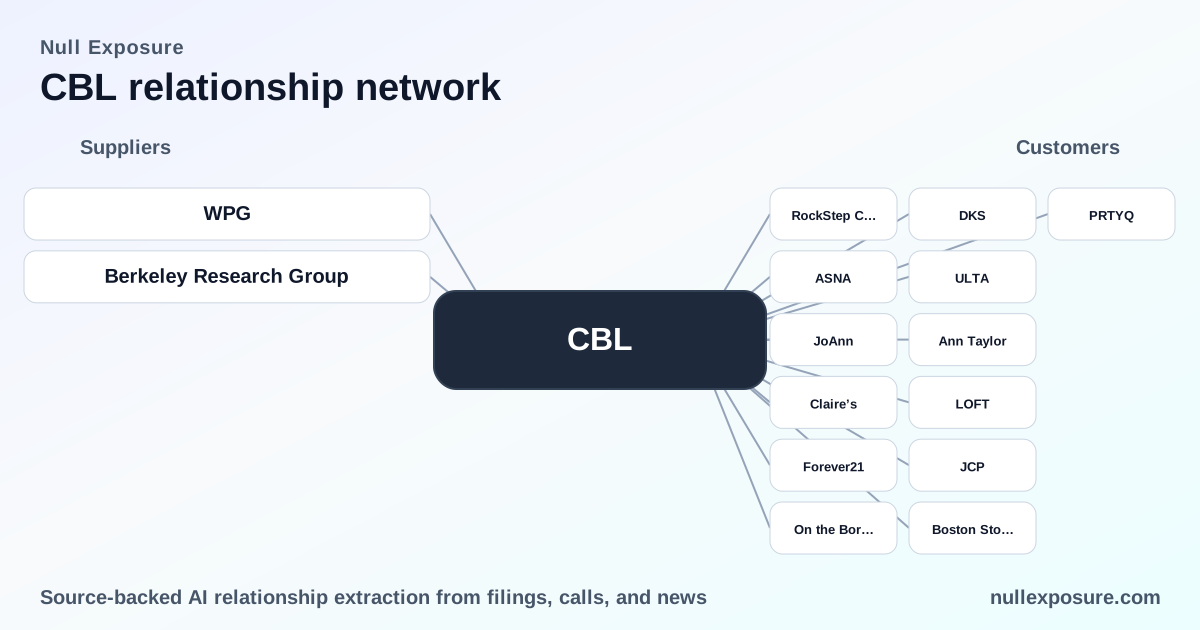
CBL & Associates Properties: a supplier-side read for investors and operators
CBL & Associates Properties (CBL) is a mall-focused REIT that monetizes through tenant rents, asset redevelopment and periodic dispositions—recycling capital from sales into targeted acquisitions and redevelopments to lift income and NAV. The company runs a portfolio of enclosed regional malls and mixed-use projects, collects stable lease cashflows (including multi-decade ground leases), and supplements recurring income with strategic dispositions; recent financials show roughly $554 million in revenue (TTM) and $301 million of EBITDA, with a market capitalization near $994 million and a forward-looking yield profile that supports income-oriented allocations. For further background on supplier exposures and relationship mapping visit https://nullexposure.com/.
How CBL runs its supplier and counterparty relationships (what matters to investors)
CBL operates like a traditional retail REIT with active portfolio management: leasing and property operations are core revenue engines, while capital allocation decisions—dispositions and acquisitions—drive episodic valuation uplifts. Operationally, this produces predictable demand for long-term counterparties (ground lessors, service providers, lenders, and professional advisers) and intermittent, high-impact counterparties tied to transactions and restructurings.
Key operating-model signals from company disclosures and filings:
- Long-term contracting posture. Evidence shows CBL occupies ground leases with terms extending into the 2060s (for example, Meridian Mall ground leases through March 2067) and is encumbered by secured term loans—both indicators of contractual stickiness and capital-structure constraints that affect deal flexibility.
- Service-provider reliance. Filings include consent and auditor references (for instance, Deloitte & Touche), showing reliance on established professional firms for financial reporting and restructuring advice.
- Capital redeployment discipline. CBL routinely sells assets to redeploy proceeds into acquisitions that are intended to be accretive to portfolio NOI; disposition proceeds have been used directly to fund purchases of regional malls from peer owners.
These company-level signals indicate moderate counterparty concentration, high contract maturity, and operational criticality for a narrow set of suppliers (auditors, lenders, and large tenant/lessor counterparties). Investors should price in both the durability of long-term lease cashflows and the limitations that secured loans and long-term encumbrances place on rapid portfolio reallocation.
Visit https://nullexposure.com/ to explore supplier relationship maps and historical counterparties for CBL.
What the data shows about CBL’s named relationships
Below are all supplier/partner relationships identified in the examined material. Each relationship is summarized succinctly with source attribution.
Washington Prime Group (WPG)
CBL acquired four enclosed regional malls from Washington Prime Group, funding the transaction in part by redeploying approximately $240 million of disposition proceeds into a $178.9 million purchase of those assets, underscoring CBL’s playbook of selling non-core assets and buying accretive properties from peers. (TradingView report summarizing a Zacks note, March 9, 2026: https://www.tradingview.com/news/zacks:a3bfc921e094b:0-cbl-stock-gains-following-q4-earnings-same-center-noi-rises/)
Berkeley Research Group
Berkeley Research Group provided advisory support to CBL with personnel engagement noted since June 2020; individual managing directors from BRG have been advising the company through credit and operational challenges, indicating use of restructuring and advisory specialists. (WLKY reporting on related retail-owner filings and advisory activity, 2026: https://www.wlky.com/article/owner-of-three-louisville-area-malls-files-for-chapter-11-bankruptcy-protection/34556481)
Why these relationships matter for counterparties and operators
The Washington Prime transaction demonstrates CBL’s active counterparty engagement in secondary-market mall trades—CBL is both a buyer and seller in the same market, so counterparties that transact with CBL will find a counterparty that executes on capital redeployment strategies. This behavior elevates the importance of reliable transactional relationships with lenders and title/escrow agents, and creates timing sensitivity around cash inflows from dispositions.
The BRG advisory link is emblematic of another side of supplier dependence: CBL calls on specialized advisers to manage distressed asset issues and complex restructuring scenarios. For service providers, that positions CBL as a client that requires deep restructuring and operational analytics capabilities rather than only standard property-management work.
Combined with the company-level constraints—long-dated ground leases and secured term loan encumbrances—these relationships signal a counterparty profile that is:
- Mature: contracts that persist for decades reduce churn but lock capital.
- Critical: lenders and auditors materially affect CBL’s ability to execute transactions.
- Concentrated: a relatively small set of high-impact suppliers (advisers, auditors, lenders) carry disproportionately large influence.
Investment implications: risk and opportunity checklist
- Value-accretion thesis: The firm’s model of selling non-core assets to buy higher-return malls is an active value-driving strategy; investors should watch disposition cadence and reinvestment yield. CBL reported redeploying roughly $240 million of sales proceeds into a $178.9 million purchase from Washington Prime, a clear example of that playbook.
- Leverage constraints: Encumbered assets and secured term loans limit flexibility; counterparty negotiations on loan covenants and refinance windows are critical to downside protection.
- Service-provider dependency: Reliance on specialized advisers in stress scenarios increases operating costs but reduces execution risk when restructuring is required.
- Operational durability: Long-term ground leases provide predictable occupancy frameworks but can concentrate geographic and counterparty risk.
Final notes and next steps for analysts
CBL is a focused mall REIT that combines steady lease cashflow with opportunistic portfolio rotation. Its supplier relationships—transactional with peer REITs and advisory-focused with consulting firms—reflect a company that executes both market-facing acquisitions and behind-the-scenes restructuring. For investors and counterparties, the most material exposures are contractual maturity (long-term leases), capital-structure encumbrances (secured loans), and dependency on a small set of specialized service providers.
For a deeper supplier map, counterparty risk scoring, and historical transaction analysis, visit https://nullexposure.com/ and review CBL’s counterparties and contract-level signals. For practitioners negotiating with CBL, prioritize clarity on lien positions, timing for disposition proceeds, and the firm’s adviser relationships before committing capital.